Japanese Board Games: 7 Games From Shogi to Sugoroku
The best-known traditional Japanese board games are shogi (Japanese chess), go (igo), sugoroku, hasami shogi and gomoku. Shogi is the most widely played of them in Japan today. Two modern shogi variants, animal shogi and minishogi, are also Japanese and make good starting points.
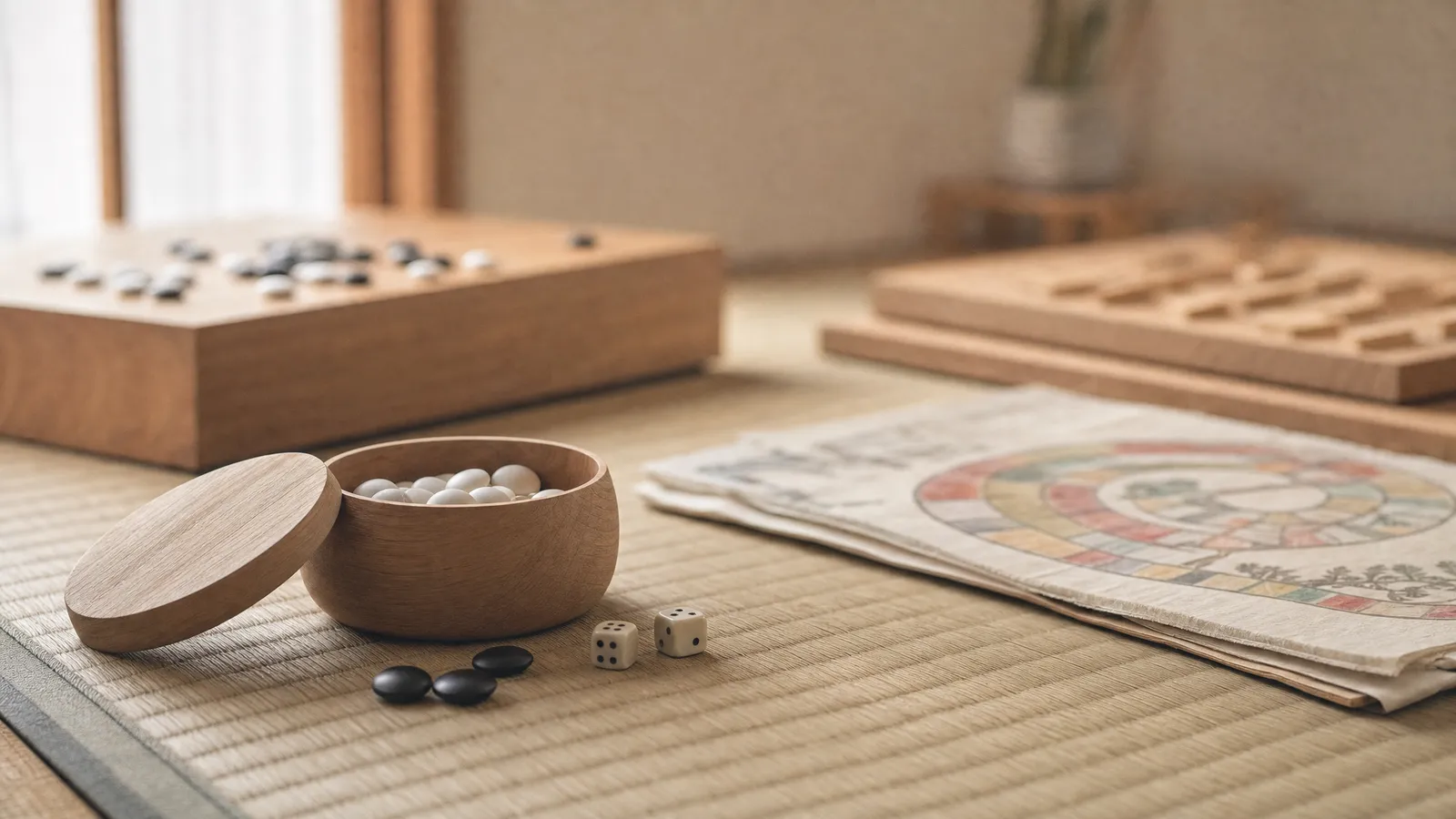
Japan’s best-known traditional card games, karuta and hanafuda, aren’t board games. They get their own short section near the end, along with mahjong.
The games at a glance
| Game | Type | Players | Equipment | Where to learn |
|---|---|---|---|---|
| Shogi (将棋) | Strategy, chess family | 2 | 9x9 board, 40 pieces | How to play shogi |
| Animal shogi (どうぶつしょうぎ) | Strategy, shogi for children | 2 | 3x4 board, 8 pieces | Play animal shogi |
| Minishogi (5五将棋) | Strategy, small shogi | 2 | 5x5 board, 12 pieces | Play minishogi |
| Go (囲碁, igo) | Strategy, territory | 2 | 19x19 board, black and white stones | Shogi vs go and local go clubs |
| Hasami shogi (はさみ将棋) | Strategy, capture | 2 | Shogi board, 9 pieces each | Rules below |
| Gomoku (五目並べ) | Strategy, five in a row | 2 | Go board and stones | Rules below |
| Sugoroku (双六) | Dice race | 2 or more | Printed board or tables board, dice | History below |
1. Shogi: Japanese chess
Shogi is the Japanese member of the chess family. Two players move 20 pieces each on a 9x9 board, and the goal is to checkmate the enemy king. Its best-known twist is the drop rule: a captured piece joins your side, and you can place it back on the board later as your own. Excavated pieces date the game in Japan to at least 1058, and the drop rule appeared around the 15th century.
Shogi is the most played board game on this list in Japan. The Leisure White Paper 2025 from the Japan Productivity Center estimated 4.3 million shogi players aged 15 to 79, against 1.2 million for go.
If you’re looking for “the Japanese game like chess,” this is it. Start with:
- What is shogi: history and the basics in one page
- Shogi rules: every rule, with diagrams
- Shogi pieces: all eight pieces and their kanji
- Shogi vs chess: what carries over from chess
- Play shogi against the computer, free in your browser
Animal shogi and minishogi
Two smaller Japanese versions make shogi easier to pick up. Animal shogi (dobutsu shogi) was designed in 2008 by professional player Madoka Kitao to teach children. It uses a 3x4 board and four animal pieces per side. Minishogi keeps the real shogi pieces but shrinks the board to 5x5. Both are playable on this site. The shogi variants page covers the larger historical versions too, including chu shogi and the 36x36 taikyoku shogi.
2. Go (igo)
Go came to Japan from China by the 7th century, and Japan is where it got its English name, from the Japanese 碁. Players take turns placing black and white stones on a 19x19 grid, and the stones never move. The aim is to wall off more of the board than your opponent. Go has few rules but great depth, and it is played widely across East Asia. For how it compares with shogi, see shogi vs go.
3. Hasami shogi
Hasami shogi (“sandwich shogi”) is a simple capture game played with a shogi board and pawns. It is popular with Japanese children, and you can play it with any shogi set.
- Each player sets 9 pieces along their own back row. One side traditionally uses pawns, the other uses pawns turned over to their promoted side. Black moves first.
- Every piece moves like a shogi rook: any number of empty squares straight up, down, left or right. No jumping.
- You capture by sandwiching. If your move puts enemy pieces between two of yours in a straight line, with no gaps, they are removed. You can capture a whole row of enemy pieces at once this way.
- A piece in a corner is captured by occupying the two squares next to it.
- Moving your own piece into a gap between two enemy pieces is safe. Only the side that moves can capture.
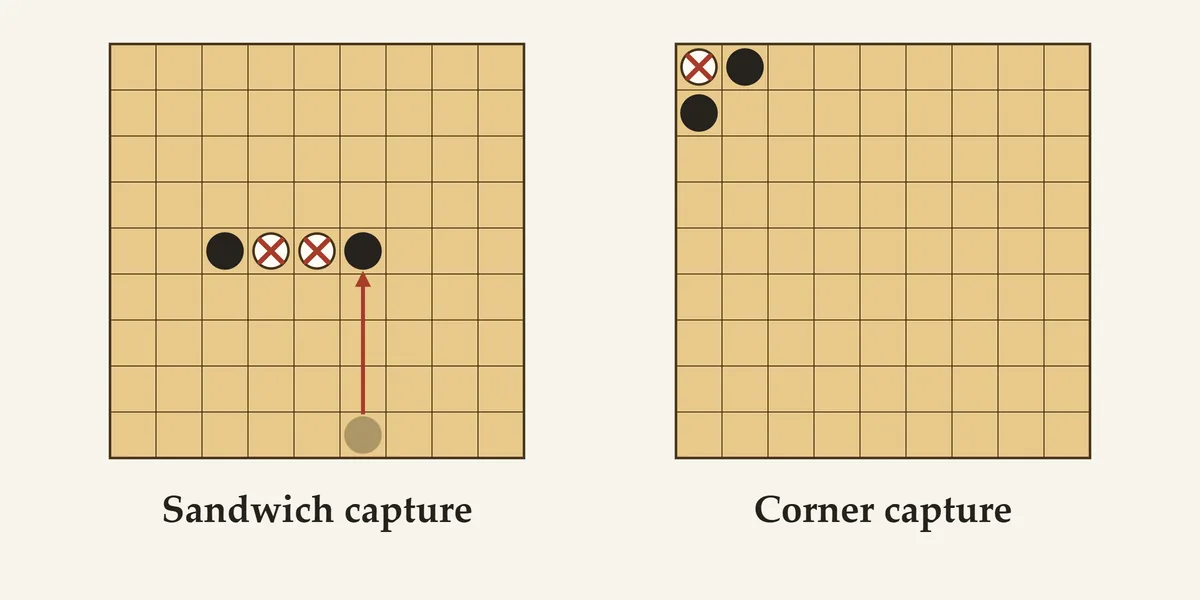
Win conditions vary. One common rule is that you win when your opponent is down to one piece. Others play to a set number of captures, such as five. Agree on one before you start.
A larger version, dai hasami shogi, gives each player 18 pieces on two rows and is won by forming a straight line of five outside your starting rows.
4. Gomoku
Gomoku, from the Japanese gomokunarabe (五目並べ, “five in a row”), dates to Japan’s Edo period. It uses go equipment. Players take turns placing a stone on an empty point, Black first, and the first to make an unbroken line of five, in any direction, wins. Modern play uses a 15x15 board. Because the first player has a strong advantage, tournament play adds an opening rule called Swap2 to balance it.
5. Sugoroku
Sugoroku is the name of two different Japanese dice games.
- Ban-sugoroku was a race game related to backgammon, with the same starting position. It came to Japan from China around the 6th century. It was so popular for gambling that it was banned several times, including in 689 and 754, and it is no longer played.
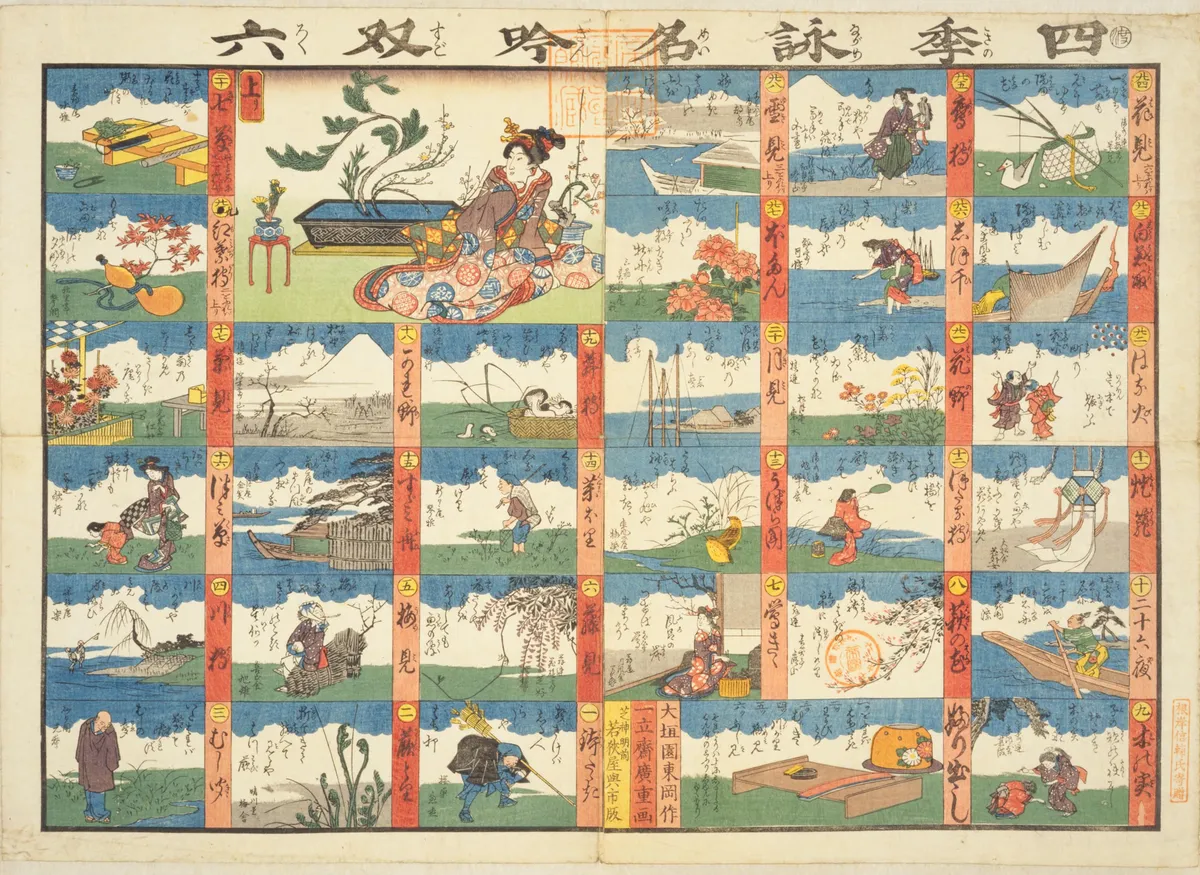
- E-sugoroku (“picture sugoroku”) is a roll-and-move game on a printed board, close to snakes and ladders. It appeared by the late 13th century and became very popular in the Edo period, when woodblock printers made thousands of themed boards. Today “sugoroku” usually means this version.

Japanese card and tile games
These are not board games, but they come up in every search for traditional Japanese games, so here they are in brief.
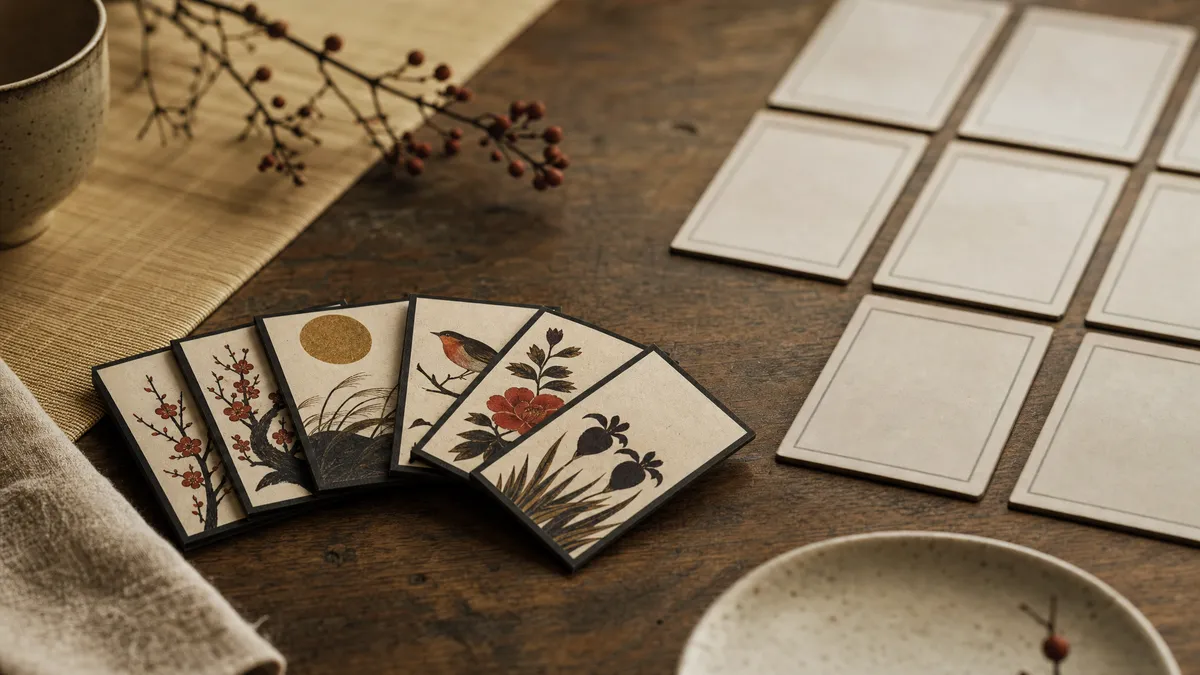
Karuta (かるた). The word comes from the Portuguese carta, “card,” because Portuguese traders brought playing cards to Japan in the mid-16th century. The best-known game, uta-garuta, uses the 100 poems of the Ogura Hyakunin Isshu: a reader recites the start of a poem, and players race to grab the card with its ending. It is a New Year tradition, and national championships have been held at Ōmi Shrine in Ōtsu since 1955.
Hanafuda (花札). “Flower cards” are a 48-card deck with 12 suits, one for each month, and four cards per suit showing plants and animals. The cards are small and stiff. Nintendo was founded in 1889 to make hanafuda and still produces them.
Love Letter. For a modern example, Love Letter is a 16-card game designed by Seiji Kanai and first published in Japan in 2012. A game takes about 20 minutes, and English editions followed.
Mahjong (麻雀). Mahjong is Chinese, but Japan has its own popular version, riichi mahjong. It was brought to Japan in 1909. Four players draw and discard from 136 tiles to build a winning hand, and the riichi rule lets a player declare that their hand is one tile from complete.
Other Asian board games
Japan’s games sit in a wider family. Chinese chess, xiangqi, is a close cousin of shogi; see xiangqi vs shogi for how they differ. Korea has its own chess game, janggi, and go is played across China, Korea and Japan. If you know chess variants, crazyhouse vs shogi shows how shogi’s drop rule works inside chess.
FAQ
What is the most popular board game in Japan?
Among traditional board games, shogi. The Leisure White Paper 2025 estimated 4.3 million shogi players in Japan aged 15 to 79, against 1.2 million for go. Mahjong, a tile game, is also widely played.
What is the Japanese game like chess called?
Shogi (将棋), often called Japanese chess. Like chess it has a king to checkmate, but it uses a 9x9 board, 20 pieces per side, and lets you drop captured pieces back onto the board as your own.
What are some traditional Japanese games?
Board games include shogi, go, sugoroku, hasami shogi and gomoku. Traditional card games include karuta, with uta-garuta played at New Year, and hanafuda, the 48-card flower deck. Riichi mahjong is the Japanese form of the Chinese tile game.
Is go a Japanese game?
Go was invented in China more than 2,500 years ago and reached Japan by the 7th century. Its English name comes from the Japanese 碁.
How do you play hasami shogi?
Each player lines up 9 pieces on their back row of a shogi board. Pieces move like rooks, any distance in a straight line. You capture by trapping enemy pieces between two of yours. A common rule is that you win when your opponent has one piece left.