Shogi Board (Japanese Chess Board): Sizes, Woods, Buying
A shogi board, the Japanese chess board, is a 9x9 grid of 81 uncheckered squares, traditionally a solid block of pale kaya wood with a face around 36 by 33 centimeters. Boards range from thin tabletop slabs and folding boards to the classic floor-standing block on four carved legs, prized in thicknesses measured in traditional units.
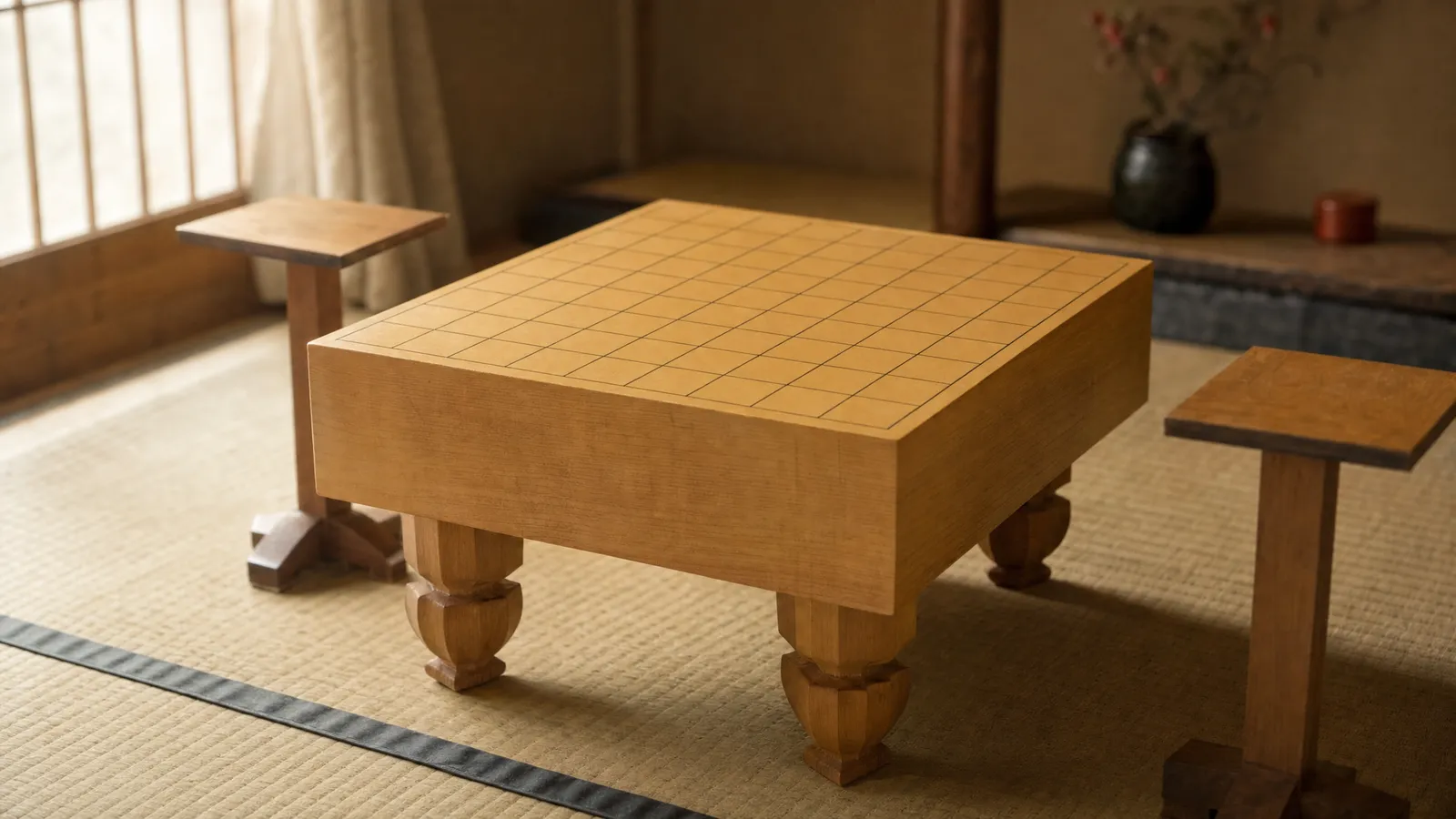
The board itself
Start with what makes it recognizably a shogi board. The grid is 9x9, giving 81 squares to chess’s 64, and the squares are all one color: no checkering, because square color has no meaning in shogi (no piece is bound to diagonals of one shade the way a chess bishop is). The lines are traditionally applied in black lacquer on pale yellow wood, with small dots marking the corners of the central and promotion-zone boundaries.
Look closer and there’s a detail almost nobody notices until it’s pointed out: the squares aren’t square. A traditional board is slightly deeper than it is wide, so each of the 81 cells is a subtle vertical rectangle. The elongation matches the pieces, which are themselves longer than wide, and compensates for the foreshortening you get viewing the board from a seated position. Centuries of ergonomics, hiding in a few millimeters.
Shogi board size and dimensions
| Measurement | Standard size |
|---|---|
| Board face | 1 shaku 2 sun deep by 1 shaku 1 sun wide, about 36.4 x 33.3 cm |
| One square | About 3.9 cm deep by 3.5 cm wide |
| Grid | 9 x 9, 81 squares |
| Thickness, folding and thin tabletop boards | A few centimeters at most |
| Thickness, professional title-match boards | 6 to 7 sun, about 20 cm, on legs |
Shaku and sun are traditional Japanese length units; one sun is about 3 centimeters. The face size is a widely followed convention rather than a strict rule, so cheaper boards and travel sets often run smaller.
The pieces that go on it are five-sided wedges, identical in color for both players, pointing at the opponent; if that’s news, the pieces guide explains the whole system, and board setup shows where all 40 go.
Why traditional boards stand on legs (the shogi table)
The image everyone knows from shogi (and go) culture: a massive wooden block, ankle-high, standing on four carved legs on a tatami floor, players kneeling on cushions. That format has practical logic: floor seating was the Japanese norm, and a thick freestanding board puts the playing surface at the right height while the legs lift it above the mat.
The classic leg shape is a stylized carving traditionally likened to a gardenia fruit, and the underside of premium boards is carved with a pyramidal recess at the center called the heso (“navel”), which lightens the block and is said to improve the acoustics of each piece snapped onto the surface (the sound of a firmly played move is part of the game’s sensory culture). Around that recess has grown a famous bit of folklore: that it’s a “blood pool” meant as a warning about the penalty for interfering in a game. Board historians treat that as legend, not history, but every shogi player has heard it, and it tells you something about the reverence the equipment attracts.
Floor boards are graded by thickness in sun, a traditional unit of about 3 centimeters; serious boards commonly run from around 4-sun to 6-sun or more, meaning a solid block 12 to 18-plus centimeters thick. A fine legged board is furniture, heirloom, and instrument at once, priced accordingly. It is, in effect, its own shogi table. If you play in a chair, a thinner tabletop board on an ordinary table does the same job.
Kaya and the wood hierarchy
Ask why one board costs very little and another costs a fortune, and the answer is mostly wood.
The prize is kaya, Japanese nutmeg-yew (Torreya nucifera): pale gold color, fine straight grain, a faint pleasant scent, the right hardness to feel lively under a piece, and slow-growing scarcity that puts genuine Japanese-grown kaya, especially from the famed Hyuga region, at the top of the market. Boards cut so the grain runs straight across the surface command the highest prices of all.
Below true kaya, the market offers honest substitutes. Shin-kaya (“new kaya”) is the standard mid-range choice: typically spruce, chosen to resemble kaya’s color and grain at a small fraction of the cost. Laminated boards, folding wooden boards, and vinyl mats all play perfectly well; clubs and schools run on them.
| Grade | Typical woods |
|---|---|
| Top | Hon-kaya (true kaya), best of all from Hyuga, with straight grain |
| High | Hiba, hinoki (Japanese cypress), ginkgo |
| Middle | Shin-kaya (usually spruce), katsura |
| Budget | Laminated or synthetic boards, folding boards, vinyl mats |
The honest buying truth: the board’s material changes the experience, never the game. A vinyl mat hosts the same shogi as a Hyuga kaya masterpiece.
Buying a shogi board: what to look for
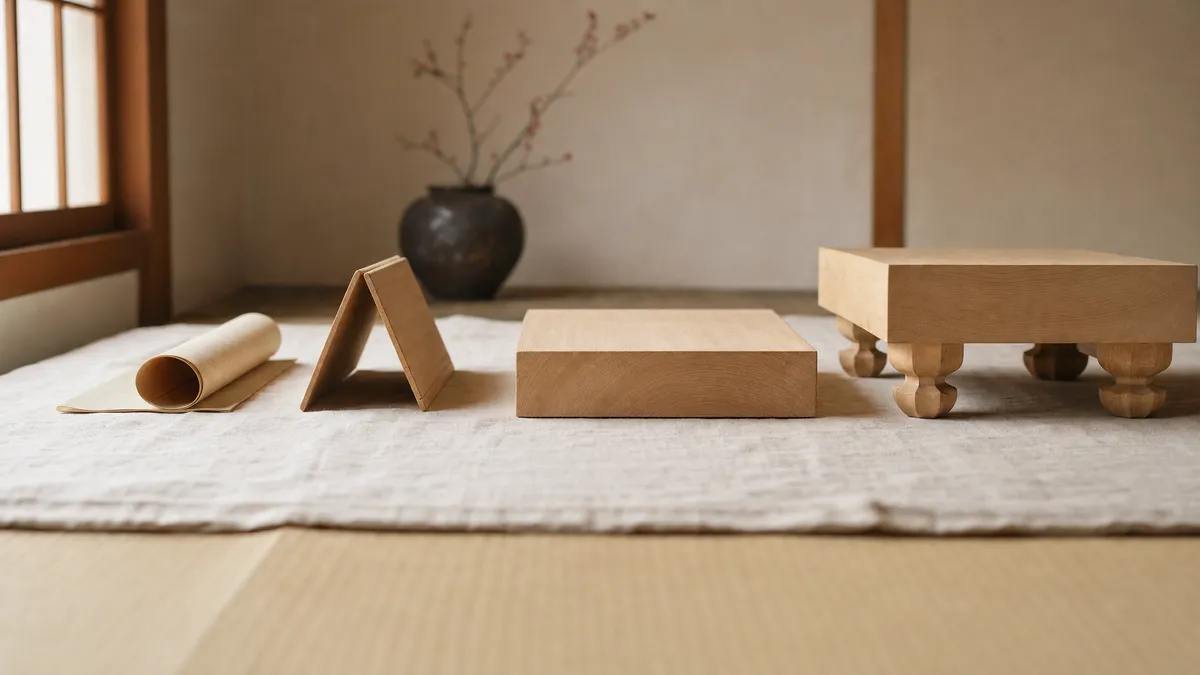
Shogi boards for sale fall into four broad tiers. For a first physical set, here they are in ascending budget (our complete shogi set buying guide covers pieces and stands too):
- Vinyl mat or printed board with plastic pieces. Fully functional, travels flat, costs little. Fine for learning; pair it with the rules reference and you’re playing tonight.
- Folding wooden board with stamped wooden pieces. The sweet spot for most learners: real wood feel, storable, inexpensive. Most pieces at this tier print the kanji plus, on some beginner sets, movement arrows.
- Tabletop board (2 to 6 cm solid slab) with boxwood-style pieces. Shin-kaya slab, better pieces, the classic click when a piece is played. This is the tier where the equipment starts adding pleasure.
- Legged floor board in kaya, with carved boxwood pieces. The heirloom tier. Buy it because you love the game, not to learn it.
Piece quality, incidentally, matters to the hand more than board quality: pieces range from stamped, through lacquer-raised inscriptions, up to hand-carved calligraphy in fine boxwood, and a mid-grade board with good pieces beats the reverse. If the kanji worry you, sets with international symbols exist, though most players find the eight characters stick within a few games; the pieces guide has the fast method.
One more zero-cost option: print a paper board, or skip hardware entirely. The board on this site is free, enforces every rule, includes both kanji and international piece sets, and plays you at whatever strength you can handle; many learners run games here and buy wood later, already fluent. The how to play guide gets you moving in an hour.
Caring for a wooden board
Brief, because good habits are simple: keep wood boards out of direct sun and away from humidity swings, wipe with a dry or barely damp cloth (no household cleaners on lacquered lines), and store legged boards surface-up or safely covered. Kaya darkens gracefully with age and handling; that patina is a feature, and boards pass between generations wearing it proudly.
FAQ
What size is a shogi board?
The standard board face is about 36.4 by 33.3 centimeters (1 shaku 2 sun by 1 shaku 1 sun), divided into a 9x9 grid of 81 cells, each about 3.9 cm deep and 3.5 cm wide. Overall thickness varies enormously: folding boards are flat, tabletop slabs run a few centimeters, and legged floor boards can exceed 15 centimeters.
Why do shogi boards have legs?
Traditional Japanese play happens seated on the floor, and a thick board on four carved legs raises the surface to a comfortable height above the tatami. The format, shared with go, also gives the board mass and resonance, producing the distinctive snap when a piece is played firmly.
What wood are shogi boards made of?
The premium wood is kaya (Torreya nucifera), prized for its color, straight grain, scent, and feel, with Japanese-grown Hyuga kaya at the very top. Mid-range boards use shin-kaya, usually spruce resembling kaya, or woods like katsura. Budget boards use laminates, folding panels, or vinyl, all fully playable.
Are shogi board squares actually square?
No. Traditional boards are slightly deeper than wide, so each cell is a subtle vertical rectangle. The proportions match the elongated wedge shape of shogi pieces and compensate visually for viewing the board at an angle from a seated position.
Do I need to buy a board to learn shogi?
No. You can play free in your browser on this site, with rules enforced, adjustable computer opponents, and a choice of kanji or international pieces. Many players learn entirely online and buy a wooden set once they know the game will stick. A printable paper board is another zero-cost start.