Shogi Rules: Japanese Chess Rules and a Cheat Sheet
Shogi rules in brief (shogi is often called Japanese chess): two players battle on a 9x9 board, each starting with 20 pieces, and the first to checkmate the enemy king wins. Captured pieces join the captor’s hand and can be dropped back onto the board as that player’s own. Pieces entering the far three ranks may promote to stronger forms.
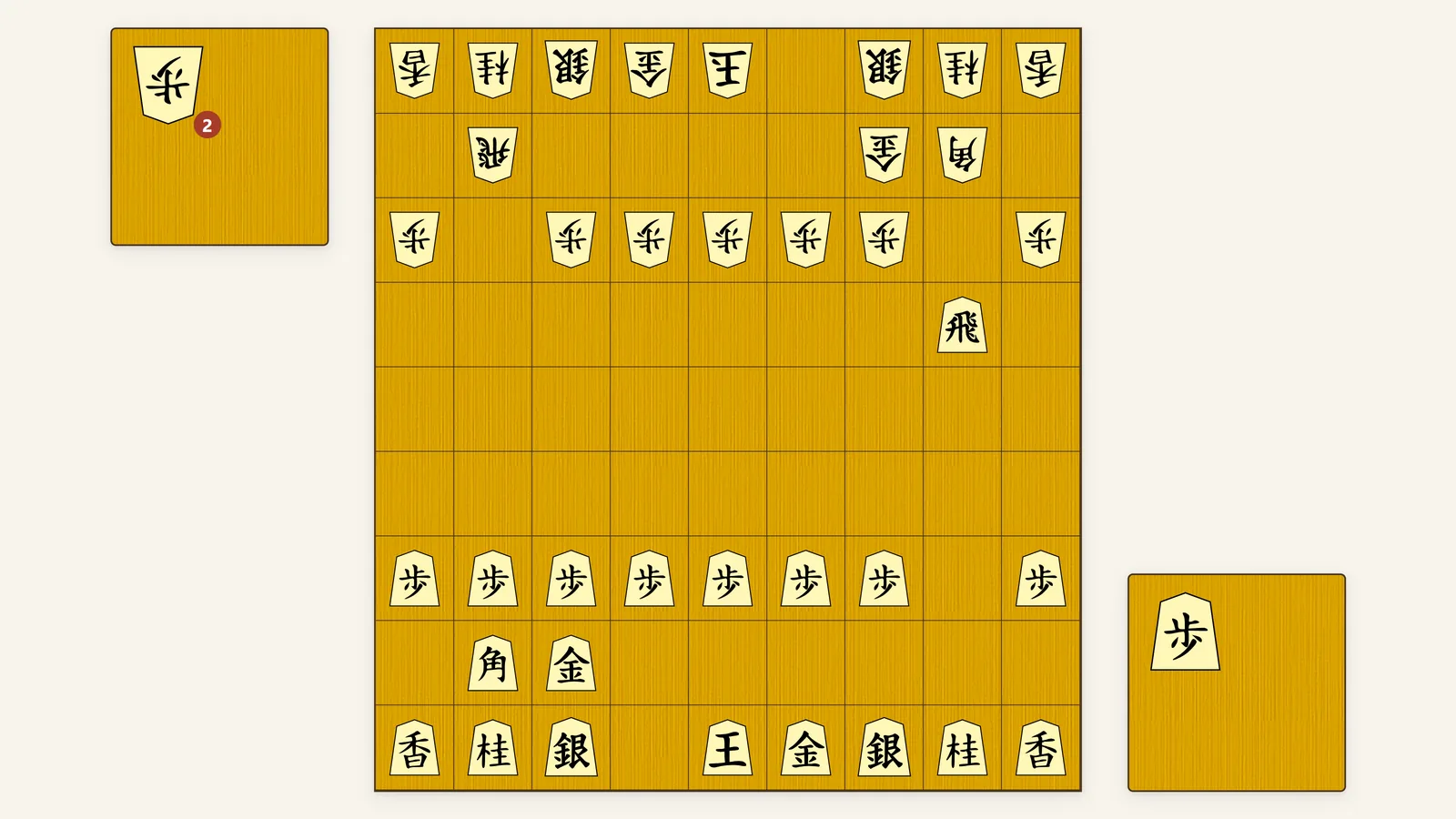
This page is the full reference. If you’d rather learn by doing, the step-by-step lesson teaches the same material in order, with practice positions. And everything here is enforced live on our free board, so you can test any rule the moment you read it.
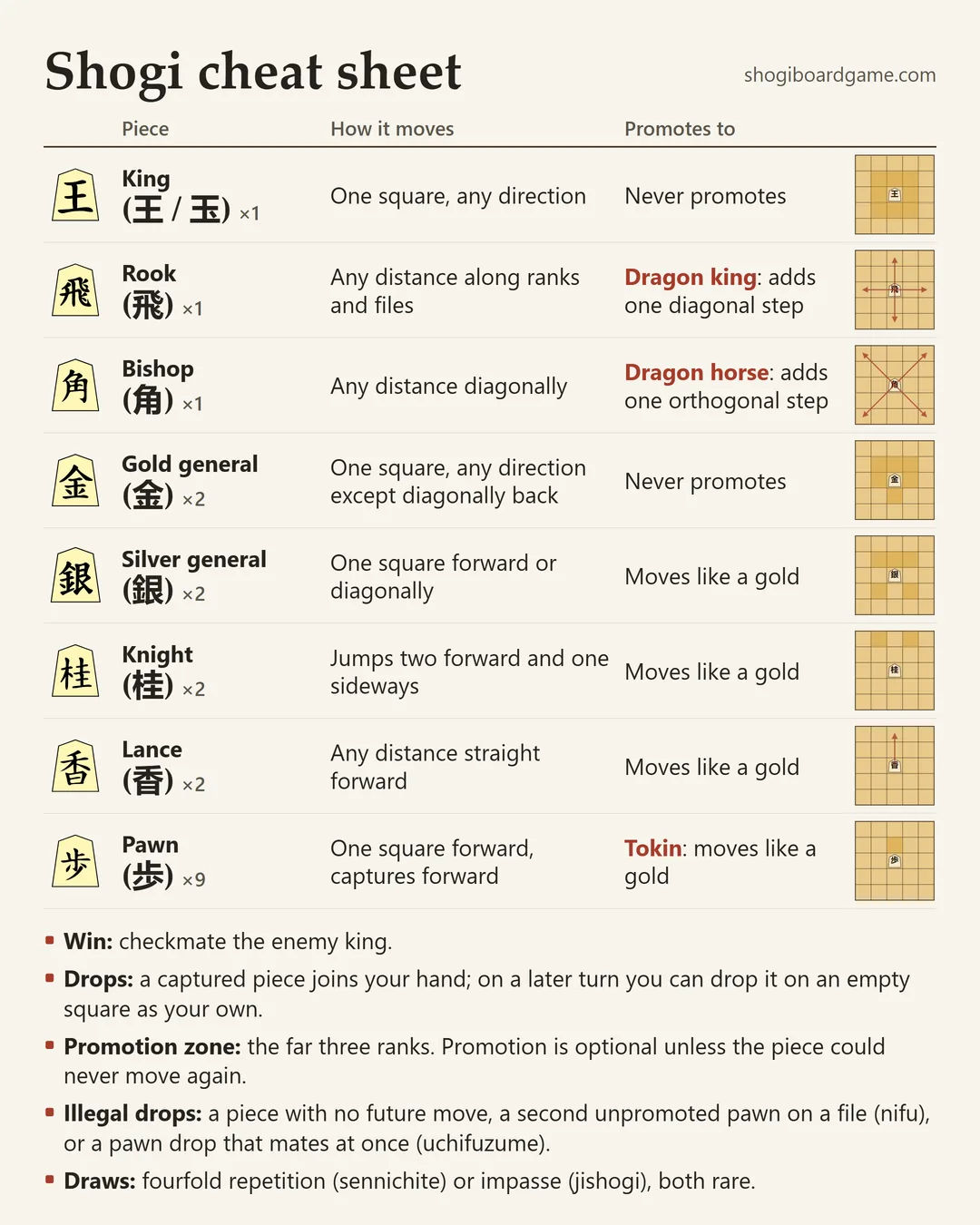
Shogi cheat sheet
Every piece on one table. Each player starts with the count shown.
| Piece (kanji) | Count | How it moves | Promotes to |
|---|---|---|---|
| King (王 / 玉) | 1 | One square, any direction | Never promotes |
| Rook (飛) | 1 | Any distance along ranks and files | Dragon king: adds one diagonal step |
| Bishop (角) | 1 | Any distance diagonally | Dragon horse: adds one orthogonal step |
| Gold general (金) | 2 | One square, any direction except diagonally back | Never promotes |
| Silver general (銀) | 2 | One square forward or diagonally | Moves like a gold |
| Knight (桂) | 2 | Jumps two forward and one sideways | Moves like a gold |
| Lance (香) | 2 | Any distance straight forward | Moves like a gold |
| Pawn (歩) | 9 | One square forward, captures forward | Tokin: moves like a gold |
The rules on one line each:
- Win: checkmate the enemy king.
- Drops: a captured piece joins your hand; on a later turn you can drop it on an empty square as your own.
- Promotion zone: the far three ranks. Promotion is optional unless the piece could never move again.
- Illegal drops: a piece with no future move, a second unpromoted pawn on a file (nifu), or a pawn drop that mates at once (uchifuzume).
- Draws: fourfold repetition (sennichite) or impasse (jishogi), both rare.
The objective
Checkmate the opposing king: attack it so that no legal move can save it. That’s the whole goal. There’s no counting territory, no points during play. A game can also end by resignation (how most decided games actually finish), by an illegal move (instant loss, even in professional play), or, rarely, by repetition or impasse. More on those at the bottom, because they almost never come up in beginner games.
The player who moves first is called sente (black), the second player gote (white); what the words mean is covered with the other shogi terms. Who gets sente is decided by a pawn toss called furigoma, described on the board setup page.
The board and starting position
The board is a 9x9 grid, plain and unchecked. Each player arranges 20 pieces in three rows: nine pawns across the third rank, the bishop and rook on the second, and the back rank holding the lances, knights, silvers, golds, and king symmetrically from the corners inward.
Files are numbered 1 to 9 and ranks lettered a to i in Western notation, counted from the top-right corner from sente’s point of view. You don’t need notation to play, but you’ll want it eventually for reading games; see board setup for the details and common setup mistakes.
How each piece moves
Eight piece types, and four of them only move one square at a time. The movement rules are quicker to learn than chess, honestly. What takes practice is the kanji recognition, and the pieces hub has a full guide for that.
The king moves one square in any direction.
The rook slides any distance along ranks and files, the strongest piece on the board.
The bishop slides any distance diagonally.
The gold general steps one square in any direction except diagonally backward.
The silver general steps one square forward or one square along any diagonal.
The knight jumps to either square two ranks ahead and one file over. It’s the only piece that jumps, and unlike its chess cousin it can never move sideways or backward.
The lance slides any distance straight forward. Only forward.
The pawn steps one square straight forward, and captures the same way. No diagonal captures, no two-square first move, no en passant.
Capturing works like chess: move onto an enemy piece’s square and remove it. Where it goes next is where shogi stops being chess.
Drops: captured pieces come back
A captured piece is not dead. It goes into your hand (kept beside the board, visible to both players), and on any later turn you may spend your move dropping it onto any empty square, unpromoted, facing your opponent. A dropped piece is fully yours: it moves, captures, and promotes normally from then on.
Three restrictions, and only three:
- No dead drops. You can’t drop a piece where it could never move again: pawns and lances on the last rank, knights on the last two ranks.
- No two pawns on a file (nifu). You may not drop a pawn onto a file that already contains one of your own unpromoted pawns. Promoted pawns don’t count. This is the most common illegal move in shogi, and yes, professionals have forfeited games to it.
- No pawn-drop mate (uchifuzume). You may not drop a pawn to deliver immediate checkmate. Dropping a pawn to give a survivable check is fine, and mating by moving a pawn forward is fine. Only the drop-that-mates is banned.
Everything else is legal. Drop a silver next to the enemy king. Drop a lance behind an undefended pawn. Drop your opponent’s former rook into their own camp. The drop rule page covers the tactics this opens up; here it’s enough to know the mechanics.
Promotion
The far three ranks (where your opponent’s pieces start) are your promotion zone. When a move starts in the zone, ends in the zone, or crosses it, you may flip the piece to its promoted side as part of that move.
Promotion is optional except when a piece would otherwise be stranded with no legal moves: a pawn or lance reaching the last rank must promote, and a knight reaching either of the last two ranks must promote.
What each piece becomes:
- Pawn, lance, knight, and silver all promote to pieces that move exactly like a gold general. The promoted pawn has its own famous name, the tokin.
- The rook promotes to the dragon king: rook movement plus one step diagonally.
- The bishop promotes to the dragon horse: bishop movement plus one step orthogonally.
- The king and the gold general never promote.
Two things trip up new players. First, promotion happens on your move, immediately, or not at all; you can’t promote while sitting still, though the piece gets a fresh chance each time it moves within the zone. Second, when a promoted piece is captured, it reverts: the tokin your opponent captures goes into their hand as a plain pawn. That asymmetry drives real strategy, covered on the promotion page, including the surprisingly common cases where declining promotion is correct.
Check, checkmate, and illegal moves
Check works as in chess: your king is attacked, and you must address it by moving the king, blocking, or capturing the attacker. In shogi you have a fourth option: blocking by dropping a piece in the way.
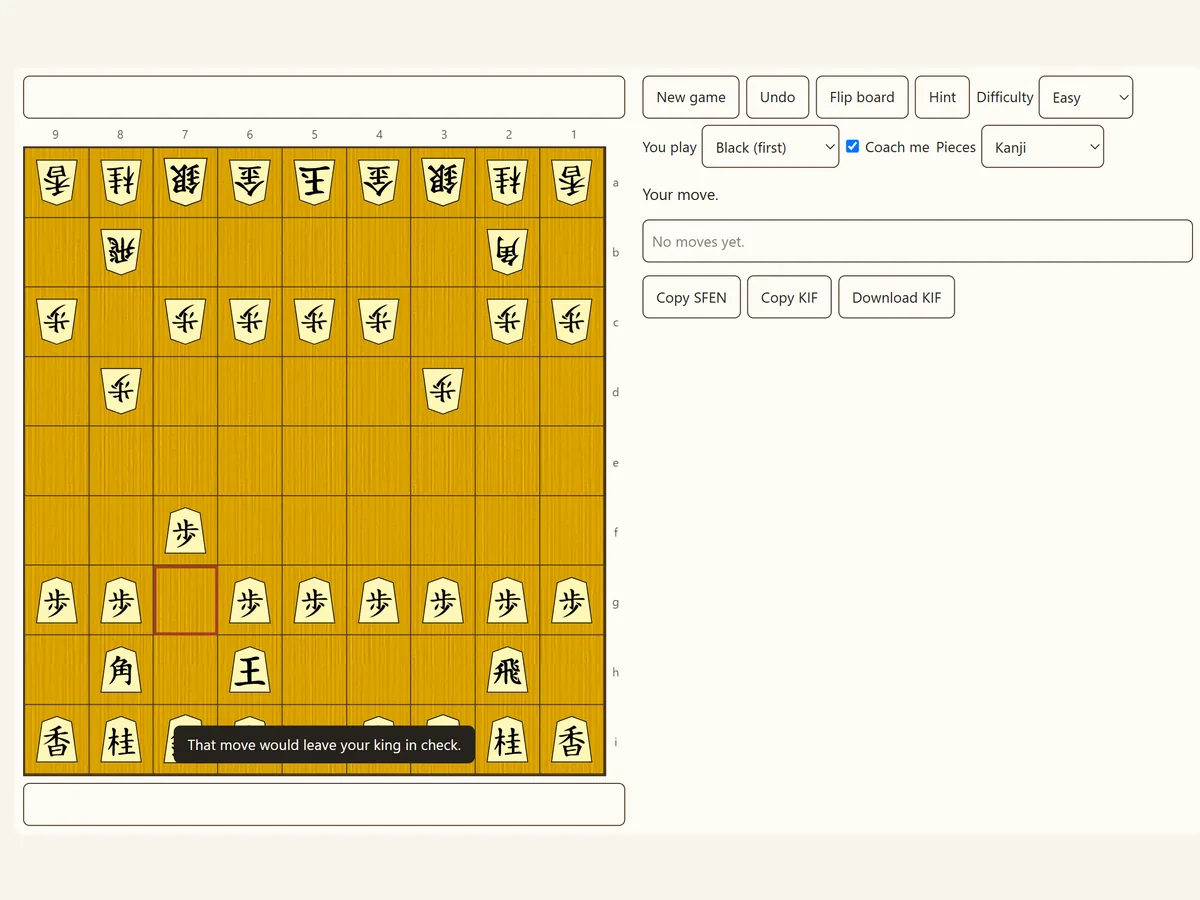
You may never make a move that leaves your own king in check. Combined with the drop restrictions above, that’s the complete list of illegal moves. In over-the-board play there’s no taking it back; in professional games an illegal move ends the game on the spot. Our board simply won’t let you play one, and with coaching mode on it tells you which rule you bumped into.
Checkmate ends the game. There is one lovely wrinkle drops add: a defense that looks like mate in chess often isn’t mate in shogi, because the defender can drop a blocker, and an attack that looks harmless can be mate because the attacker can drop the final piece. Counting the pieces in hand is part of reading every position.
Repetition (sennichite)
If the identical position occurs four times, same pieces on the board, same pieces in each hand, same player to move, the game is a draw. One exception: if one player caused the repetition by giving check every time (perpetual check), that player loses. You can’t force a draw by chasing the king forever.
Draws are rare regardless. Professional games end in sennichite only a few percent of the time, and when they do, professionals replay the game with colors reversed.
Impasse (jishogi)
Occasionally both kings march up the board and burrow into each other’s promotion zones. With the kings past each other, neither side can build a mating attack, and the game would never end. Shogi resolves this with counting, using pieces on the board and in hand:
| Piece | Impasse points |
|---|---|
| Rook or bishop (promoted or not) | 5 each |
| Every other piece except the king | 1 each |
| King | Not counted |
A player with fewer than 24 points loses; if both have 24 or more, it’s a draw. Some amateur and online rules use a 27-point declaration version instead.
You can play hundreds of games without seeing an impasse. It’s in the rules so that entering-king endgames, where one king escapes into enemy territory, have a defined ending. If it happens to you, congratulations on witnessing shogi’s rarest finish.
Learn it by playing
Rules stick when you use them. The beginner lesson sequences all of this into a teachable order, tsume shogi puzzles drill checkmates, and the board on our homepage enforces every rule on this page while explaining any illegal move you attempt.
FAQ
What are the basic rules of shogi (Japanese chess)?
Two players move pieces on a 9x9 board, aiming to checkmate the enemy king. Captured pieces join the captor’s hand and may be dropped back onto empty squares on later turns. Pieces that reach the far three ranks may promote to stronger forms. The first player to checkmate wins.
What moves are illegal in shogi?
You may not leave your own king in check, drop a pawn onto a file containing your unpromoted pawn (nifu), drop a pawn to give immediate checkmate (uchifuzume), drop any piece where it could never move again, or give perpetual check through repetition. In professional play an illegal move loses instantly.
Can shogi end in a draw?
Yes, but rarely. A fourfold repetition of the same position (sennichite) is a draw, unless caused by perpetual check, which loses. An impasse where both kings enter the enemy camp is scored by counting points. Professional shogi games end drawn only around 2 to 3 percent of the time.
Why can’t you drop a pawn for checkmate in shogi?
The uchifuzume rule forbids delivering immediate checkmate by dropping a pawn, shogi’s humblest piece. Tradition aside, the rule adds real depth: attackers must arrange mates so the final blow comes from a moved piece or a stronger drop. Pawn drops that merely check, or pawn moves that mate, stay legal.
Do all shogi pieces promote?
No. The king and the gold general never promote. The other six piece types all can: silver, knight, lance, and pawn promote to gold-general movement, the rook becomes the dragon king, and the bishop becomes the dragon horse. Promotion is optional unless the piece would otherwise have no legal moves.