Shogi Players: How Pros Qualify and the Best of All Time
Professional shogi players are full-time competitors licensed by the Japan Shogi Association (JSA). Almost all of them got there the same way: years in the JSA’s apprentice school, the shoreikai, followed by a top-two finish in its 3-dan league. The best known today are Sota Fujii, who held all eight major titles at once in 2023, and Yoshiharu Habu, who holds the record of 99 career titles.
How to become a professional shogi player
The only regular route to professional status runs through the shoreikai (新進棋士奨励会), the JSA’s apprentice school. It has existed since 1928, and the JSA took over running it in 1931.
- Get a sponsor. Applicants must normally be 19 or younger and need a recommendation from a professional ranked 4-dan or above, who becomes their teacher (師匠, shishō).
- Pass the entrance exam. Successful applicants enter at an apprentice rank between 6-kyu and 1-kyu, depending on age and results.
- Climb from 6-kyu to 3-dan. Promotion depends on results in apprentice games, played separately in Tokyo and Osaka.
- Win the 3-dan league. All 3-dan apprentices play one league every six months. The top two are promoted to 4-dan and become professionals.
- Beat the clock. An apprentice who has not reached 1-dan by their 21st birthday, or 4-dan by the end of the league that includes their 26th birthday, must leave. A 3-dan who keeps a winning league record can stay until 29.
That means only about four new professionals a year come through the main route. A player who finishes third twice can also accept promotion as a “free class” professional.
There is one other door. Since 2006 the JSA has run a Professional Admission Test for strong amateurs and women’s professionals with outstanding results against pros. Only a handful of people have passed it, including Kenji Imaizumi in 2014, Shogo Orita in 2020 and Reo Koyama in 2023.
What professional players do
Professionals are ranked from 4-dan to 9-dan and never drop a dan. They earn a salary based on rank, plus game fees and prize money from tournaments that newspapers and companies sponsor. The shogi ranks guide explains how pros move from 4-dan to 9-dan, and how amateur ranks compare.
The best shogi players in history
This table lists the players with the strongest claim to “best ever.” Title counts are career totals of major title terms from each player’s JSA profile, as of October 1, 2026.
| Player | Born | Best known for | Major titles won |
|---|---|---|---|
| Yoshiharu Habu (羽生善治) | 1970 | First to hold all seven titles at once (1996); first to 1,600 official wins (2025) | 99 |
| Yasuharu Oyama (大山康晴) | 1923 (died 1992) | 18 Meijin terms; held the career wins record until 2019 | 80 |
| Makoto Nakahara (中原誠) | 1947 | 16th Lifetime Meijin | 64 |
| Sota Fujii (藤井聡太) | 2002 | First to hold all eight titles at once (2023) | 37 |
| Akira Watanabe (渡辺明) | 1984 | Nine Ryuo titles in a row, 2004 to 2012 | 31 |
| Koji Tanigawa (谷川浩司) | 1962 | Won the Meijin in 1983 at 21; 17th Lifetime Meijin | 27 |
| Toshiyuki Moriuchi (森内俊之) | 1970 | 18th Lifetime Meijin | 12 |
| Yoshio Kimura (木村義雄) | 1905 (died 1986) | First Meijin decided by tournament play (1937) | 8 |
| Takumi Ito (伊藤匠) | 2002 | Ended Fujii’s eight-title run in 2024; holds Eio and Oza | 4 |
Kimura’s count looks small because, for most of his career, the Meijin was the only title that existed. Fujii’s will keep moving: as of October 2026 he is defending the Ryuo, and Ito is defending the Oza. The shogi titles page has the current holder of every title.
Sota Fujii
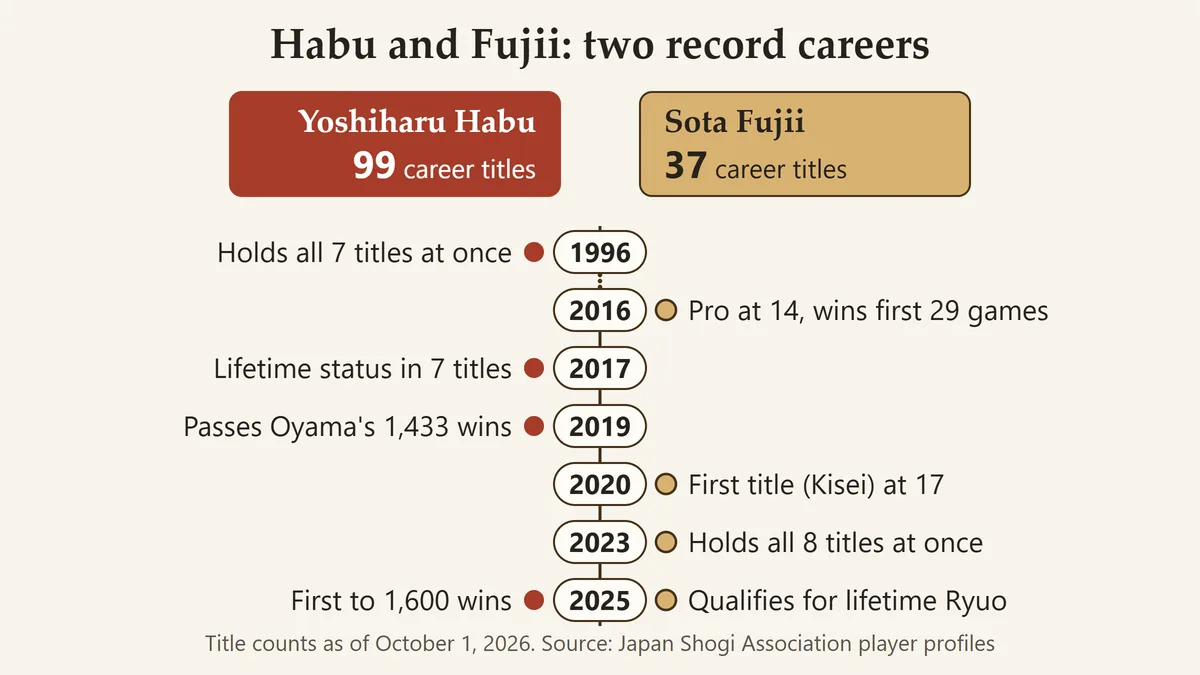
Sota Fujii (藤井聡太), born July 19, 2002 in Seto, Aichi, is the strongest player of the current era and holds six of the eight major titles as of October 2026: Ryuo, Meijin, Oi, Kisei, Kio and Osho.
- Youngest professional. He became a 4-dan professional on October 1, 2016, at 14, the youngest player ever to reach regular professional status.
- 29 straight wins. He won his first 29 official games, breaking a 30-year-old record of 28.
- First title at 17. He won the Kisei in July 2020, the youngest player ever to win a major title.
- All eight titles. On October 11, 2023 he became the first player to hold all eight major titles at the same time. The run lasted 254 days, until Takumi Ito took the Eio in June 2024.
- Lifetime titles. He has qualified for three lifetime titles: Kisei and Oi in 2024, and Ryuo in 2025.
In 2025 he became the first shogi player to earn more than 200 million yen in prize money and game fees in a single year.
Yoshiharu Habu
Yoshiharu Habu (羽生善治), born September 27, 1970 in Tokorozawa, Saitama, dominated professional shogi from the early 1990s and still holds most of its career records.
- Seven titles at once. On February 14, 1996 he became the first player to hold all seven major titles that existed then (the eighth, the Eio, was added in 2017).
- Lifetime titles in seven events. In December 2017 he became the only player to qualify for lifetime status in seven different titles.
- Career records. His 99 career titles are a record. In 2019 he passed Oyama’s record of 1,433 official wins, and in November 2025 he became the first professional to win 1,600 games.
- Beyond the board. He received Japan’s People’s Honour Award in 2018, served as JSA president from June 2023 to June 2025, and is a FIDE Master at chess.
Habu took on the Osho title match against Fujii in early 2023 and lost 4 games to 2. As of October 2026 he plays in Meijin ranking class B2.
Women’s professional shogi players
Women’s professionals (女流棋士, joryū kishi) are a separate category with their own ranks, titles and entry route. Women can and do enter the shoreikai, but as of the latest reports we found (May 2026), no woman has yet earned regular professional status through it or the admission test. Kana Fukuma, Tomoka Nishiyama and Nanami Naka all reached 3-dan in the apprentice school.
How the women’s system works:
- Entry is through the JSA’s training groups (研修会, kenshūkai). A strong enough record earns provisional women’s professional 3-kyu, then full status at 2-kyu.
- Ranks run from 2-kyu up through the dan ranks, with separate promotion rules from the men’s system.
- Titles: the JSA lists eight women’s titles, including the Hakurei, Seirei, Women’s Meijin and Kurashiki Toka.
- Two organizations: most women’s professionals belong to the JSA. A smaller group formed the Ladies Professional Shogi-players’ Association of Japan (LPSA) in 2007.
As of October 2026, Kana Fukuma and Tomoka Nishiyama hold four women’s titles each. Women’s title matches began in 1974 with the Women’s Meijin. In 2017 Karolina Styczyńska of Poland became the first non-Japanese professional of either category when she reached women’s 2-kyu. And since June 2025 the JSA itself has been led by a women’s professional, Ichiyo Shimizu.
Watch, then play
Professional games are long. Title matches give each player 4 to 9 hours, as the guide to how long a shogi game lasts explains. If watching the pros makes you want to try it yourself, start with how to play shogi, then play shogi free in your browser against the computer. When you are ready for human opponents, see where to play shogi online.
FAQ
Who is the best shogi player in the world?
As of October 2026, Sota Fujii is the top player by results. He holds six of the eight major titles and held all eight at once from October 2023 to June 2024. Yoshiharu Habu holds the record for career titles, 99, ahead of Yasuharu Oyama’s 80.
How do you become a professional shogi player?
Enter the Japan Shogi Association’s apprentice school, the shoreikai, before age 20 with a professional’s recommendation. Climb from 6-kyu to 3-dan, then finish in the top two of a six-month 3-dan league to reach professional 4-dan. Apprentices who don’t reach 4-dan by about age 26 must leave.
How many professional shogi players are there?
About 200 regular professionals are active at any time, according to English Wikipedia’s shogi article, plus a separate group of women’s professionals. The main route adds only about four new professionals a year.
Are there female professional shogi players?
Yes. Women’s professionals compete in their own system with separate ranks and eight women’s titles. Women may also enter the regular apprentice school. As of the latest reports we found (May 2026), none had yet earned regular professional status, though three reached the final 3-dan stage.
How much do professional shogi players earn?
Professionals receive a rank-based salary plus game fees and prize money. The top prize is the Ryuo, worth 44 million yen to the winner. In 2025 Sota Fujii became the first player to earn more than 200 million yen in a single year.