Shogi History: When Was Shogi Invented and How Old Is It?
No one knows exactly when shogi was invented. The oldest shogi pieces ever found date to 1058, so the game is at least 968 years old as of 2026. It came to Japan from the family of games that began with chaturanga in India, and the modern game with drops had taken shape by the 16th century, more than 400 years ago.
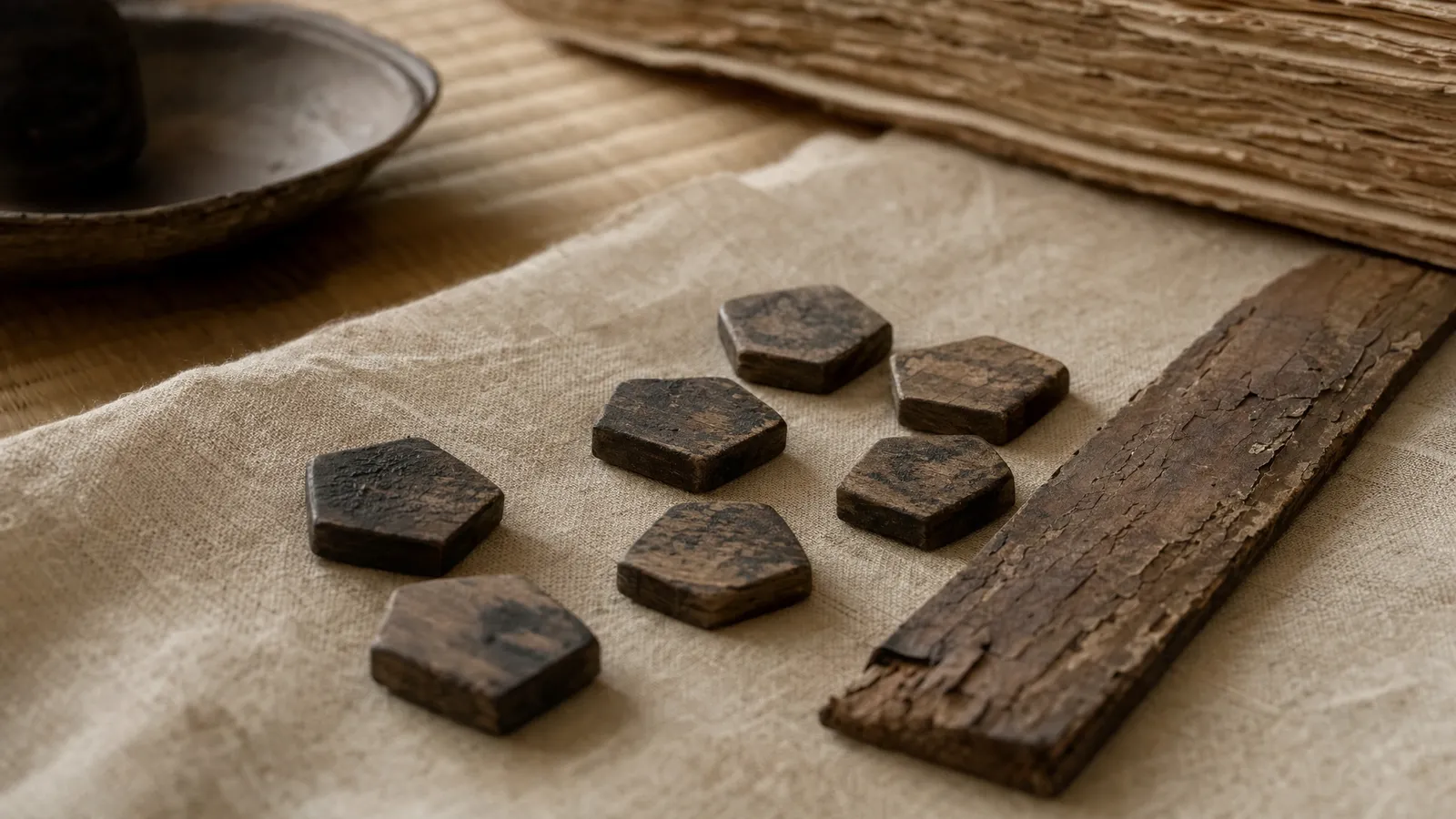
Shogi history at a glance
| Date | Event |
|---|---|
| By the 7th century | Chaturanga, the shared ancestor of chess, xiangqi and shogi, is played in India |
| Uncertain (theories range from the 6th to the 11th century) | A chaturanga-type game reaches Japan |
| 1058 | Date on a wooden tablet found with the oldest known shogi pieces, at Kofuku-ji temple in Nara |
| 1058 to 1064 | Shin Saru Gakuki mentions shogi, the oldest accepted written reference |
| 1210 to 1221 | The Nichūreki encyclopedia describes two shogi games, small and large |
| About the 13th century | Larger games such as dai shogi appear; small shogi gains the rook and bishop |
| About the 14th century | Chu shogi is created as a simpler form of dai shogi |
| 15th to 16th century | The drunk elephant is dropped from small shogi and captured pieces can be dropped back in: modern shogi |
| 1587 | Oldest surviving record of a shogi position, in a samurai’s diary |
| 1612 | The shogunate gives a stipend to Ohashi Sokei, the first head of a shogi house |
| 1636 | Ohashi Soko, the second Meijin, writes down the forbidden moves for the first time |
| 1716 | Shogun Tokugawa Yoshimune fixes an annual castle shogi game on November 17 |
| 1868 | The shogunate falls and the shogi houses lose their support |
| 1893 | The last hereditary Meijin dies, ending the house system |
| From about 1899 | Newspapers start publishing game records |
| September 8, 1924 | Tokyo professionals form the Tokyo Shogi Federation, the start of today’s Japan Shogi Association |
| 1928 | The apprentice school for future professionals (shoreikai) begins |
| 1935 to 1937 | The Meijin becomes a title won by play; Yoshio Kimura is the first winner |
| 1947 | The organization takes back the name Japan Shogi Association |
| 1974 | The first women’s title, the Women’s Meijin, is played |
| 1975 | The JSA names November 17 Shogi Day |
| 1988 | The Ryuo title is created |
| 1996 | Yoshiharu Habu holds all seven titles at once |
| 2017 | The Eio becomes the eighth title; the program Ponanza beats the reigning Meijin |
| 2023 | Sota Fujii holds all eight titles at once |
Where shogi came from
Shogi belongs to the chess family, which goes back to chaturanga in India. As chaturanga spread across Asia and Europe it turned into different games: chess in the West, xiangqi in China, janggi in Korea, makruk in Thailand and shogi in Japan.
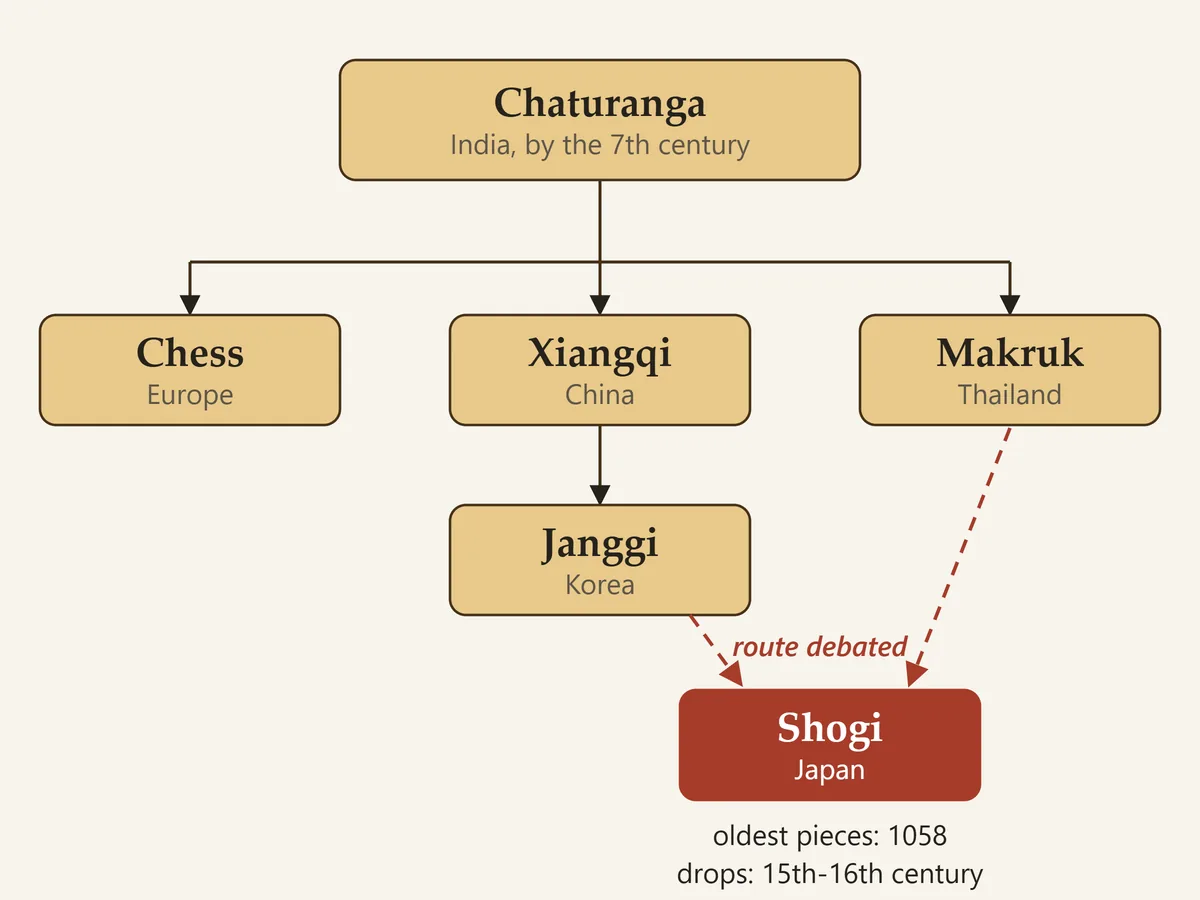
How it reached Japan is still argued over. The Japan Shogi Association (JSA) names two candidate routes: India to China to Korea to Japan, or India through Southeast Asia to Japan. Shogi shares features with both sides:
| Like Chinese xiangqi | Like Thai makruk |
|---|---|
| Flat pieces with characters written on them | Pieces sit on squares, not on line crossings |
| The king starts in the middle of a nine-file board | A full row of pawns on the third rank |
| Pawns capture straight ahead | Pieces promote by entering the enemy camp |
| A silver general that moves like makruk’s elephant |
Chess is a cousin from the same family, not a parent. The shogi vs chess comparison shows how far the two drifted apart.
Heian period: the first evidence
The best evidence for shogi’s age comes from Nara. In 1993, archaeologists digging at the grounds of Kofuku-ji temple found 16 shogi pieces next to a wooden tablet dated 1058. The pieces were cut from scrap writing tablets, but they already had the five-sided shape used today. They show five piece types: king, gold, silver, knight and pawn.
The oldest accepted written mention is from the same decades. Shin Saru Gakuki (新猿楽記), a satirical work dated to about 1058 to 1064 and attributed to Fujiwara no Akihira, lists shogi among one character’s hobbies.
About 150 years later, the encyclopedia Nichūreki (二中歴) describes two games, now called Heian shogi and Heian dai shogi. Heian shogi used the king, gold, silver, knight, lance and pawn, the ancestors of today’s pieces. But you won by reducing your opponent to a lone king, which shows that captured pieces were still removed for good.
How shogi got its drops
The drop rule is the part of shogi that is Japan’s own, and no record says exactly when it began. Over the following centuries, players kept changing the game:
- Around the 13th century, larger games such as dai shogi appeared, and small shogi borrowed the rook, bishop and drunk elephant from them.
- Around the 14th century, chu shogi was created as a simpler version of dai shogi. It became the most respected form for a time.
- In the 15th and 16th centuries, the drunk elephant was taken out of small shogi, leaving the modern set of pieces.
Drops came in during that same period. The JSA suggests a practical reason: with captured pieces thrown away, too many games couldn’t be finished, so players began reusing them. Another theory links the idea to mercenaries who changed sides. Once drops arrived, standard shogi pushed chu shogi aside, though chu shogi was still played into the 20th century. The shogi variants guide covers those older and larger games, and the drop rule page explains how drops work today.
The oldest recorded shogi position comes from 1587, in the diary of the samurai Matsudaira Ietada.
Edo period: the shogi houses
Under the Tokugawa shogunate, shogi became an official art run by hereditary houses. In 1612 the shogunate gave a stipend to Ohashi Sokei. His family and two others, the Ohashi branch house and the Ito house, became the shogi houses (家元, iemoto). For roughly 260 years the title of Meijin passed only among them, and a Meijin held it for life.
- The second Meijin, Ohashi Soko, wrote down the forbidden moves for the first time, in a book of 100 mating problems presented to the shogunate. It is dated 1636.
- In 1716 the eighth shogun, Tokugawa Yoshimune, made castle shogi, games played before the shogun, an annual event on November 17. The JSA has marked that date as Shogi Day since 1975.
- Collections of mating problems, the forerunners of today’s tsume shogi puzzles, were presented to the shogunate. The tenth shogun, Tokugawa Ieharu, even compiled one himself.
The system ended with the shogunate in 1868. Without stipends, the houses faded. The last hereditary Meijin, Ito Soin, died in 1893.
Modern shogi: newspapers and the JSA
Shogi survived as a popular pastime, and from about 1899 newspapers began printing game records. Their sponsorship is still the backbone of professional shogi today.
- 1924. On September 8, three rival Tokyo groups merged into the Tokyo Shogi Federation. The JSA counts this as its founding date.
- 1927. Players from the Kansai region joined, and the group took the name Japan Shogi Association.
- 1928. The apprentice school for future professionals, the shoreikai, began.
- 1935 to 1937. The 13th Meijin, Kinjiro Sekine, gave up the lifetime title. Yoshio Kimura won the first Meijin decided by tournament play in 1937.
- 1936 and 1947. The association was renamed Shogi Taiseikai in 1936, then took back the name Japan Shogi Association in 1947.
After the war more titles followed: the Osho in 1951, the Oi in 1960, the Kisei in 1962, the Kio in 1975, the Oza in 1983, the Ryuo in 1988 and the Eio in 2017. The shogi titles guide covers all eight. Women’s professional shogi began with the first Women’s Meijin match in 1974, and shogi players covers the pros who have shaped the modern game, from Yasuharu Oyama to Yoshiharu Habu and Sota Fujii.
Computers caught up too. Engines had become important study tools for professionals by the 2000s, and in 2017 the program Ponanza beat the reigning Meijin, Amahiko Sato.
How old is shogi?
It depends on what you count:
- Shogi in some form: at least 968 years, counting from the 1058 tablet found with the Kofuku-ji pieces.
- Modern shogi with drops: more than 400 years. The rules were settled in the 15th to 16th century, and the oldest recorded position dates to 1587.
- The modern professional system: 102 years as of 2026, counting from the JSA’s 1924 founding date.
For the game itself, start with what shogi is, then play a game free in your browser on the board this site provides.
FAQ
When was shogi invented?
There is no single invention date. A chaturanga-type game reached Japan sometime before the 11th century. The oldest shogi pieces date to 1058, and the modern game with drops took shape in the 15th and 16th centuries.
How old is shogi?
Shogi is at least 968 years old as of 2026, based on pieces found at Kofuku-ji temple in Nara alongside a tablet dated 1058. The modern rules, including drops, are more than 400 years old.
Who invented shogi?
No single person invented shogi. It developed in Japan from chaturanga, an Indian game that also gave rise to chess and xiangqi. Japanese players changed it over centuries, adding drops and removing the drunk elephant by the 16th century.
When were drops added to shogi?
No record gives an exact date. Drops are generally placed in the 15th or 16th century, around the time the drunk elephant was removed from small shogi. Earlier Heian-era rules said you won by reducing the opponent to a lone king, which means captured pieces were not reused then.
Is shogi older than chess?
Neither is simply older. Shogi and chess are cousins that both descend from chaturanga, recorded in India by the 7th century. Each changed in its own region over centuries; shogi’s oldest physical evidence is the set of pieces dated to 1058.