What Is Shogi? How Japanese Chess Works
Shogi is the Japanese form of chess, played on a 9x9 board with 20 pieces per side. Its defining rule is the drop: when you capture a piece, it joins your army, and on a later turn you can place it back on the board as your own. The goal, as in chess, is checkmate.
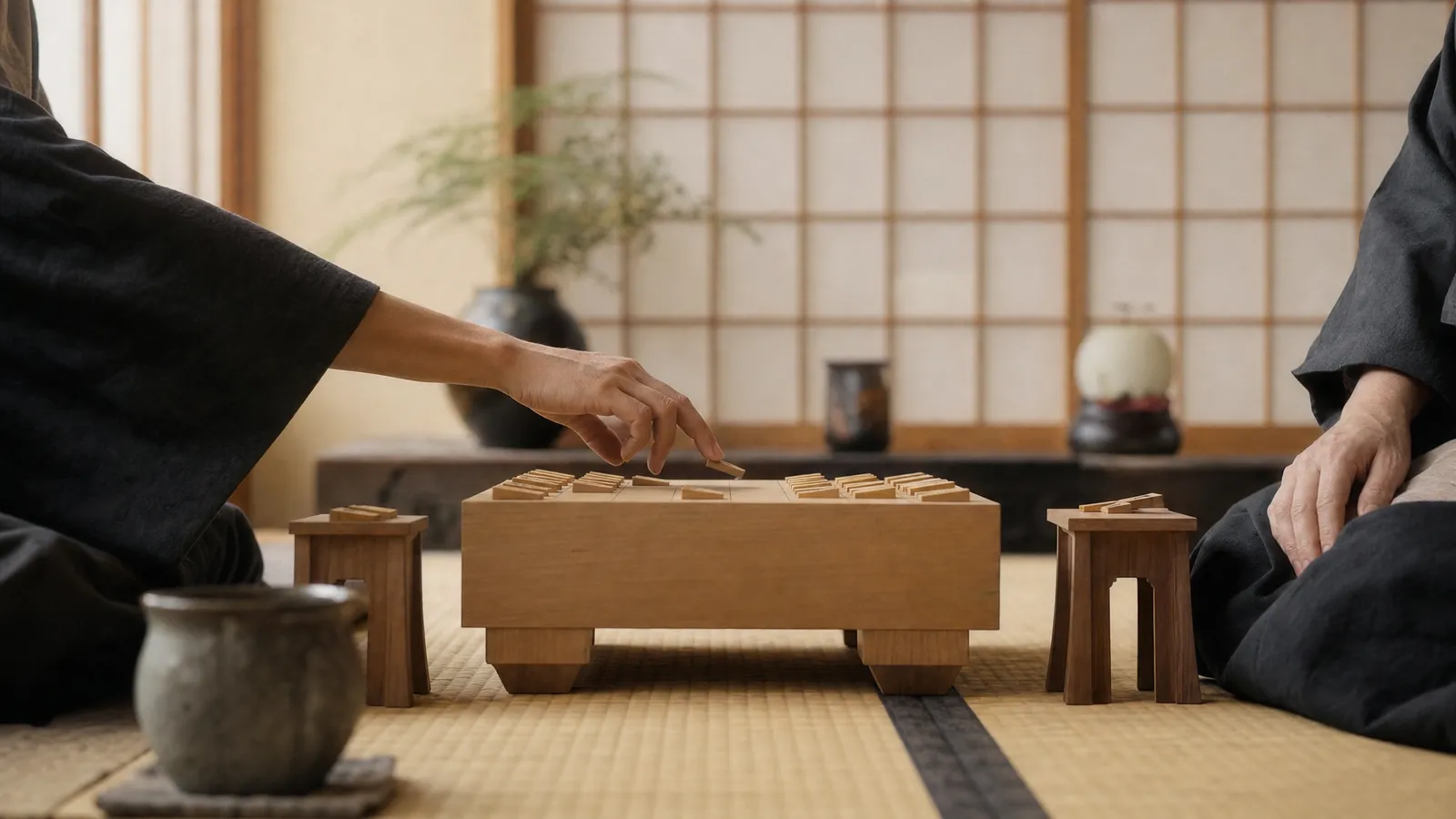
The rule that changes everything
Call shogi “Japanese chess” and you’re roughly right. You’re also underselling it.
In chess, a captured piece is gone. The game slowly empties out, and by the endgame two exhausted armies shuffle around a bare board, often agreeing to a draw. Shogi never empties. Every piece you capture goes into your hand, and on any later turn you can spend a move placing it on almost any empty square, facing your opponent, fighting for you.
That single rule, called the drop, rewrites the whole game:
- Material never leaves. A knight you lost on move 20 can reappear behind your opponent’s king on move 60.
- No defense is airtight. Walls that would hold in chess can be pried open by a pawn dropped in exactly the wrong place.
- Draws almost vanish. Because pieces keep flowing back into play, professional shogi games end in a draw only 2 to 3 percent of the time. In top-level chess, more than half of games are drawn.
You can read the full mechanics on the drop rule page, but the short version: drops are why shogi players say the game never lets you relax.
How does shogi work?
Shogi is a two-player game on a 9x9 grid of 81 squares. Each player starts with 20 pieces: a king, a rook, a bishop, two gold generals, two silver generals, two knights, two lances, and nine pawns.
The pieces are flat five-sided wedges, all the same color for both players. Ownership is shown by direction: your pieces point away from you, your opponent’s point at you. That design isn’t decoration. Since captured pieces switch sides, a piece has to be able to fight for either player, so you mark ownership by turning it around rather than by painting it a different color.
Each piece carries its name in kanji (Japanese characters). That looks intimidating for about a day. There are only eight characters to learn, most pieces move in simple patterns, and our board offers an international piece set with movement symbols if you’d rather learn the moves first and the characters later. The pieces guide covers all of them.
Shogi rules in one paragraph
Players take turns, and the first to checkmate the enemy king wins. On your turn you either move a piece or drop a captured piece onto an empty square, with three limits: no piece where it could never move again, no second unpromoted pawn on a file, and no pawn drop that gives immediate mate. A piece that moves into, out of, or within the far three ranks may promote. The full list, including repetition and impasse, is on the complete shogi rules page.
How shogi pieces move
The king steps one square in any direction. The rook slides along ranks and files, and the bishop slides diagonally. Gold and silver generals step one square in set patterns, the knight jumps two squares forward and one to the side, the lance slides straight forward, and the pawn steps one square forward and captures the same way. Diagrams for every piece and its promoted form are in the guide to how shogi pieces move, and the shogi vs chess comparison shows how these moves differ from chess.
Most pieces can also promote. Cross into the far third of the board and a piece can flip over to reveal a stronger form on its reverse side, which is why shogi pieces have writing on both faces. Promotion has its own rules and strategy.
Where shogi came from
Shogi and chess are cousins, not parent and child. Both trace back to chaturanga, an Indian board game dated to the seventh century. One branch traveled west through Persia and became chess. Another traveled east through Asia, and the Japanese branch became shogi. Its other cousins include xiangqi, Chinese chess.
| When | What happened |
|---|---|
| 7th century | Chaturanga is played in India, the shared ancestor of chess and shogi |
| 1058 | Date of the oldest known shogi pieces, a group of 16 excavated at the Kofuku-ji temple grounds in Nara |
| 15th to 16th century | A game recognizable as modern shogi, with the 9x9 board, today’s pieces, and the drop rule |
| 1924 | The Japan Shogi Association, which runs professional shogi, is founded in Tokyo |
One popular (and unproven) story links the drop rule to mercenary samurai of that era, who were known to switch sides when captured. Captured pieces changing loyalty would have felt natural. The full history of shogi separates what is known from what is legend.
The word itself is plain: sho (将) means general, gi (棋) means board game. The general’s game. Today title matches run for days, get broadcast nationally, and top players are household names in Japan.
How shogi differs from chess
Beyond drops, a few differences stand out immediately:
- The board is 9x9 instead of 8x8, and each side fields 20 pieces instead of 16.
- Pawns capture straight ahead, not diagonally.
- Most pieces promote, and each has its own promoted form. Pawns promote to a piece worth as much as a gold general, which changes how you value them.
- There’s no queen. The rook and bishop share the job of heavy artillery, and each gains extra moves when promoted.
- Draws barely exist. No stalemate rule matters in practice, and repetition draws are rare.
The full side-by-side comparison lives at shogi vs chess, including an honest look at which game is harder.
Chess players tend to pick up shogi fast, then hit a wall in a specific place: the endgame. Chess endgame instincts say simplify, trade down, grind. Shogi endgames are races. Both kings come under attack from dropped pieces, and the winner is usually whoever mates first, not whoever is ahead in material. It’s closer to a gunfight than a siege.
Do you need to be good at chess?
No. Chess experience helps with board vision, but shogi is friendly to complete beginners in one underrated way: comebacks are always possible. A beginner who blunders a rook in chess is usually just lost. In shogi, the game keeps generating chances, because every capture arms the side that’s behind on the board with pieces in hand.
If you want structure, the how to play shogi lesson walks through everything in order: board, setup, moves, drops, promotion, and your first strategy. If you’d rather poke at it, the rules reference is built for looking things up.
Try it right now
The fastest way to understand shogi is to move some pieces. You can play shogi free in your browser on this site, against a computer with adjustable strength or with a friend on the same screen. No signup, no download, and a beginner mode that explains any illegal move you try instead of just blocking it.
FAQ
Is shogi a real game?
Yes. Shogi is a traditional Japanese board game with roughly a thousand years of history: the oldest known pieces date to 1058. It has a professional league run by the Japan Shogi Association, founded in 1924, and title matches are broadcast nationally in Japan. It is not a game invented for anime or video games.
Is shogi related to chess?
Yes. Shogi and chess both descend from chaturanga, an Indian strategy game dated to the seventh century. Chess developed as the game spread west through Persia and Europe, while shogi developed in Japan. They’re separate branches of the same family tree rather than one being derived from the other.
Do I need to read Japanese to play shogi?
No. Traditional pieces are labeled with kanji, but there are only eight characters to learn, and most players recognize them within a few games. Many boards, including the one on this site, offer international piece sets that use movement symbols instead of characters.
How long does a shogi game take?
Casual games commonly take 30 minutes to 2 hours. Shogi games run longer than chess on average, around 115 half-moves versus roughly 70 in chess, because captured pieces return to the board and keep the fight going. Professional title games with long time controls can span two days.
Why do shogi pieces point in a direction?
Both players’ pieces are the same color because captured pieces change sides. Ownership is shown by orientation: each piece points toward the opponent. When you capture a piece and later drop it back on the board, you simply turn it to face the other way and it fights for you.