Shogi vs Go: Differences, Complexity, and Which to Learn
Shogi and go are Japan’s two great board games, and they work in opposite ways. In shogi you move 20 pieces around a 9x9 board to checkmate the enemy king. In go you place stones, one at a time, on the 361 points of a 19x19 grid to surround more territory than your opponent.
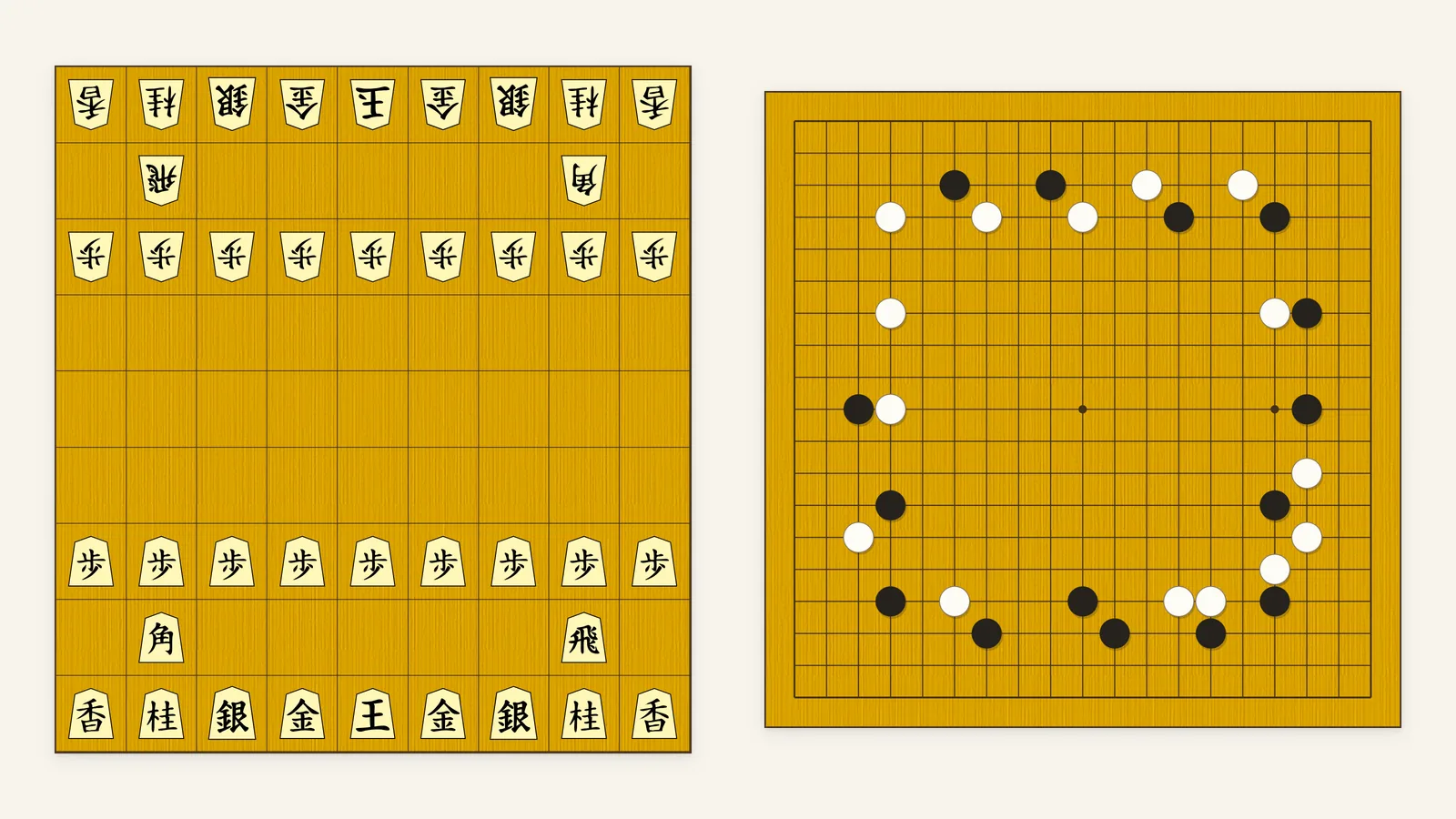
The verdict first
Pick shogi if you like the feel of chess: pieces with different powers, a king to hunt, and a game that ends the moment one side is mated. Pick go if you want a game with almost no rules to learn and a large open board where strategy plays out slowly. Shogi is the more popular game in Japan by a wide margin. Go has the bigger player base worldwide and the larger English-language community.
Shogi vs go at a glance
| Shogi | Go | |
|---|---|---|
| Japanese name | 将棋 (shōgi) | 囲碁 (igo), or just 碁 (go) |
| Board | 9x9 squares, 81 in total | 19x19 lines, 361 points |
| Equipment | 20 pieces per side, 8 types | Black and white stones, all identical |
| Pieces move? | Yes, each type has its own move | No, stones stay where they are placed |
| Captures | Captured pieces join your side and can be dropped back in | Surrounded stones come off the board |
| Goal | Checkmate the enemy king | Control more territory |
| First-move compensation | None | White gets komi, 6.5 points under Japanese rules |
| Average game length | About 115 half-moves | About 211 half-moves |
| Game-tree complexity (estimate) | 10^226 | 10^505 |
| Origin | Chaturanga family, via India; pieces in Japan by 1058 | China, more than 2,500 years ago; in Japan by the 7th century |
Board and equipment
A shogi board has 81 squares, and pieces sit inside them. A go board has 19 lines each way, and stones go on the 361 points where the lines cross. Beginners often play go on smaller 9x9 or 13x13 boards first. One historical variant, ko shogi, is even played on a go board.
Shogi pieces are flat, five-sided wedges marked with kanji. Both players use the same set. Ownership is shown by which way a piece points, which is why a captured piece can change sides just by being turned around. See the shogi pieces guide for all eight types.
Go equipment is simpler. Black has black stones, White has white stones, and every stone is the same. A stone’s strength comes only from where it sits and what it connects to.
How you win
Shogi is a race to a single target. Both players build an attack and a defense, and the game ends the moment one king is checkmated. Material, position, and time all matter only as far as they help you mate first. The full rules are on the shogi rules page.
Go is a negotiation over the whole board. Players take turns placing stones. A group of stones with no empty points next to it is captured and removed. At the end, each player counts the empty points they have walled off (under Japanese rules, plus one point per captured stone), and the higher score wins. White receives komi (6.5 points under Japanese rules) to make up for Black moving first.
That difference shapes how each game feels. A shogi game can be lost in one careless move near your king. A go game is usually decided by many small gains and losses spread across the board.
Captures: two opposite ideas
In shogi, a captured piece is not removed. It goes into your hand, and on a later turn you can drop it back onto the board as your own. Material never leaves the game, so attacks keep reloading right to the end.
In go, captured stones leave the board for good. But since go stones don’t move anyway, captures matter less as material and more as territory: removing a group frees the points it occupied.
Game length and complexity
Shogi games are shorter in moves. Commonly cited estimates put the average at about 115 half-moves (single moves by one player) for shogi and about 211 for go. A casual shogi game usually takes 30 minutes to 2 hours; more on that in how long is a shogi game.
On raw numbers, go is the bigger game. The table below uses the standard estimates collected on Wikipedia’s game complexity page.
| Measure | Shogi | Go (19x19) | Chess, for reference |
|---|---|---|---|
| Board points | 81 | 361 | 64 |
| Average legal moves per turn | 92 | 250 | 35 |
| Possible positions (state space) | 10^71 | 10^170 | 10^44 |
| Game-tree complexity | 10^226 | 10^505 | 10^123 |
Bigger numbers don’t make a game harder for a human, though. They mostly explain why computers took longer to master go. A shogi program called Ponanza beat the reigning Meijin, Amahiko Sato, in May 2017. Go’s landmark came a year earlier, when DeepMind’s AlphaGo beat Lee Sedol 4-1 in Seoul in March 2016.
Popularity in Japan
Shogi has far more players in Japan. The Leisure White Paper 2025 from the Japan Productivity Center, a survey of people aged 15 to 79, put shogi’s player population at 4.3 million and go’s at 1.2 million. Both numbers are near record lows for the survey, and both leave out children under 15.
Both games have professional systems with title matches, and some title names overlap. Meijin, for example, is a top title in shogi and in go.
Outside Japan the picture flips. Go is popular across China and Korea, and Wikipedia cites a 2016 survey estimate of over 20 million current go players worldwide. Shogi is played mostly in Japan.
Which should you learn first?
If you already play chess, learn shogi first. Kings, checkmate, pieces with fixed moves, and promotion will all feel familiar, and you can play a real game within an hour. The shogi vs chess page covers what changes.
If you have never played a strategy board game, go is a fair place to start. Its rules fit on a postcard. Expect your first games on a 19x19 board to feel shapeless, though, and start on 9x9.
Either way, you can try shogi right now: read how to play shogi, then play the computer on the board at beginner strength.
FAQ
What is the main difference between shogi and go?
Shogi is a chess-like game: you move pieces to checkmate the opponent’s king on a 9x9 board. Go is a territory game: you place identical stones on a 19x19 grid and never move them, aiming to surround more of the board than your opponent.
Is shogi or go more popular in Japan?
Shogi. The Leisure White Paper 2025 estimated 4.3 million shogi players and 1.2 million go players in Japan, counting people aged 15 to 79. Go is more widely played than shogi outside Japan, especially in China and Korea.
Is go more complex than shogi?
By the standard estimates, yes. Go has about 10^170 possible positions and a game-tree complexity of about 10^505, against 10^71 and 10^226 for shogi. That made go harder for computers. For a human learner, both games take years to master.
Is go Japanese or Chinese?
Go comes from China, where it was played more than 2,500 years ago. It reached Japan by the 7th century, and the English name “go” comes from the Japanese 碁. Shogi is the game that developed in Japan, from the same Indian chaturanga family as chess.
Should I learn shogi or go first?
If you know chess, start with shogi, since most chess ideas carry over. If you want the fewest rules possible, start with go on a 9x9 board. Many players learn both; they train different skills.