Shogi Strategy and Tactics: A Beginner's Guide
Good shogi strategy comes down to one rule: castle your king before you attack, then trade only when the pieces you hand over can’t hurt you. Both habits come from the drop rule: captured pieces come back, so material never drains out of the game, and a careless king can lose to pieces you gave away earlier.
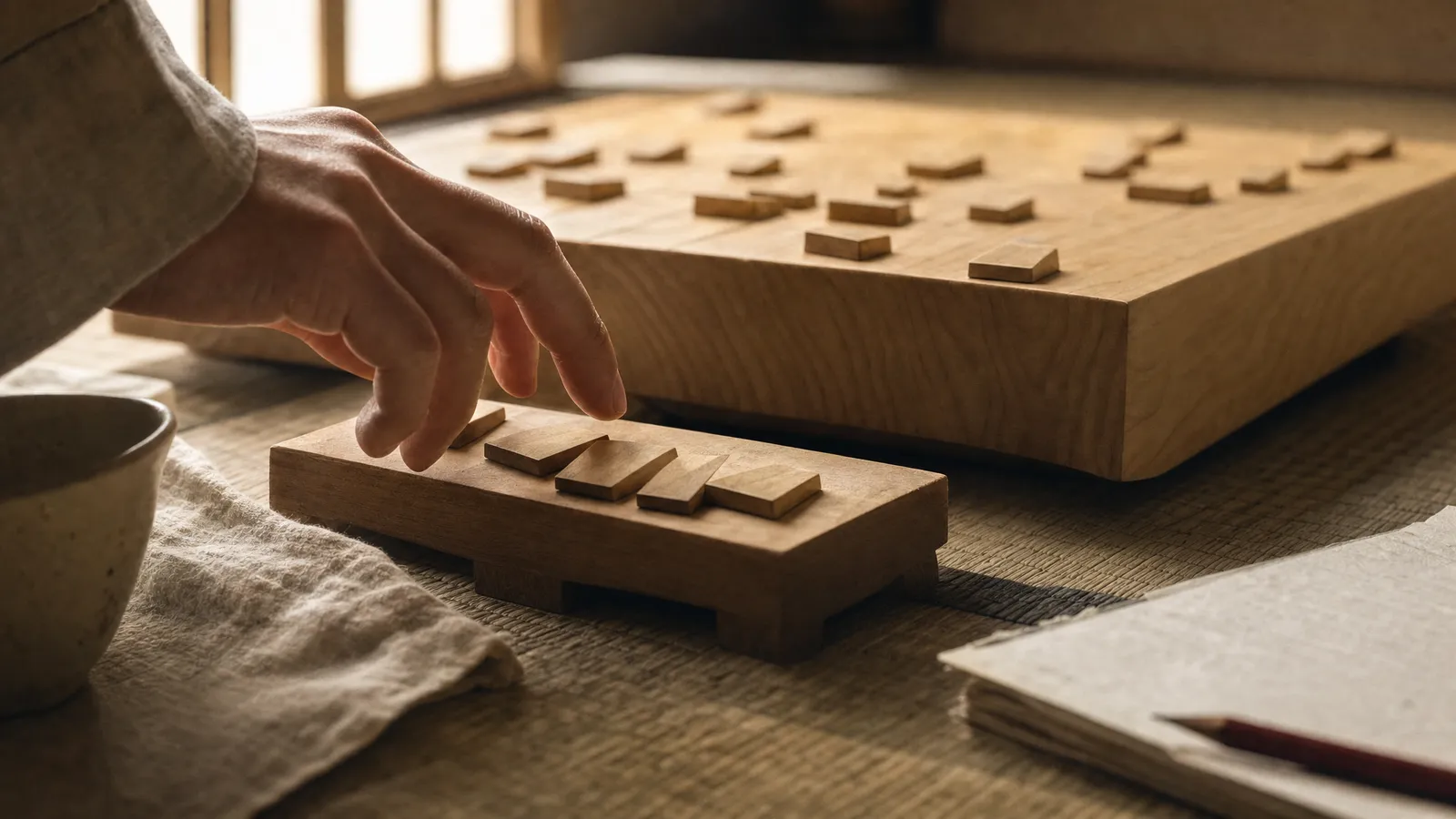
This guide covers six principles, a checklist you can run every move, and the handful of tactics that decide most beginner games.
The six principles at a glance
| Principle | What it means | The beginner habit |
|---|---|---|
| King safety | Build a castle before the fighting starts | Spend your early moves on the castle and your attack setup |
| Piece activity | Pieces that can’t move don’t count | Open lines for the rook and bishop; don’t strand pieces |
| Pawns and pawn drops | Pawns are your cheapest tools | Keep a few pawns in hand; they start most attacks |
| Exchange value | Every trade arms both players | Ask what your opponent can drop after the trade |
| Tempo | The race to mate matters more than material | Count how many moves each side needs to win |
| The drop threat | Empty squares near your king are landing zones | Check which drops your opponent’s hand allows |
King safety comes first
Castle first, attack second. A shogi king left on its starting square is called igyoku, the “sitting king”, and it is one of the most common ways beginners lose. Leaving the king in the middle puts it in the crossfire of every exchange on the board.
A standard castle uses three generals: two golds and a silver. Silvers make better attackers because they can retreat diagonally. Golds make better defenders because they guard the squares beside them. So the usual split is one silver forward for the attack and the rest wrapped around the king.
The Mino castle above takes six moves, counting the rook swing, and is the easiest complete castle to learn. The castles guide compares it with the Yagura and the Anaguma. One more proverb worth knowing: keep the king and rook apart. The rook is where the fighting starts, so a king next to it gets caught in that fight.
Keep your pieces active
A piece that can’t move is a piece you don’t have. In opening play, activity means developing pieces toward squares they can use. In the middlegame it means opening lines for the rook and bishop, often by trading pawns on purpose. Japanese players call this sabaki: getting your pieces working, even when no material changes hands.
Two warnings:
- Attackers get trapped. A rook or bishop deep in enemy territory can lose its retreat to a single dropped pawn. Know your way back before you go in.
- Promoted major pieces are worth the trouble. A dragon (promoted rook) or horse (promoted bishop) behind enemy lines is one of the strongest things you can build. The promotion guide explains what each piece becomes.
Pawn structure and pawn drops
In chess a pawn is permanent. In shogi a pawn in hand can be dropped back on almost any file, which makes pawns the ammunition for nearly every attack. A common opening goal is to trade your rook’s pawn for the opponent’s. You open the rook’s file and add a pawn to your hand in one go.
Three things to know:
- Two-pawn rule (nifu). You can’t drop a pawn on a file where you already have an unpromoted pawn. Trading pawns frees files for later drops.
- Pawns attack, then promote. A pawn that reaches the enemy camp promotes to a tokin, which moves like a gold. If it’s captured, your opponent only gets a pawn back. That makes tokin attacks almost free.
- Three pawns is an attack. A proverb says that with three pawns in hand you can play a tsugifu (a second pawn strike right after the first) and then a tarefu (a dangling pawn). Both are covered on the tesuji page.
Piece values and exchanges
Shogi players rank pieces roughly like this. The numbers are a rough guide for trades, not a law.
| Piece | Kanji | Per side | Relative value | Promotes to |
|---|---|---|---|---|
| King | 王将 | 2 | n/a (the game) | does not promote |
| Rook | 飛車 | 2 | 10 | Dragon King |
| Bishop | 角行 | 2 | 8 | Dragon Horse |
| Gold General | 金将 | 4 | 6 | does not promote |
| Silver General | 銀将 | 4 | 5 | Promoted Silver |
| Knight | 桂馬 | 4 | 4 | Promoted Knight |
| Lance | 香車 | 4 | 3 | Promoted Lance |
| Pawn | 歩兵 | 18 | 1 | Tokin |
A captured piece comes back unpromoted. If your opponent takes your tokin, they get a pawn. If you take their gold with that tokin, you get a gold. This is why trading a tokin for a gold is a classic winning trade. It’s also why a promoted rook is worth more on the board than in anyone’s hand.
Before any trade, check three things:
- What do I get in hand, and where can I drop it?
- What does my opponent get in hand, and can it reach my king?
- Does the trade open a line toward my king or toward theirs?
Attack or defend: counting tempo
Shogi endgames are races. When both kings are under fire, the side that mates first wins, whatever the material count. Strong players do a quick count: if neither side defends, how many moves does each side need to mate? If you’re faster, attack. If you’re slower, make the one defensive move that buys the most time, then attack.
A move that threatens mate next turn forces a reply. A move that threatens mate no matter what the opponent does (a brinkmate, hisshi in Japanese) usually wins outright if your own king is safe for one more turn. Tsume shogi puzzles train the counting side of this: forced mates where every move is a check.
Respect the drop threat
The drop rule changes defense more than anything else. A piece in your opponent’s hand can land on almost any empty square, so you guard squares, not just pieces.
- Look at your opponent’s hand every move. A silver in hand means every square diagonal to your king’s front is a possible drop.
- Empty squares beside and in front of your king are the dangerous ones. A finished castle covers them twice.
- Don’t capture a piece just because it’s free if the recapture hands your opponent a knight or silver next to your king.
Shogi strategy for beginners: a move-by-move checklist
Run through this list before each move until it becomes automatic.
- What did my opponent’s last move threaten? Check captures, checks, and new drop squares.
- Is my king castled? If not, does this move help build the castle?
- What’s in both hands? Picture the worst drop your opponent could make next to your king.
- Is every piece I’m about to leave undefended safe? Loose pieces are the targets of forks.
- Does this move make a piece more active? Open a line, bring a piece forward, or trade off a bad one.
- Who is faster? In the endgame, count the moves to mate for both sides before you choose attack or defense.
- Before dropping a pawn, scan the file. A doubled pawn by drop is an illegal move, and it loses the game on the spot.
Shogi tactics: five patterns that win games
Tactics are short sequences that win material or force mate. In shogi they’re called tesuji. The five below show up in almost every beginner game. The full list of shogi tesuji has more, with their Japanese names.
| Tactic | How it works | Piece to watch |
|---|---|---|
| Fork by drop | Drop a piece that attacks two enemy pieces at once; they can only save one | Knight, silver, gold |
| Pin and skewer | A long-range piece lines up two enemy pieces on a file or diagonal | Lance, rook, bishop |
| Dangling pawn (tarefu) | Drop a pawn just short of the promotion square so it threatens to promote next | Pawn |
| Loose pieces | A piece no other piece defends is a free target for forks and checks | Any |
| Sacrifice to open the king | Give up a piece to tear the castle open, then drop pieces into the gap | Any, often bishop or rook |
Forks with drops
Forks are more common in shogi than in chess because you can drop the forking piece on exactly the right square. The knight fork is the classic. When two enemy pieces stand on the same rank with one empty square between them, a knight dropped two ranks closer to you, on that middle file, attacks both. The silver works backward: dropped on the far side of the gap, its two rear diagonals hit both pieces.
Pins and skewers on files
A lance only moves straight forward, but that’s enough to pin. Drop a lance on a file where a valuable piece stands in front of another. The front piece can’t move away without losing the one behind. Rooks and bishops do the same along longer lines. Check for one before you put two pieces on the same file as an enemy lance.
The dangling pawn
A dangling pawn (tarefu) is dropped one square short of where it would promote. Because it attacks nothing yet, there is often no clean way to chase it off. Next move it steps forward and becomes a tokin inside the enemy camp.
Joining your pieces
Japanese players talk about tying pieces together with a string (himo). A piece with a string attached is defended; a piece without one is loose. Most forks work only because one of the two targets is loose. Before you end your turn, check that your advanced pieces are tied to something.
Sacrifice to open the king
Captured pieces come back, so a sacrifice in shogi costs less than it looks. Give a rook to break the castle, take a gold or silver in return, and that piece goes straight back onto the board next to the king. Count the race first. The sacrifice should leave you closer to mate than your opponent is to mating you.
How to get better at shogi strategy
- Learn one opening family. Static Rook teaches attack. Ranging Rook gives you a castle that builds itself. The openings hub explains how to choose.
- Learn one attack. The climbing silver is the first attacking plan most players learn, and it teaches the pawn-silver-rook teamwork every attack uses.
- Solve mating puzzles. A few tsume shogi problems a day sharpen the counting that decides endgames.
- Play and review. Play against the computer and look back at the move where the game turned.
FAQ
What is the most important strategy in shogi?
King safety. Build a castle with two or three generals before you start an attack. Because captured pieces can be dropped back into play, an uncastled king can be mated by pieces your opponent picked up anywhere on the board.
What are the basic tactics in shogi?
The basic tactics are forks with dropped pieces (especially knights and silvers), pins and skewers with the lance, rook, and bishop, the dangling pawn drop (tarefu), attacking loose pieces, and sacrificing material to break open the enemy castle. In Japanese, tactical patterns like these are called tesuji.
How is shogi strategy different from chess strategy?
Captured pieces return in shogi, so trades arm both players instead of simplifying the game. Defense relies on castles that cover drop squares near the king. Endgames are races to mate rather than material grinds, and a pawn in hand is a weapon instead of a spare.
What should a shogi beginner focus on first?
Castle before attacking, check both players’ hands every move, keep your pieces defended, and learn one opening plan such as the climbing silver. Then solve short mating puzzles to learn how attacks finish.
Are there shogi proverbs about strategy?
Yes, many. Two that beginners hear early: keep your king and rook apart, and with three pawns in hand you can attack with a second pawn strike and a dangling pawn. Proverbs are guidelines, and strong players break them when the position calls for it.