Shogi Set Buying Guide: Types, Sizes, What's Included
A shogi set is a 9x9 board plus 40 flat, wedge-shaped pieces, 20 for each player. For a first set, buy a folding or tabletop board with standard-size wooden pieces. If you can’t read the kanji yet, get pieces that also show movement arrows or a single large character.
That covers most buyers. The rest of this guide explains the choices you’ll see on listings, so you can tell a learner’s set from an heirloom and avoid paying for things that don’t matter yet.
What’s in a shogi set
A complete set has four parts. Budget sets often ship only the first two.
- 40 pieces: Each side gets 1 king, 1 rook, 1 bishop, 2 gold generals, 2 silver generals, 2 knights, 2 lances and 9 pawns. Both sides use the same color; direction shows ownership. The pieces guide covers every piece and its kanji.
- A board: A 9x9 grid of 81 squares, all one color. The shogi board guide covers sizes and woods in depth.
- Two piece stands (komadai): Small trays, one per player, for captured pieces. Captured pieces must stay in view, because your opponent is entitled to see what you hold for drops.
- A box or bag: A wooden box (komabako) or a cloth drawstring pouch keeps pieces from scratching each other.
Piece stands are the part most often left out. As one example, the shogi.cz Red Box set lists 40 pieces, a folding board and a manual, with no stands. The same shop’s wooden Classic board comes with two 11 x 11 cm stands. Check the contents list before you buy. A saucer works fine until you upgrade.
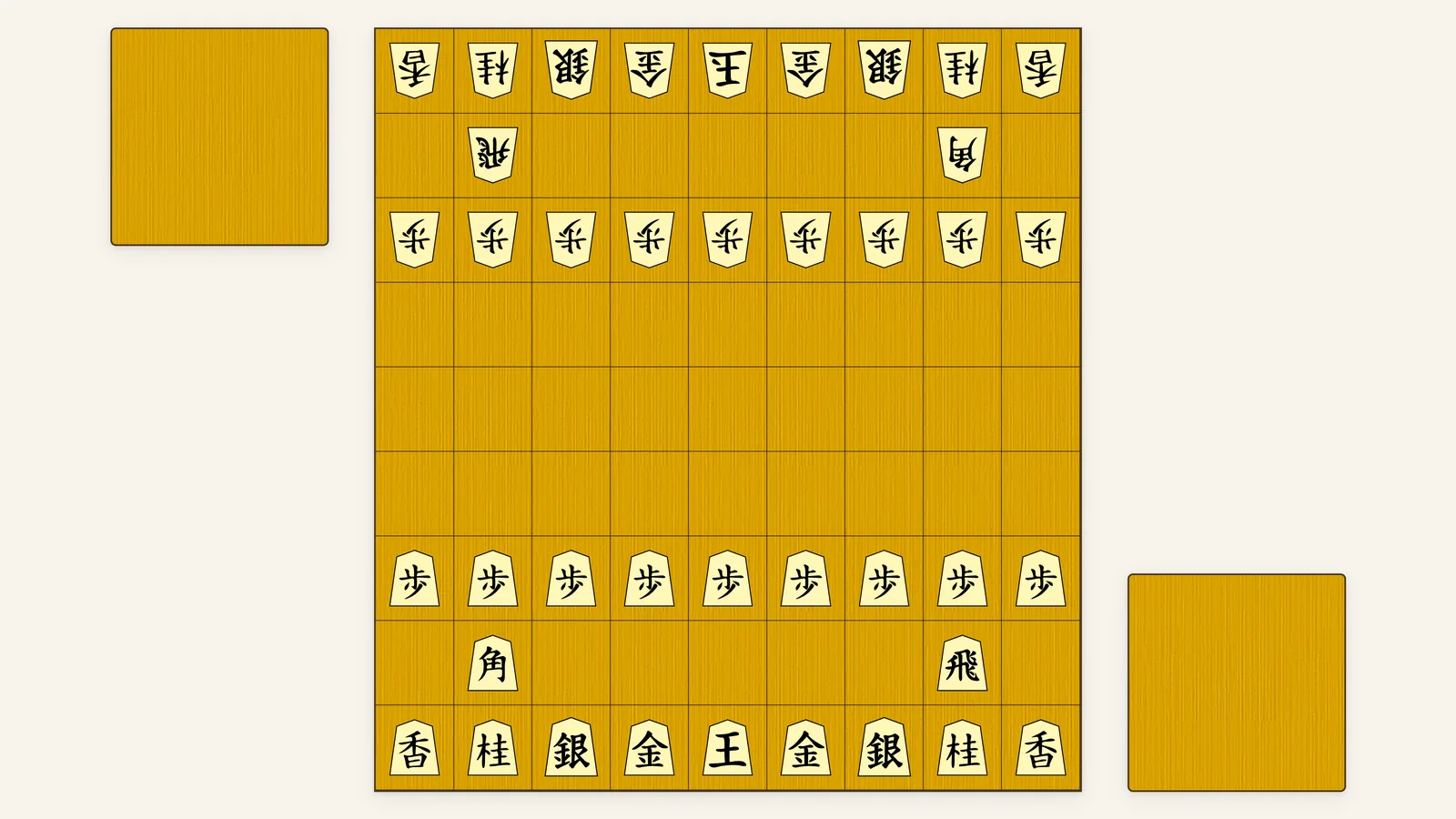
Here are all 40 pieces in their starting positions:
Types of shogi set compared
The price gap between sets comes mostly from the pieces, not the board. This table runs from cheapest to most expensive.
| Set type | Board | Pieces | Best for | Watch for |
|---|---|---|---|---|
| Magnetic travel set | Small folding magnetic board | Small plastic or magnetic tiles | Trains, planes, kids | Pieces are small and easy to lose |
| Paper or vinyl board with plastic pieces | Rolled or folded mat | Plastic, printed kanji | Cheapest way to own a set | Light pieces slide around |
| Folding board with wooden pieces | Folding cardboard or wood | Wood, stamped or printed kanji | Most beginners | Often no piece stands |
| Beginner or “international” set | Folding board | Wood, one kanji plus movement arrows | Learners who don’t read kanji | You’ll outgrow the arrows |
| Tabletop board with boxwood-style pieces | Solid slab, a few cm thick | Wood, carved or lacquered characters | Regular players and clubs | Match piece size to square size |
| Legged floor board with carved boxwood | Thick kaya block on four legs | Hand-carved Japanese boxwood | Collectors, serious players | Furniture prices |
Piece markings: kanji, one kanji, or arrows
This is the first real decision, and it matters more than wood.
- Two-kanji pieces are the traditional style. Each piece shows its full name, such as 銀将 for silver general. This is the standard style in Japan.
- One-kanji pieces show a single large character, such as 銀. They are easier to read across the board. Shogi.cz notes they are the style mostly used in shogi books.
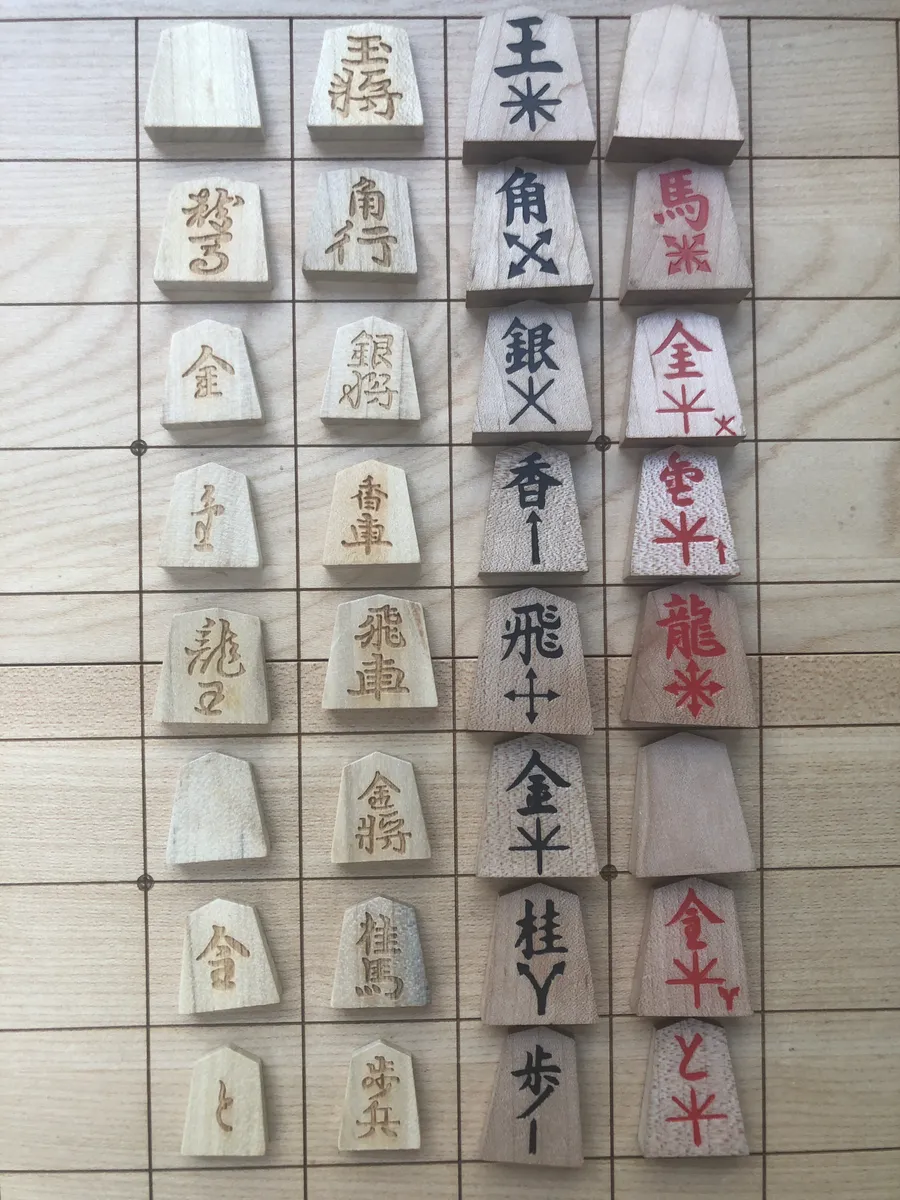
- Kanji plus arrows add small marks showing where each piece can move. Sets sold as an “English shogi set” or “international shogi set” use pieces like these, or replace the kanji with Western-style symbols. The rules are the same; only the faces differ.
- Red promoted sides are common on beginner pieces, so a promoted piece stands out at a glance.
Arrow pieces get you playing on day one, but they become a crutch. Most players learn the eight pieces within a few games. A good middle path is one-kanji pieces with a printed cheat sheet beside the board. If you’d rather practice before buying, the board on this site has a kanji set and an international set you can switch between, so you can learn the pieces for free.

How shogi pieces are made
Listings use Japanese names for how the characters get onto the piece. From cheapest to most expensive:
| Method | Japanese name | What it means |
|---|---|---|
| Plastic | Molded pieces with printed characters | |
| Stamped | Oshigoma | Characters stamped onto wood |
| Printed | Insatsu-goma | Characters printed onto wood |
| Hand-written | Kakigoma | Characters painted on with lacquer |
| Carved | Horigoma | Characters carved, then lacquered. Machine carving costs less than hand carving |
| Carved and filled | Horiumegoma | Carved grooves filled with lacquer until flush |
| Raised lacquer | Moriagegoma | Lacquer built up above the surface. The top grade |
Almost all of Japan’s shogi pieces come from one city, Tendo in Yamagata Prefecture. Four of the methods above (hand-written, carved, carved and filled, and raised lacquer) were designated National Traditional Crafts in 1996.
Piece woods
Better pieces are boxwood, called tsuge.
- Hon-tsuge (Japanese boxwood) is the top material. The two famous sources are Mikurajima in the Izu Islands and Satsuma in Kagoshima Prefecture. Satsuma wood is valued for being hard and durable.
- Imported boxwood from Southeast Asia, sold as Siamese tsuge or plain “tsuge”, is the mid-range choice.
- Other hardwoods such as ono-ore, maple, birch and camellia are used for cheaper wooden pieces.
On expensive pieces you’ll also see grain names. Straight grain (masame) is the most common. Figured grain, such as the “peacock” pattern (kujaku-moku), costs much more. None of it changes how the pieces play.
Piece size and board size
Pieces are graded by rank, so they come in six sizes in every set. One standard size runs like this:
| Piece | Height | Width | Thickness |
|---|---|---|---|
| King | 32 mm | 28.7 mm | 9.7 mm |
| Rook, bishop | 31 mm | 27.7 mm | 9.3 mm |
| Gold, silver | 30 mm | 26.7 mm | 8.8 mm |
| Knight | 29 mm | 25.5 mm | 8.3 mm |
| Lance | 28 mm | 23.5 mm | 8.0 mm |
| Pawn | 27 mm | 22.5 mm | 7.75 mm |
Other makers’ sizes differ by a few millimeters. The rule that matters: the king must sit inside a square without touching the lines. A traditional board’s playing surface is around 36 by 33 cm, which gives squares wide enough for pieces like these. Real products vary. The shogi.cz Classic board measures 33 x 29.5 cm and is 13 mm thick, and the folding cardboard board in their Red Box is 35 x 39 cm. Travel sets shrink everything.
If you buy pieces and a board separately, compare the listed square size with the king’s width before you order. The shogi board guide explains board woods, thicknesses and legged boards.
How to choose a shogi set
- Decide if you’re learning or upgrading. Learners need readable pieces and a flat board. Upgraders care about feel and sound.
- Pick the piece faces. Arrows if you want zero friction, one kanji if you want to learn the real symbols, two kanji if you already play.
- Check the contents list. Look for piece stands and a box or bag.
- Prefer wood to plastic. Wooden pieces are heavier and stay put. Plastic is fine for travel.
- Check sizes. The king should fit a square with a little room to spare.
- Spend on pieces before the board. Good pieces on a modest board feel better than cheap pieces on a fine board.
Where to buy shogi sets and pieces
These sellers had shogi sets or pieces listed when we checked on October 1, 2026. We have no affiliation with any of them. Prices are as listed that day and will change.
- Yellow Mountain Imports (US) listed three sets: wooden pieces with a paper board ($16.99), a magnetic travel set ($14.99), and a wooden table board with drawers and wooden pieces ($65.99).
- Shogi.cz (Czech Republic, ships in the EU) sells its Red Box set with one-kanji pieces and arrows (59.6 EUR). It also sells pieces on their own: Japanese wooden pieces in one-kanji or two-kanji styles (45.5 EUR) and plastic two-kanji pieces (26.9 EUR).
- Kuroki Goishiten and Hyuga Goboard & Stone (Japan, English-language shops) sell boxwood pieces, piece stands and kaya boards for buyers ready for a traditional set.
Searching for “shogi pieces for sale” also turns up secondhand sets on marketplaces. Count all 40 pieces in the photos before buying, since a missing piece usually means hunting down a matching replacement.
Practice before you buy
You don’t need a physical set to start. You can play shogi online here free with no account, against the computer at three strengths. A week of games tells you whether you want arrows or kanji on your pieces. For apps, see the best shogi apps. For study, the best shogi books list pairs well with a board on the table.
FAQ
What comes in a shogi set?
A full set has 40 pieces (20 per player), a 9x9 board, two piece stands for captured pieces, and a box or bag. Many budget sets include only the pieces and a folding board, so check the contents list for piece stands.
Is there a shogi set with English on the pieces?
Yes. Beginner sets often called English or international shogi sets add movement arrows or simple symbols to the kanji, and some print the promoted side in red. The rules are unchanged. Most players can switch to plain kanji pieces after a few games.
What is the best shogi set for a beginner?
A folding board with standard-size wooden pieces. Choose pieces with movement arrows or a single large kanji if you don’t read Japanese. You don’t need kaya or hand-carved boxwood to learn; those are upgrades for later.
How big are shogi pieces?
They come in graded sizes within one set. In one common standard size, the king is 32 mm tall and the pawn 27 mm, with the other pieces in between. Travel sets are smaller. The king should fit inside a board square without touching the lines.
What are the best shogi pieces made of?
Japanese boxwood, called hon-tsuge, from Mikurajima or Satsuma. The finest pieces have raised-lacquer characters (moriagegoma). Imported boxwood and other hardwoods are used for mid-range and budget wooden pieces.