Chu Shogi: Rules, Pieces, and the Lion Explained
Chu shogi (中将棋, “middle shogi”) is a historical form of shogi played on a 12x12 board. Each player has 46 pieces of 21 types, captured pieces never come back, and the star is the lion, a piece that can move twice in one turn. It is the most played of the large shogi variants, and you can play it free online on lishogi.
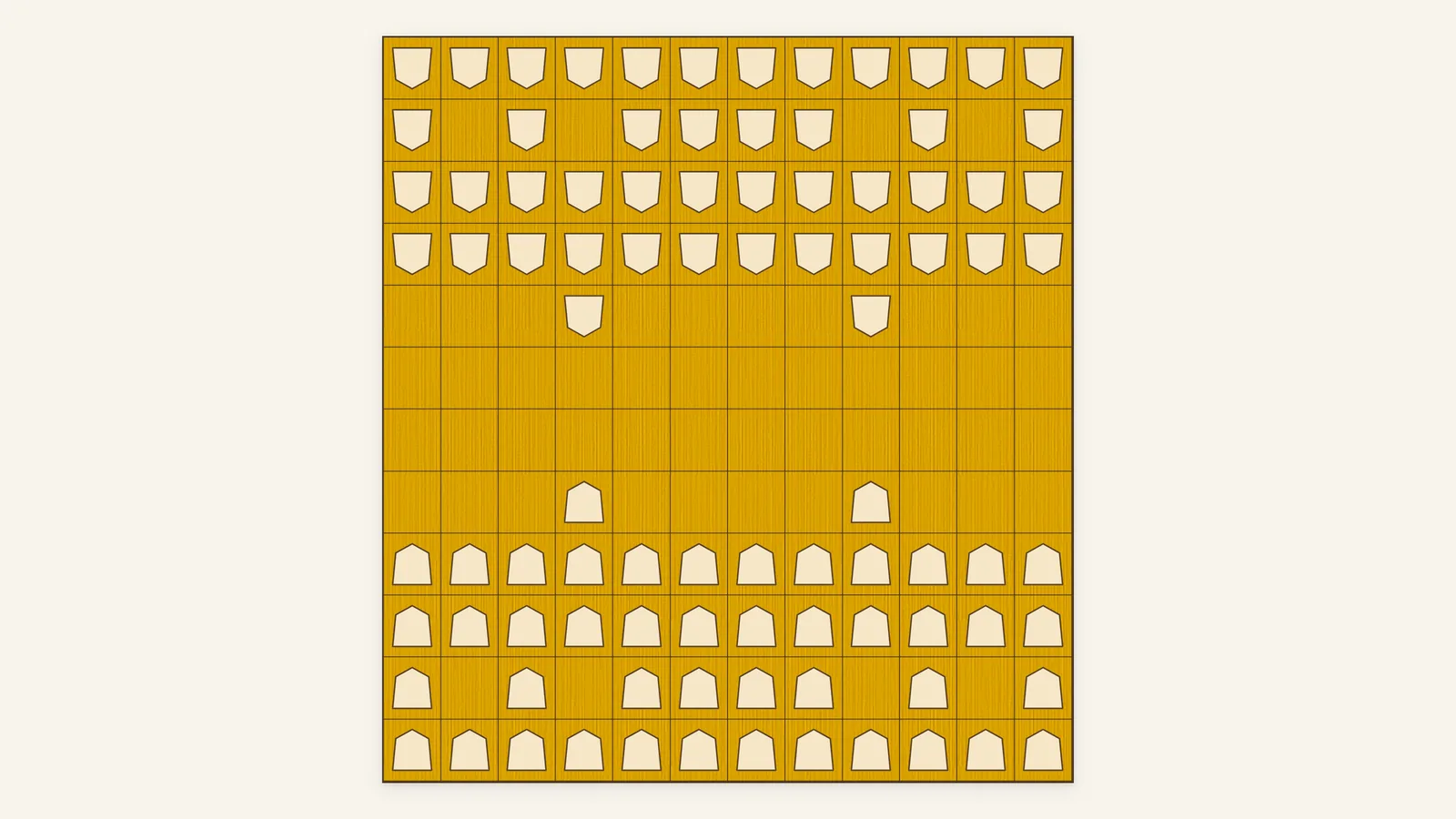
Chu shogi at a glance
| Chu shogi | Standard shogi | |
|---|---|---|
| Board | 12x12 (144 squares) | 9x9 (81 squares) |
| Pieces per player | 46 | 20 |
| Piece types | 21 | 8 |
| Drops | No, captured pieces stay captured | Yes |
| Promotion zone | Far 4 ranks | Far 3 ranks |
| How you win | Capture the king (and prince, if you have one) | Checkmate the king |
| Oldest records | Early 14th century | Drops added around the 16th century |
The name means “mid-sized shogi”. It comes from a time when shogi was played in three sizes, and chu was the middle one. It grew out of the larger dai shogi (15x15) by shrinking the board and dropping the weakest pieces.
How chu shogi differs from regular shogi
If you know standard shogi, four changes matter most:
- No drops. A captured piece leaves the game, as in chess. The board empties as the game goes on, the opposite of the drop rule in 9x9 shogi.
- Two royal pieces are possible. The drunk elephant promotes to a prince, which counts as a second king. You only lose when you have no king or prince left.
- You win by capture. The goal is to take the enemy king, not just to checkmate it. You may even move into check. In practice, a player who is mated resigns.
- Promotion works differently. A piece may promote when it enters the far four ranks from outside, or when it captures while already inside them. Promotion is optional, and a piece can only promote once.
The Japanese Chu Shogi Association also lets you win by capturing every enemy piece except the king, leaving a “bare king”, as long as your own king is not bared on the very next move.
The starting position
The setup is symmetrical. Here is the first player’s side, seen from that player’s seat, with file 12 on the left. The two go-betweens stand alone on the fifth rank in front of the pawns.
| Rank | 12 | 11 | 10 | 9 | 8 | 7 | 6 | 5 | 4 | 3 | 2 | 1 |
|---|---|---|---|---|---|---|---|---|---|---|---|---|
| 5th | Go-between | Go-between | ||||||||||
| 4th | Pawn | Pawn | Pawn | Pawn | Pawn | Pawn | Pawn | Pawn | Pawn | Pawn | Pawn | Pawn |
| 3rd | Side mover | Vertical mover | Rook | Dragon horse | Dragon king | Lion | Queen | Dragon king | Dragon horse | Rook | Vertical mover | Side mover |
| 2nd | Reverse chariot | Bishop | Blind tiger | Kirin | Phoenix | Blind tiger | Bishop | Reverse chariot | ||||
| 1st | Lance | Leopard | Copper | Silver | Gold | King | Drunk elephant | Gold | Silver | Copper | Leopard | Lance |
The 21 pieces and how they move
Many pieces you already know from shogi. The rest step or slide in new combinations. “Step” means one square. “Slide” means any number of empty squares in a line.
| Piece | Kanji | Count | How it moves | Promotes to |
|---|---|---|---|---|
| King | 玉将 / 王将 | 1 | Steps one square in any direction | Does not promote |
| Queen (free king) | 奔王 | 1 | Slides any distance in any direction | Does not promote |
| Lion | 獅子 | 1 | Two king steps in one turn (see below) | Does not promote |
| Dragon king | 龍王 | 2 | Slides like a rook, plus one diagonal step | Soaring eagle |
| Dragon horse | 龍馬 | 2 | Slides like a bishop, plus one orthogonal step | Horned falcon |
| Rook | 飛車 | 2 | Slides along ranks and files | Dragon king |
| Bishop | 角行 | 2 | Slides diagonally | Dragon horse |
| Kirin | 麒麟 | 1 | One diagonal step, or jumps two squares straight in any orthogonal direction | Lion |
| Phoenix | 鳳凰 | 1 | One orthogonal step, or jumps two squares diagonally | Queen |
| Drunk elephant | 酔象 | 1 | One step any way except straight back | Prince |
| Blind tiger | 盲虎 | 2 | One step any way except straight forward | Flying stag |
| Ferocious leopard | 猛豹 | 2 | One step diagonally, or straight forward or back | Bishop |
| Gold general | 金将 | 2 | As in shogi: one step any way except diagonally back | Rook |
| Silver general | 銀将 | 2 | As in shogi: one step diagonally or straight forward | Vertical mover |
| Copper general | 銅将 | 2 | One step forward (straight or diagonal) or straight back | Side mover |
| Vertical mover | 竪行 | 2 | Slides forward or back, one step sideways | Flying ox |
| Side mover | 横行 | 2 | Slides sideways, one step forward or back | Free boar |
| Reverse chariot | 反車 | 2 | Slides straight forward or straight back | Whale |
| Lance | 香車 | 2 | Slides straight forward | White horse |
| Go-between | 仲人 | 2 | One step straight forward or straight back | Drunk elephant |
| Pawn | 歩兵 | 12 | One step straight forward | Gold general |
A few promotions trade away a power: a promoted gold becomes a rook and can no longer step diagonally forward, for example. That is why players sometimes decline promotion.
The lion’s double move
The lion is what makes chu shogi famous. On each turn it may take up to two king steps, and it can change direction between them. That gives it three ways to use its turn:
- Double capture. Step onto an enemy piece, take it, then step again and take a second piece.
- Capture without moving (igui). Step onto an adjacent enemy piece, take it, and step back to the starting square. The lion eats a neighbour and stays put.
- Pass (jitto). Step to an empty neighbouring square and back. Nothing changes on the board, so the lion effectively skips a turn, which can break a deadlock.
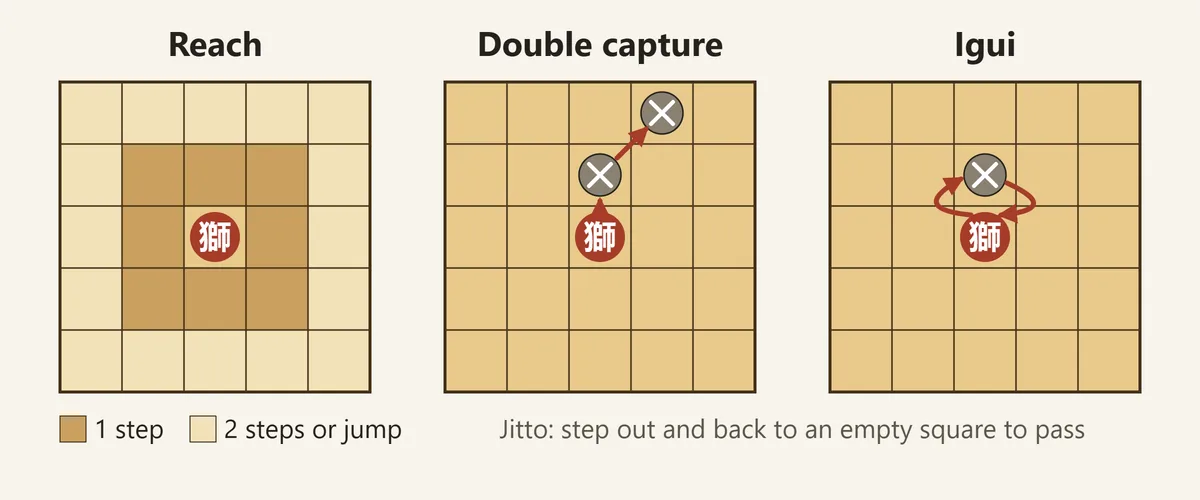
The lion can also jump straight to any square two steps away, passing over whatever is in between. That includes every square a chess knight can reach.
The kirin promotes to a second lion. The dragon king and dragon horse promote to the soaring eagle and horned falcon, which have a limited lion move in one or two forward directions.
The lion-trading rules
Because the lion is so strong, chu shogi has special rules to stop players from simply swapping lions off the board:
- A lion may not take a non-adjacent lion that is protected, unless it also captures a piece other than a pawn or go-between in the same move.
- After a lion is taken by a non-lion piece, the opponent may not answer by taking a lion on a different square with a non-lion piece on the very next move. The Japanese association adds an exception, called the Okazaki rule, when the lion being taken is unprotected.
Why chu shogi is the most played large variant
Chu shogi is the one large variant that never fully died out. It was still commonly played in Japan between 1928 and 1939, especially around Osaka, Kobe and Kyoto, and declined after World War II.
Four things have kept it alive:
- It cut the dead weight. Chu dropped dai shogi’s weakest pieces, and players have long found the smaller game more exciting.
- Its rules are well recorded. Most large variants survive only in terse, contradictory texts. Chu was prestigious enough that its rules were written down in detail.
- Professional support. Ōyama Yasuharu, one of the strongest shogi players in history, played chu shogi when young. He credited it with building his cautious, tenacious style and later spoke up for the game.
- An organised community. The Japanese Chu Shogi Association (Chushogi Renmei) still sets the modern rules, and there is a German Chu Shogi Association with games to replay online.
It has admirers in the West too. Chess variant historian David Pritchard called it “the best of all large chess games”. The standard English reference is George Hodges’ Middle Shogi Manual.
Where to play chu shogi online
As of October 2026:
| Where | What you get |
|---|---|
| Lishogi | Free chu shogi against people, live or by correspondence, plus studies and a position editor |
| HaChu (WinBoard shogi variants package) | Free desktop software by H. G. Muller with a computer opponent for chu shogi |
| 81Dojo | Offered live chu shogi with an English interface in the past. Wikipedia’s chu shogi article lists that server as not currently working |
We don’t offer chu shogi on this site yet. If you want a variant you can play here right now, try Animal Shogi or minishogi, or play standard shogi on the main board.
Ko shogi: shogi on a go board
Ko shogi (広将棋, “broad shogi”) is another large variant, and an unusual one. It borrows from three games at once: shogi, Chinese chess and go.
| Ko shogi | |
|---|---|
| Board | 19x19 go board, played on the 361 intersections |
| Pieces per player | 90 |
| Piece types | 34 |
| Pieces | Round and flat, like go stones |
| Drops | No |
| Credited to | Confucian scholar Ogyū Sorai (1666-1728) |
| Dated to | Around the turn of the 18th century |
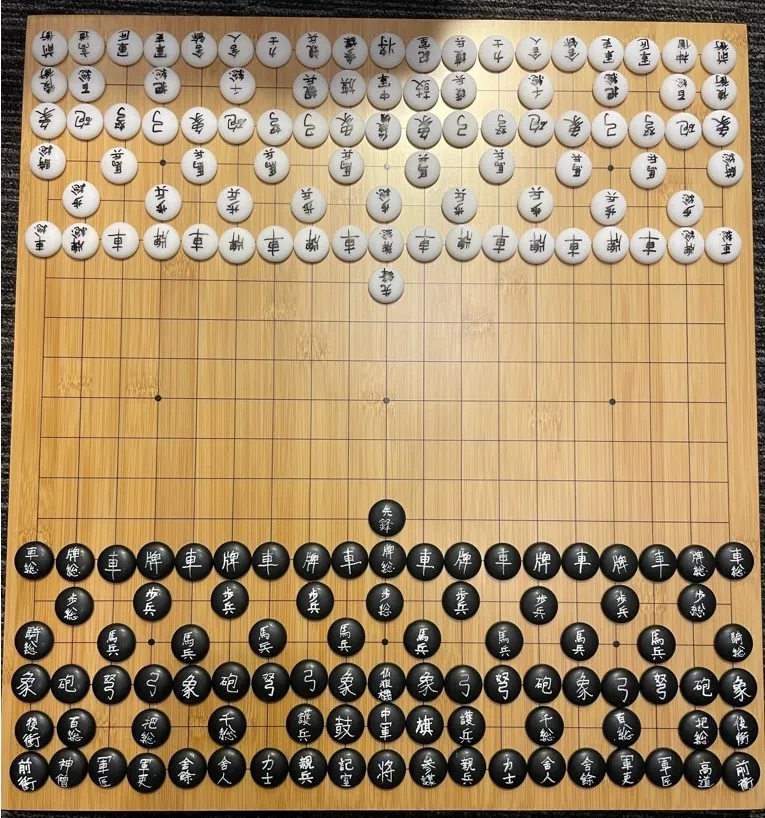

Its pieces have military names such as general, clerk, engineer and sumo wrestler, and it includes cannons that fire over other pieces, an idea taken from Chinese chess. To win, you capture the enemy general along with certain other command pieces. Sorai described the rules in his own book on the game. Promotion is complicated, and the fates of several pieces depend on each other. For the biggest games in the family, see taikyoku and tai shogi.
FAQ
What is chu shogi?
Chu shogi is a historical Japanese chess variant on a 12x12 board. Each player has 46 pieces of 21 types, including the powerful lion. It dates to at least the early 14th century and is the most played of the large shogi variants today.
Does chu shogi have drops?
No. Captured pieces are removed from the game for good, as in chess. Drops are a feature of standard 9x9 shogi, not of chu shogi or the other large historical variants.
How does the lion move in chu shogi?
The lion can make two king steps in one turn. It can capture two pieces in one move, capture a neighbour and return to its own square, or step out and back to pass. It can also jump to any square two steps away.
Where can I play chu shogi online?
Lishogi offers free chu shogi against other players, live or by correspondence, as of October 2026. For a computer opponent, the free HaChu engine runs in H. G. Muller’s WinBoard shogi variants package.
What is ko shogi?
Ko shogi is a large shogi variant played on the intersections of a 19x19 go board. Each player has 90 round pieces of 34 types, including cannons borrowed from Chinese chess. It is credited to the scholar Ogyū Sorai, who lived from 1666 to 1728.