Crazyhouse vs Shogi: Chess With Drops Compared
Crazyhouse is a chess variant that borrows shogi’s best-known rule: when you capture a piece, it changes colour and goes into your reserve, and you can later drop it onto an empty square as your own. The board, pieces and moves are otherwise normal chess. Shogi has had drops since around the 15th century; crazyhouse took off with online chess servers in the 1990s.
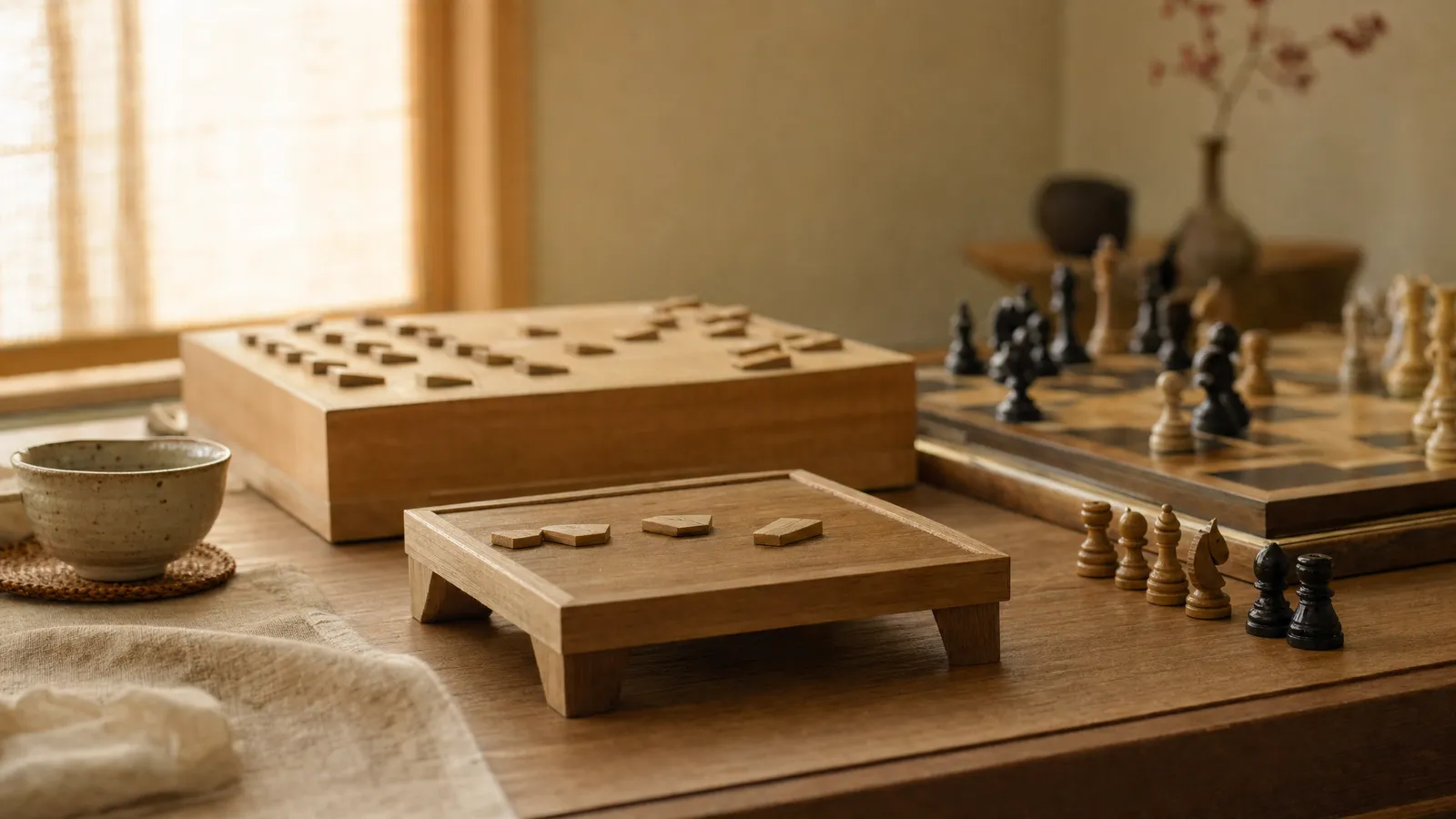
The verdict first
If you play chess and want to feel what drops do to a game, crazyhouse is the quickest way in, since you already know every piece. If you enjoy it, shogi is the full version of the idea: a game designed around drops for centuries, with tighter drop rules, slower short-range pieces, and a deep theory of king defense. Crazyhouse games tend to be wilder, and shogi’s extra drop limits make it more balanced.
What crazyhouse is
Crazyhouse uses a standard chessboard and the standard chess setup. All chess rules apply, with one addition:
- When you capture a piece, it flips to your colour and goes into your pocket (also called the reserve or hand).
- On any turn, instead of moving a piece, you may drop one piece from your pocket onto any empty square.
- Pawns may not be dropped on the 1st or 8th rank.
- A promoted pawn that gets captured goes into the captor’s pocket as a pawn, not as a queen.
A pawn dropped on its own 2nd rank may still make the two-square first move. Drops can give check and can give checkmate, and a drop can also block a check. You can play crazyhouse on Lichess and Chess.com.
Wikipedia notes the variant may trace back to Mad Mate, a game designed by Alex Randolph in 1972, but it only became widely known once internet chess servers appeared in the 1990s.
Drop rules compared
Both games share the core drop idea. Shogi adds more restrictions.
| Rule | Shogi | Crazyhouse |
|---|---|---|
| Captured pieces change sides | Yes | Yes |
| A drop uses your whole turn | Yes | Yes |
| Promoted pieces revert when captured | Yes, every promoted piece returns to its basic form | Yes, a promoted pawn returns as a pawn |
| Pawn drop on the last rank | Not allowed (also no lance on the last rank, no knight on the last two) | Not allowed on the 1st or 8th rank |
| Two of your pawns on one file (nifu) | Not allowed | Allowed |
| Checkmate by dropping a pawn (uchifuzume) | Not allowed | Allowed |
| Checkmate by dropping any other piece | Allowed | Allowed |
| Dropping to block check | Allowed | Allowed |
| Dropped piece’s state | Always unpromoted, even inside the promotion zone | Pawns can’t reach the promotion rank by drop |
Nifu (二歩, “two pawns”) and uchifuzume (打ち歩詰め, “pawn-drop mate”) are the two shogi rules that catch new players most often. The shogi drop rule page covers both, with a live board.
Why drops change strategy
The same rule plays out very differently on the two boards.
Crazyhouse pieces are long-range. A queen, rook or bishop dropped next to an open king can end the game at once. That puts kings in crazyhouse under pressure from very early in the game.
Shogi pieces are mostly short-range. Generals, knights and lances step or jump short distances, so a single dropped piece rarely mates on its own. Attacks are built from several drops working together, and defense means building a castle of golds and silvers that leaves no safe square to drop on.
Material counts differently in both. In normal chess, winning a piece is often decisive. With drops, every piece you take gives you a new attacker, and every piece you lose arms your opponent. Players in both games learn to ask “what can they drop after this trade?” before capturing.
Draws become rare. Since captured pieces return, the board never empties out. Professional shogi has a draw rate of only about 2 to 3 percent, against over half of top-level games in chess. The shogi vs chess page explains why.
Bughouse: drops for four players
Bughouse is the team version of the idea. Four players form two teams of two and play on two boards at once. Partners sit side by side, one playing White and one playing Black. When you capture a piece, you pass it to your partner, who can drop it on their board. As in crazyhouse, pawns can’t be dropped on the first or last rank.
The whole match ends as soon as either game ends, by checkmate, resignation or time, so both boards are played on chess clocks. The four-player form appeared in the 1970s, and it is still a club favourite in Europe and North America.
From crazyhouse to shogi
If you like crazyhouse, shogi will feel familiar within a game or two. Expect four adjustments:
- The board is 9x9 and pieces point toward the enemy instead of using two colours.
- There is no queen. The strongest pieces are the rook and bishop, and both get stronger when they promote.
- Pawns capture straight ahead, not diagonally.
- Pawn drops follow nifu and uchifuzume.
The how to play shogi lesson covers the rest, and you can play a full game against the computer on the board, free and in your browser.
FAQ
What is crazyhouse chess?
Crazyhouse is a chess variant with drops. Captured pieces change colour and go into the capturing player’s pocket. On a later turn, that player can place one on any empty square instead of moving. Pawns can’t be dropped on the 1st or 8th rank, and a captured promoted pawn returns as a pawn.
Is crazyhouse based on shogi?
Shogi is the earliest known chess-like game with drops, and crazyhouse uses the same idea on a chessboard. Wikipedia traces crazyhouse to a 1972 game called Mad Mate by Alex Randolph. It became popular on internet chess servers in the 1990s.
What is the difference between crazyhouse and shogi drop rules?
Shogi forbids two of your unpromoted pawns on the same file (nifu) and forbids checkmating by dropping a pawn (uchifuzume). Crazyhouse allows both. Both games forbid dropping a pawn on the last rank, and crazyhouse also forbids pawns on your own first rank.
Can you checkmate with a drop in crazyhouse?
Yes. Any piece can be dropped to give check or checkmate in crazyhouse, including a pawn. In shogi you can mate with a dropped piece too, as long as it isn’t a pawn.
What is the difference between crazyhouse and bughouse?
Crazyhouse is a two-player game where you drop pieces you captured yourself. Bughouse is played by two teams of two on two boards, and captured pieces go to your partner, who drops them on their board.