How to Play Shogi (Japanese Chess) in 7 Steps
To play shogi, the game often called Japanese chess: set up a 9x9 board with 20 pieces per side, take turns moving one piece at a time, and aim to checkmate the enemy king. Captured pieces join your hand and can be dropped back into play. Pieces reaching the far three ranks may promote. This guide teaches each step with a live board.
Before you start: what makes shogi worth learning
One honest sentence of sales pitch: shogi is the chess-family game where being behind never means being dead, because every piece you capture becomes ammunition you can fire back onto the board. If you’ve never heard of the game at all, what is shogi gives the background, and is shogi easy to learn sets honest expectations for your first week. Ready to learn? Work through the seven steps below in order. Each one has a board you can touch. You can’t break anything, and the beginner coaching on our free board will explain any illegal move rather than just refusing it.
Step 1: Know the board
The board is a 9x9 grid, 81 squares, all the same color. No checkering, because no piece in shogi cares about square color.
You sit on one side; your pieces point away from you. The three ranks nearest your opponent are their camp, and they matter twice over: that’s where their pieces start, and later it becomes your promotion zone. Hold that thought for step 5.
What goes wrong: nothing yet. Enjoy it.
Step 2: Set up the pieces
Each player places 20 pieces in three rows. Back rank from the corners inward: lance, knight, silver, gold, then the king in the center. Second rank: bishop on the left, rook on the right. Third rank: all nine pawns.
Both armies are identical and mirror each other. Notice there’s no queen anywhere, and notice you have nine pawns, not eight. If you want the full detail, including how players decide who moves first by tossing pawns, the board setup page covers it. For now: the player moving first is called sente, the other gote.
What goes wrong: swapping the bishop and rook. From your own seat, the bishop sits on your left, the rook on your right. Both players’ setups rotate 180 degrees, so the rooks are diagonal from each other across the board.
Step 3: Learn the moves
Here’s the encouraging part: five of the eight piece types move exactly one square at a time. The movement rules overall are simpler than chess. Learn them in this order:
- King: one square, any direction. Same as chess.
- Rook: slides along ranks and files, any distance. Same as chess, and it’s your strongest piece.
- Bishop: slides diagonally, any distance. Same as chess.
- Pawn: one square straight forward, and it captures straight forward too. Not like chess. No diagonal capture, no double first move.
- Gold general: one square in any direction except the two diagonally-backward ones.
- Silver general: one square forward, or one square along any diagonal. Golds and silvers are shogi’s signature foot soldiers; the gold is the better defender, the silver the better attacker.
- Knight: jumps two ranks forward and one file sideways. Only the two forward L-squares, never sideways or back, but it does jump over pieces, the only piece that can.
- Lance: slides straight forward any distance. Never backward, never sideways.
Capturing is chess-style: land on an enemy piece, take its square, remove it from the board. Each piece’s page (king, rook, bishop, gold, silver, knight, lance, pawn) has diagrams, tactics, and a mnemonic if you want to go deep on any of them.
What goes wrong: mixing up gold and silver. Both step one square, and their kanji look vaguely similar at first. The quick tell: the gold can step straight back, the silver can’t; the silver can step diagonally back, the gold can’t. Give it three games and you’ll never confuse them again.
Step 4: Captures ARE drops
This is the step that makes shogi shogi, so slow down here.
When you capture a piece, it doesn’t leave the game. It goes into your hand, sitting beside the board in plain view. On any later turn, instead of moving a piece, you may drop one from your hand: place it on almost any empty square, pointing at your opponent. It’s now fully yours.
Think about what this means. That silver you just won isn’t a point on a scoreboard; it’s a paratrooper waiting for orders. The best square for it might be deep inside your opponent’s camp, one square from their king, on a square no piece could ever have reached by moving.
Three restrictions, learnable in one sitting:
- You can’t drop a piece where it could never move again (pawns and lances on the last rank, knights on the last two).
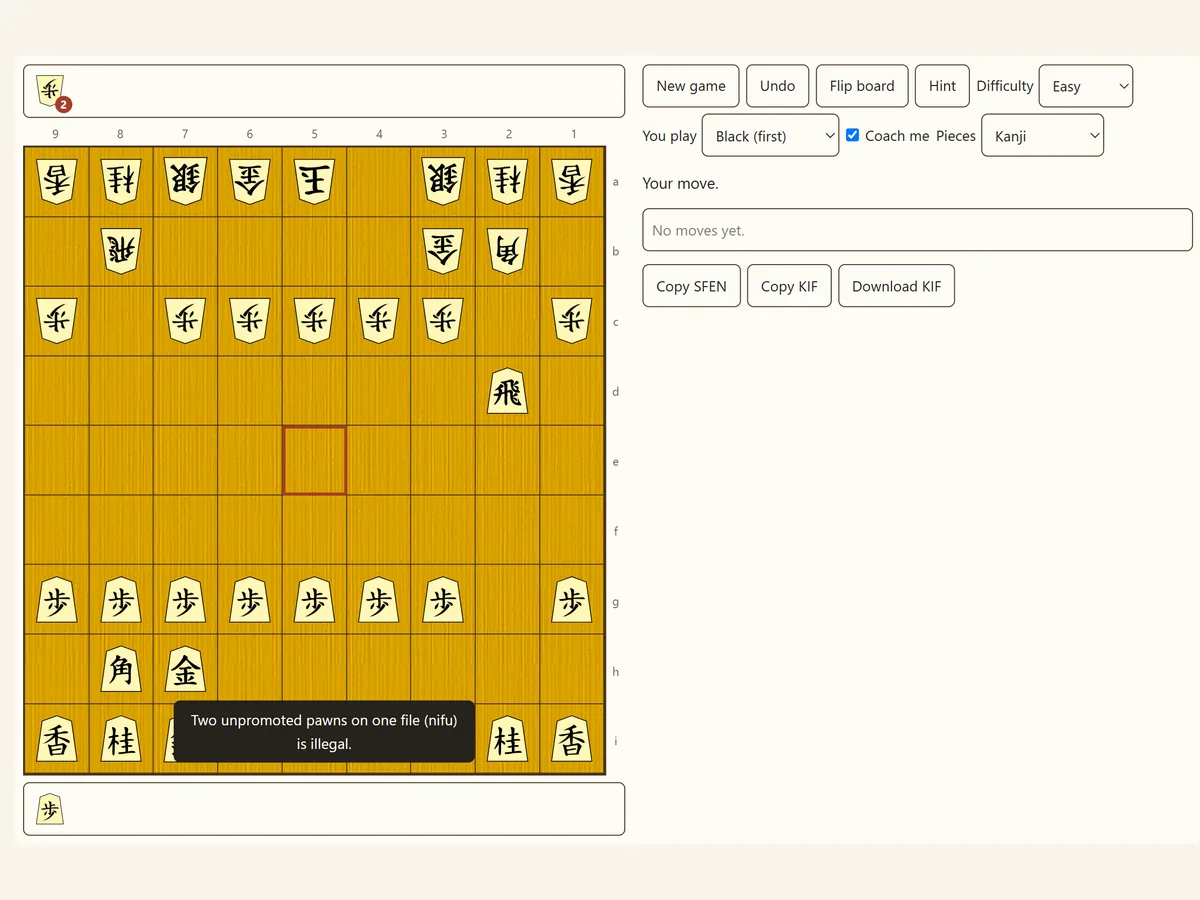
- You can’t drop a pawn onto a file where you already have an unpromoted pawn. This one’s called nifu, and it will catch you at least once. It catches professionals.
- You can’t drop a pawn to deliver instant checkmate. Pawn-drop checks are fine; only the immediate mate is banned.
Try the demo above until dropping feels natural, then read the drop rule page when you’re ready for drop tactics.
What goes wrong: hoarding. Beginners treat pieces in hand like savings and never spend them. Pieces in hand do nothing until dropped. A silver in hand at checkmate time was a wasted silver.
Step 5: Promotion
Remember your opponent’s camp, the far three ranks? That’s your promotion zone. Whenever a piece’s move starts, ends, or passes through the zone, you may flip it over to its promoted side as part of the move.
The upgrades are worth wanting:
| Piece | Promotes to | New movement |
|---|---|---|
| Rook | Dragon king | Rook slides plus one step diagonally |
| Bishop | Dragon horse | Bishop slides plus one step orthogonally |
| Silver, knight, lance | Promoted silver, knight, lance | Moves like a gold general |
| Pawn | Tokin | Moves like a gold general |
| King, gold | Never promote |
The dragon king and dragon horse are the two strongest pieces in the game. The pawn’s promotion is the famous one: a promoted pawn, the tokin, moves like a gold, but if your opponent captures it they only get a pawn in hand. Cheap to make, painful to fight.
Promotion is optional except where a piece would be left with no legal moves (pawns and lances on the last rank, knights on the last two must promote). The cases where declining is smart are genuinely interesting, and the promotion page walks through them.
What goes wrong: forgetting the zone is three ranks deep. You don’t need to reach the last rank like a chess pawn; touching rank seven (from your side) is enough.
Step 6: Check, checkmate, and how games actually end
Attack the enemy king and it’s check; they must escape, block, capture the attacker, or drop a piece in the way. If nothing works, checkmate: you win. You can never move into check yourself.
The endgame culture shock for chess players: shogi endings are races, not grinds. Because both players accumulate pieces in hand as the game sharpens, both kings come under fire, and the winner is whoever mates first. Being up a rook means little if your king falls a move early. Speed beats greed.
Draws? Nearly extinct: repetition and impasse rules exist and the rules reference explains them, but you’ll play a long time before you see either.
Step 7: Your first strategy
You could just start playing (honestly, do), but three principles will carry you through your first fifty games:
- Castle your king. There’s no castling move; you build a castle by hand over several turns, walking the king to a side and surrounding it with golds and silvers. Games between beginners are usually decided by whichever king was left in the open. Start with the Mino castle, three moves of king-walking plus your generals; the castles guide shows it.
- Decide what your rook is doing. Your rook placement defines your whole plan. Keeping it home and attacking on that side is Static Rook; swinging it toward the center or left is Ranging Rook. Pick one per game. The openings guide explains both.
- Count pieces in hand before you trade. Every capture arms your opponent too. Before starting a sequence of trades, ask what they’ll do with the pieces they get back. This one habit separates people who’ve read about drops from people who’ve absorbed them.
And a bonus habit that improves you faster than anything else at this stage: solve tsume shogi, which are checkmate puzzles. Ten minutes of one-move mates a day teaches king-hunting patterns that take years to absorb from games alone.
Play your first game now
You now know enough to play a legal, sensible game of shogi. The board on our homepage is free, runs in your browser, and has an easy computer level made for exactly this moment. Turn on coaching mode, pick Easy, and castle your king before you attack. Everything else is experience.
FAQ
How do you play Japanese chess (shogi) step by step?
Set up 20 pieces per side on a 9x9 board, with pawns on the third rank. Players alternate moves, capturing chess-style. Captured pieces join your hand and can be dropped onto empty squares on later turns. Pieces reaching the far three ranks may promote. Checkmate the enemy king to win.
Is shogi easy to learn for beginners?
Yes. Most piece movements are one-square steps, simpler than chess movement overall, and a motivated beginner can play a legal game within an hour. The drop rule adds depth gradually rather than blocking entry. Kanji piece labels take a few games to learn, or you can start with symbol-based international pieces.
How long does it take to learn shogi?
Learning the rules takes about an hour. Playing comfortably, castling your king and using drops with purpose, typically takes 10 to 20 casual games. Chess players often adapt within a handful of games, though drop-driven endgames take longer to master. Daily tsume puzzles speed the process up considerably.
Should I learn chess or shogi first?
Learn whichever you’ll actually play; neither is a prerequisite. Chess has more English-language resources and local clubs. Shogi has more forgiving comebacks for beginners, since captured pieces return to play and material deficits are recoverable. Skills transfer in both directions: board vision, tactics, and king safety carry over.
What is the best first opening for shogi beginners?
Most teachers recommend a Static Rook setup with a simple castle, or a Ranging Rook setup with the Mino castle. The Mino castle takes only a few moves, protects the king well, and teaches sound habits. Consistent castling matters far more at beginner level than which specific opening you choose.