Shogi Variants: Animal Shogi, Minishogi, and Beyond
Shogi variants are alternative versions of Japanese chess played on boards from 3x4 up to 36x36. The most played today are Animal Shogi (a children’s game on 12 squares) and Minishogi (full shogi rules on a 5x5 board). Among the historical giants, Chu Shogi still has an active community, while Taikyoku Shogi survives mostly as a curiosity.
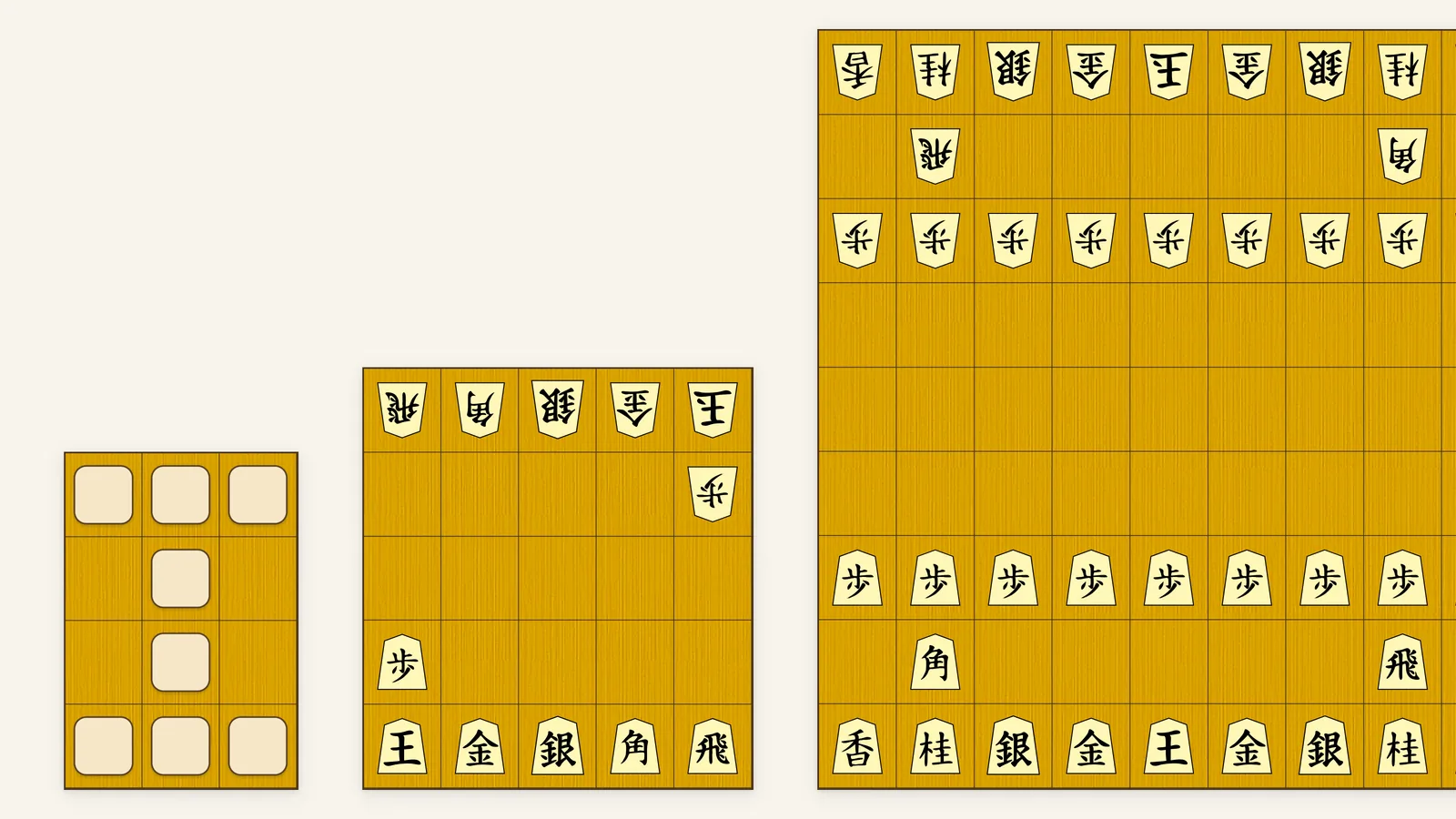
A family with unusual range
Most classic games have variants; shogi has a dynasty. Japan spent centuries experimenting with the game at every scale, from a 12-square teaching toy to a board so large that the only fully documented modern game took three days. Some variants predate modern shogi itself; standard 9x9 shogi is, historically speaking, the mid-sized member of the family that happened to win. The history of shogi explains how it won out.
Two variants are worth actually playing today, and you can play both of them here. The rest are worth knowing about, partly as history, partly because “the biggest chess game ever devised” is a fact people deserve to have at parties.
Shogi variants compared
| Variant | Board | Pieces per player | Drops | Playable here |
|---|---|---|---|---|
| Animal Shogi (dobutsu shogi) | 3x4 | 4 | Yes | Yes |
| Micro shogi | 4x5 | 5 | Yes | No |
| Minishogi | 5x5 | 6 | Yes | Yes |
| Kyoto shogi | 5x5 | 5 | Yes | No |
| Goro goro shogi | 5x6 | 8 | Yes | No |
| Whale shogi | 6x6 | 12 | Yes | No |
| Tori shogi | 7x7 | 16 | Yes | No |
| Heian shogi | 8x8 or 9x8 | 16 or 18 | Not recorded | No |
| Standard shogi | 9x9 | 20 | Yes | Yes |
| Wa shogi | 11x11 | 27 | Modern players use them | No |
| Chu shogi | 12x12 | 46 | No | No |
| Dai shogi | 15x15 | 65 | No | No |
| Tenjiku shogi | 16x16 | 78 | No | No |
| Dai dai shogi | 17x17 | 96 | No | No |
| Maka dai dai shogi | 19x19 | 96 | No | No |
| Ko shogi | 19x19 go board | 90 | No | No |
| Tai shogi | 25x25 | 177 | No | No |
| Taikyoku shogi | 36x36 | 402 | No | No |
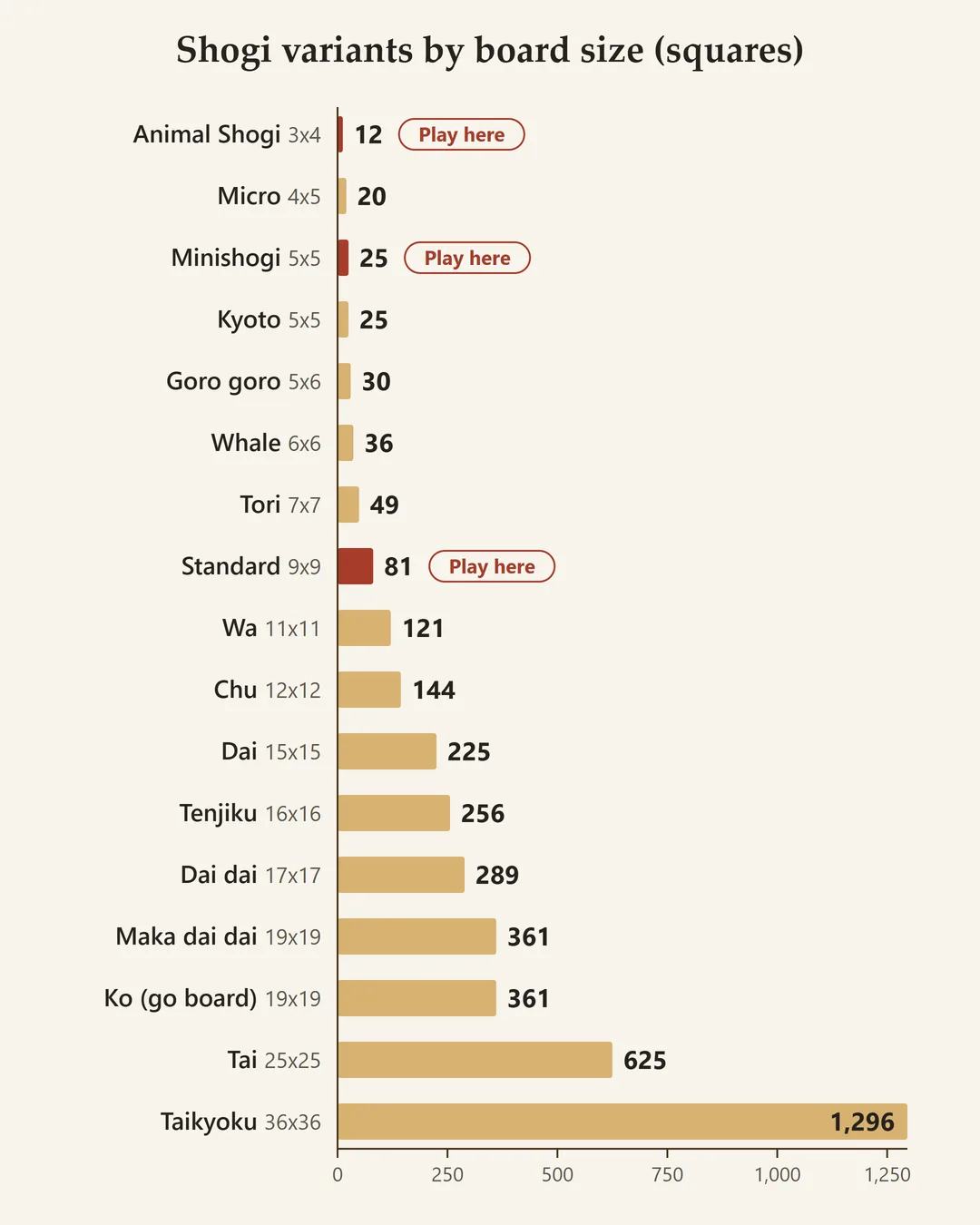
Drops belong to the small games and to standard shogi. Wa shogi, at 11x11, is the largest well-known variant played with drops.
Animal Shogi: shogi for five-year-olds (and their parents)
Animal Shogi (dobutsu shogi, sold in English as “Let’s Catch the Lion!”) was designed by professional shogi player Madoka Kitao to bring children into the game. The board is 3x4; each side has four pieces, drawn as friendly animals: a lion (the king), a giraffe, an elephant, and a chick that promotes to a hen. Movement dots on each piece show exactly where it can go, so pre-readers can play. Captures go to your hand and drop back in, so the soul of shogi, the drop rule, is fully present in miniature.
Don’t let the artwork fool you: the game has real tactical content (it’s been fully analyzed by computers, and adults lose to well-prepared children constantly). As a gateway to real shogi, or a first strategy game for a small child, it’s close to perfect. Play Animal Shogi here.
Minishogi: the full game, quartered
Minishogi is standard shogi compressed onto a 5x5 board, invented around 1970 by Shigenobu Kusumoto. Each player has six pieces: king, gold, silver, bishop, and rook across the back rank, plus a single pawn. All the real rules apply: drops, promotion (the zone is just the last rank), the same piece movements you know from the pieces guide.
What it’s for: intensity. With no development phase and nowhere to hide, minishogi games are all middlegame and endgame, tactical from move one, done in minutes. It’s an excellent training tool for drop tactics and mating technique, an honest quick game when you don’t have thirty minutes, and a surprisingly deep pond for its size. Play Minishogi here.
Other small variants
The small variants are mostly modern, and nearly all keep drops.
Micro shogi
Micro shogi is played on a 4x5 board with five pieces each: king, bishop, gold, silver and pawn. There is no promotion zone. Instead, a piece flips over every time it captures, so a gold becomes a rook, the pawn a knight, and they flip back on the next capture. It dates from before the mid-1980s, and it is sometimes credited to the great professional Ōyama Yasuharu, though that has never been confirmed.
Kyoto shogi
Kyoto shogi was invented by Tamiya Katsuya around 1976. It uses a 5x5 board and five pieces each, and every piece except the king flips to its other side each time it moves, so a silver becomes a bishop and then a silver again. The lance/tokin piece is a pun on the city of Kyoto and gives the game its name. A 2021 Japanese study weakly solved it as a win for the first player, and lishogi offers it online.
Goro goro shogi
Goro goro shogi is a 5x6 variant with eight pieces each: a king, two golds, two silvers and three pawns. There are no rooks, bishops or other long-range pieces, and the promotion zone is the two far ranks. It uses drops with the normal shogi restrictions. With three pawns instead of one, it teaches pawn play better than most tiny variants.
Whale shogi
Whale shogi was invented in 1981 by R. Wayne Schmittberger of the United States, so it is not Japanese at all. It is played on a 6x6 board with twelve pieces each, all named after whales, and you win by capturing the opponent’s white whale. Captured pieces drop back in, and the pieces carry Latin letters instead of kanji.
Tori shogi
Tori shogi (“bird shogi”) is played on a 7x7 board with sixteen pieces each, all named after birds, and you win by capturing the opponent’s phoenix. It was invented in 1799 by Toyota Genryu, though it is traditionally credited to his teacher Ōhashi Sōei, and first published in 1828. It is the only traditional variant besides wa shogi that may use drops, and it is one of the more popular variants, with tournaments held in England in the 1990s and early 2000s.
Historical variants
Heian shogi
Heian shogi is the oldest form of shogi described in writing. The description dates from the early 12th century and survives in an encyclopedia called the Nichūreki. The pieces moved as in modern shogi, but there was no rook or bishop, and the board was probably 8x8 or 9x8. The surviving description is too short to play from, so modern versions are reconstructions.
Wa shogi
Wa shogi is an 11x11 game in which every piece is named after an animal, and you win by capturing the crane king. Each side has 27 pieces. The historical sources disagree on how many pieces move, and modern players have settled on a common set of moves and play with drops.
Tenjiku shogi
Tenjiku shogi is a 16x16 game from the 15th or 16th century, an enlarged chu shogi with 78 pieces per side of 36 types. It adds pieces such as the fire demon and the lion hawk. It is one of the few large variants with a modern following, which grew in the West around 2000, though not with the historical rules.
Chu Shogi: the lion’s game
Going the other direction: Chu Shogi (“middle shogi”), the most beloved of the large historical variants, documented since the 14th century, older than the modern form of standard shogi. The board is 12x12; each player commands 46 pieces of 21 types, and, notably, there are no drops; captured pieces stay captured.
Its star is the lion, one of the most famous pieces in any chess-family game: it moves like a king but up to twice per turn, letting it capture two pieces in one move, or capture and return home, and special anti-lion trading rules exist just to keep it in check. Chu shogi retained a small dedicated following into the modern era (including, famously, within professional shogi circles) and you can play it free on lishogi. We don’t offer it (yet); our chu shogi guide covers all 21 pieces, the lion’s rules, and the 19x19 ko shogi.
Taikyoku Shogi: the largest chess game on Earth
And then there’s the one that reads like a myth but is documented in Edo-period sources: Taikyoku Shogi, “ultimate shogi.” The board is 36x36, 1,296 squares. Each player commands 402 pieces. Total pieces on the board at setup: 804. The pieces carry 207 different names, which work out to 209 piece types once you count the two names that cover two different pieces each.
The best modern data point: a game played in 2004 for a Japanese TV show ran 3,805 moves and took 32 hours and 41 minutes across three days. Nobody knows how often the game was actually played historically; surviving sources describe it without much evidence of a playing community. It exists at the boundary where “game” becomes “monument,” and shogi culture, to its credit, built the monument anyway.
Between Chu and Taikyoku sit other historical giants (Dai Shogi at 15x15, Tenjiku Shogi at 16x16, Tai Shogi at 25x25 and more), each adding pieces and lore; a handful retain tiny modern followings. The full size comparison, the 2004 game, and tai shogi are on our taikyoku shogi page.
Which variant should you actually play?
- Teaching a young child, or want a fun ten minutes: Animal Shogi. The mechanics of drops and promotion, no reading required.
- Know the rules, want sharper tactics or faster games: Minishogi. All killer, no filler, and your drop technique will thank you.
- Want a big historical game with a living community: Chu shogi, free on lishogi.
- Neither, honestly: the standard 9x9 game is the family’s masterpiece for good reasons. If you haven’t learned it yet, how to play shogi takes an hour, and the board is free.
The variants illuminate the main game from both ends: Animal Shogi shows how little you need for drops to be interesting, and the giants show how much structure the 9x9 board holds in so little space. However far you wander in the family, you tend to come home to 81 squares; see what is shogi for why the classic earned its place.
FAQ
What are the main shogi variants?
The widely played modern variants are Animal Shogi, a 3x4 children’s version with four animal pieces per side, and Minishogi, full shogi rules on a 5x5 board. Historical variants include Chu Shogi (12x12, famous for its lion piece) and enormous ceremonial games up to Taikyoku Shogi (36x36).
What is Animal Shogi?
Animal Shogi (dobutsu shogi), designed by professional player Madoka Kitao, teaches shogi fundamentals to children on a 12-square board. Each side has a lion, giraffe, elephant, and chick, with movement dots printed on the pieces. Captured pieces drop back into play, exactly as in full shogi.
What is the biggest shogi variant?
Taikyoku Shogi, played on a 36x36 board with 402 pieces per player (804 total). The pieces carry 207 names, which count as 209 piece types by how they move. A documented 2004 game took 3,805 moves and nearly 33 hours of play spread over three days. It survives from Edo-period records more as a curiosity than a living game.
Does Chu Shogi have drops?
No. Chu Shogi, the 12x12 medieval variant, predates the drop rule: captured pieces are permanently removed, as in chess. Its fame rests on the lion, a piece that moves like a king up to twice per turn and can capture two pieces in a single move.
Which shogi variants use drops?
Almost all the small modern variants do, including Animal Shogi, minishogi, kyoto shogi, goro goro shogi, whale shogi and micro shogi. Among traditional variants, tori shogi (7x7) uses drops and wa shogi (11x11) is usually played with them today. The large historical variants, from chu shogi up to taikyoku shogi, have no drops.