Xiangqi vs Shogi: Chinese Chess and Japanese Chess Compared
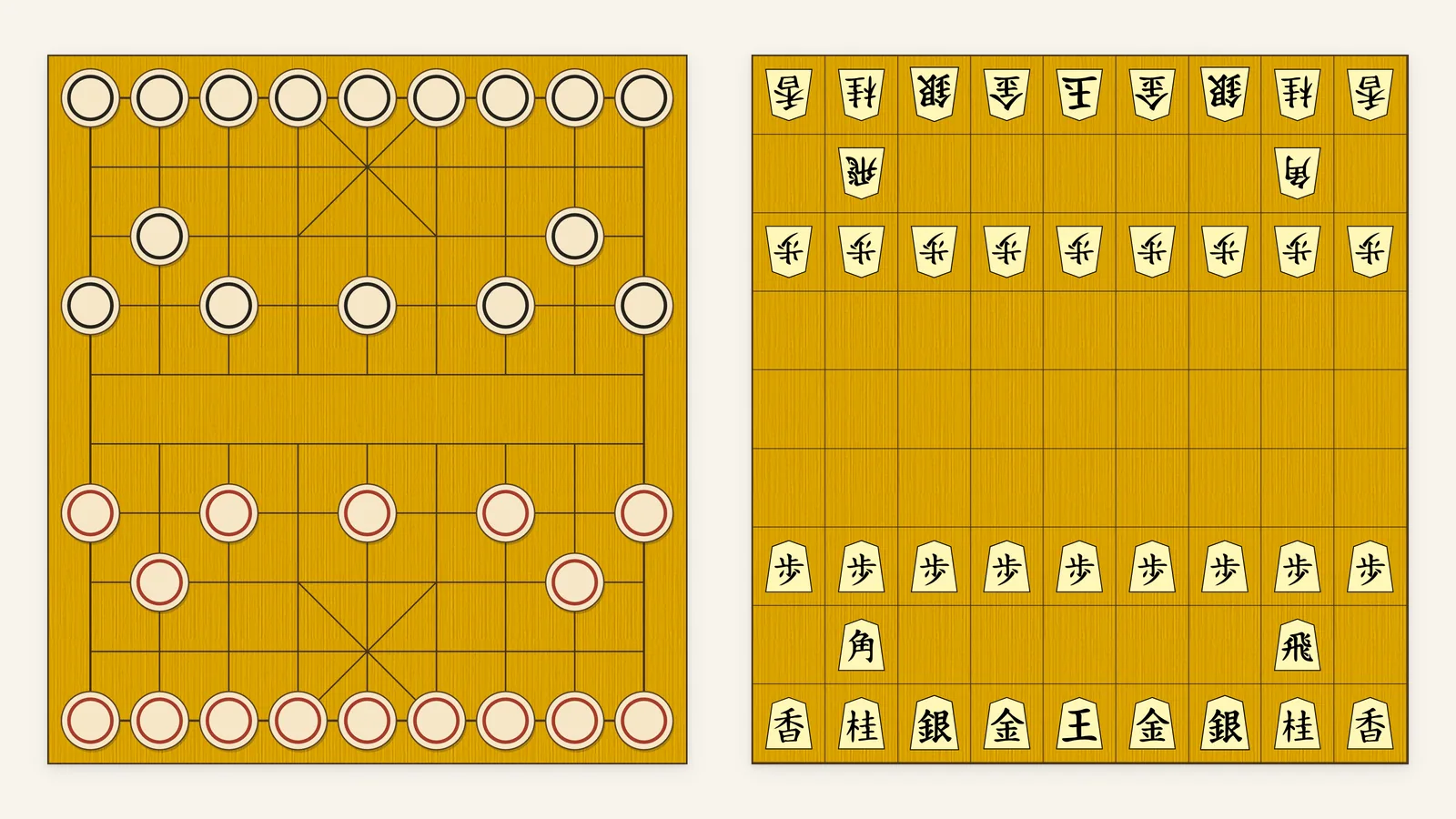
Xiangqi (Chinese chess) and shogi (Japanese chess) are related games with very different rules. Xiangqi puts 16 pieces per side on the points of a 9x10 board split by a river, with each general locked inside a palace. Shogi puts 20 pieces per side inside the squares of a 9x9 board, and lets you capture enemy pieces and drop them back in as your own.
The verdict first
Xiangqi plays like a fast, open version of chess: long-range chariots and cannons, a general that can’t leave its palace, and few pieces that grow stronger. Shogi is denser and more crowded, and the drop rule keeps every captured piece in play, so attacks never run out of material. If you want sharp tactics with a clean board, try xiangqi. If you want a game where the endgame is a mating race with reinforcements arriving from nowhere, try shogi.
A shared ancestor
Both games belong to the chess family that traces back to chaturanga in India, alongside Western chess, Thai makruk, and Korean janggi. Shogi’s exact route to Japan isn’t recorded. Wikipedia’s summary of the research says it most likely came through China or Korea, some time after the Nara period. Excavated shogi pieces at Kofuku-ji temple in Nara date to 1058, and the drop rule was added around the 15th century. More on that in what is shogi.
So xiangqi isn’t shogi’s parent, but the two are close cousins. You can see it in the pieces: both have a king that can be checkmated, a rook-like long-range piece, and foot soldiers that move one step forward.
Xiangqi vs shogi at a glance
| Xiangqi | Shogi | |
|---|---|---|
| Board | 9x10 lines, pieces on the 90 points | 9x9 squares, pieces inside the 81 squares |
| Special areas | River across the middle; a 3x3 palace on each side | Promotion zone: the far three ranks |
| Pieces per side | 16, of 7 types | 20, of 8 types |
| Captured pieces | Removed from the game | Join your hand and can be dropped back in |
| Promotion | None; a soldier gains a sideways move after crossing the river | Six of the eight types can promote in the far three ranks |
| Unique pieces | Cannon (captures by jumping), elephant, advisor | Lance, silver general, gold general, bishop |
| Kings | Generals must stay in the palace and may not face each other on an open file | King moves one square in any direction, anywhere |
| Average game length (estimate) | About 95 half-moves | About 115 half-moves |
| Game-tree complexity (estimate) | 10^150 | 10^226 |
The length and complexity figures are the standard estimates collected on Wikipedia’s game complexity page.
The boards: points vs squares
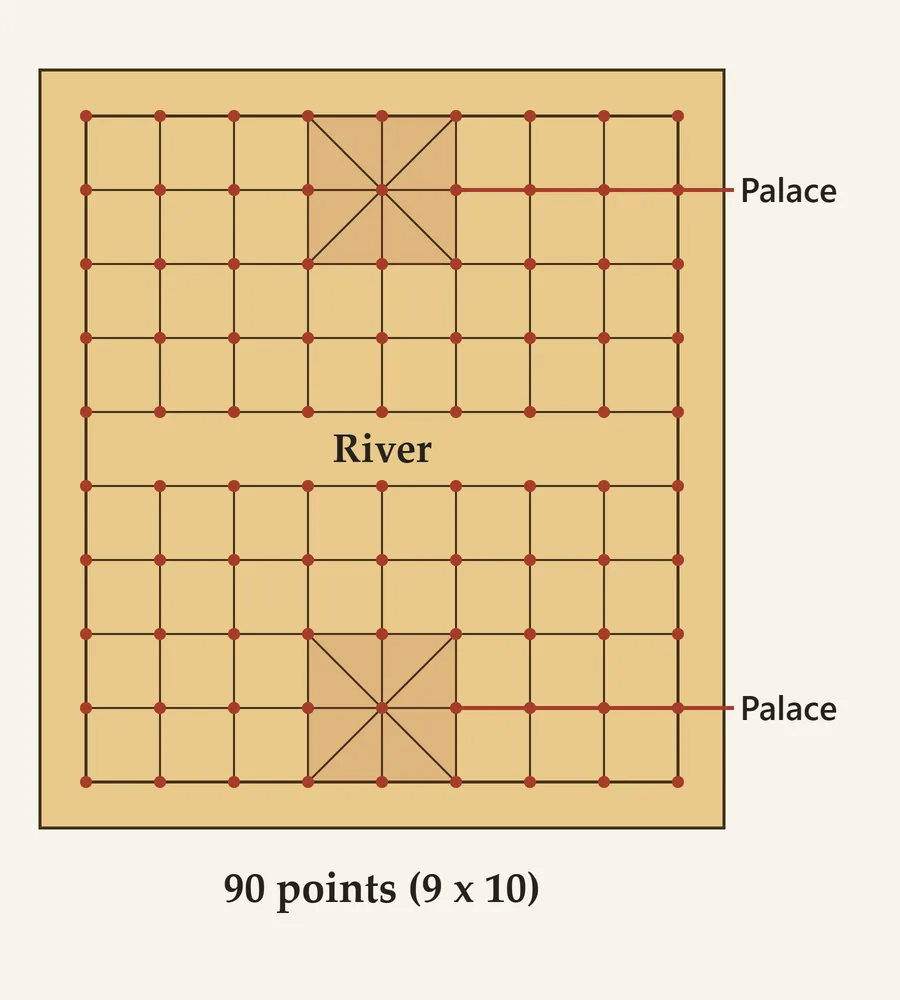
Xiangqi pieces sit on the intersections of the lines, not inside the squares. The board is 9 lines wide and 10 lines deep, which gives 90 points. A blank row across the middle is the river. Elephants can never cross it, and soldiers get stronger once they do. Each side also has a palace, a 3x3 box marked with diagonal lines, where the general and its two advisors must stay.
A shogi board is a plain 9x9 grid of 81 squares with no river and no palace. The only marked area is the promotion zone, the three ranks nearest your opponent. Any piece can go anywhere its move allows, including the king. See the shogi board for the details.
River and palace vs drops and promotion
Each game has its own big idea, and they pull in opposite directions.
Xiangqi limits where pieces can go. The river keeps elephants at home as pure defenders. The palace keeps the general and advisors in a nine-point box. The flying general rule means the two generals can never face each other on an open file. A player with no legal move (stalemate) loses. Strategy is about using those limits: pinning the enemy general in its palace and breaking through with chariots, horses and cannons.
Shogi lets pieces come back. A captured piece is turned around and becomes yours. On any later turn you can drop it on almost any empty square. Pieces that reach the far three ranks can promote to a stronger form. Because material never leaves the game, shogi defense is about building a castle around your king, not trading pieces off.
The pieces mapped
Several pieces have rough equivalents. None of the matches is exact.
| Xiangqi piece | How it moves | Closest shogi piece | Key difference |
|---|---|---|---|
| General (帥/將) | One point orthogonally, inside the palace | King | The shogi king also moves diagonally and can leave home |
| Advisor (仕/士) | One point diagonally, inside the palace | Silver general (diagonal steps) | The silver also steps straight forward and can roam the board |
| Elephant (相/象) | Exactly two points diagonally; can’t cross the river; can be blocked | None | No shogi piece is tied to one half of the board |
| Horse (傌/馬) | One point straight, then one diagonally outward; can be blocked | Knight | The shogi knight only jumps forward and can’t be blocked |
| Chariot (俥/車) | Any distance orthogonally | Rook | Same move; the shogi rook can also promote to a dragon |
| Cannon (炮/砲) | Moves like a chariot; captures by jumping exactly one piece | None | Shogi has no jumping capture |
| Soldier (兵/卒) | One point forward; also sideways after crossing the river | Pawn | The shogi pawn never moves sideways but promotes to a tokin |
Three shogi pieces have no xiangqi counterpart: the lance, the bishop and the gold general. Two xiangqi pieces have no shogi counterpart: the cannon and the elephant. The full shogi set is in the pieces guide.
Which one to learn
If you already play chess, both are a short step. Xiangqi’s rules will feel closer to chess, because captures are permanent and there are no drops. Shogi asks for a bigger shift in thinking, since every capture hands your opponent a piece back. The shogi vs chess comparison covers that shift.
You can play shogi in your browser on this site’s board, free and with no signup. The how to play shogi lesson gets you through your first game.
FAQ
Is xiangqi the same as shogi?
No. Both are chess-family games, but xiangqi uses a 9x10 board with a river and palaces, pieces on the line intersections, and permanent captures. Shogi uses a 9x9 board with pieces in the squares, promotion, and drops of captured pieces.
Did shogi come from xiangqi?
Not directly, as far as anyone can prove. Both descend from India’s chaturanga. Shogi most likely reached Japan through China or Korea, and the earliest excavated shogi pieces date to 1058. Its rules then developed separately, including the drop rule around the 15th century.
Which is harder, xiangqi or shogi?
By the standard estimates, shogi has the bigger game tree: about 10^226 against about 10^150 for xiangqi. Shogi games also run longer, about 115 half-moves against 95. Drops add many more possible moves each turn, so shogi usually feels harder to calculate.
Does xiangqi have drops or promotion?
No. Captured pieces in xiangqi leave the game for good, and no piece promotes. The only change is that a soldier gains a sideways move once it crosses the river.
What is the cannon in xiangqi?
The cannon moves like a chariot, any distance in a straight line. To capture, it must jump over exactly one piece, of either colour, to reach its target. Shogi has no piece that works like this.