Shogi Pieces: Names, Moves, Kanji Symbols, and English Sets
Shogi has eight piece types, 20 pieces per player: one king, one rook, one bishop, two gold generals, two silver generals, two knights, two lances, and nine pawns. Six of the eight types promote to stronger forms. Pieces are five-sided wedges labeled in kanji, pointed toward the opponent to show ownership.
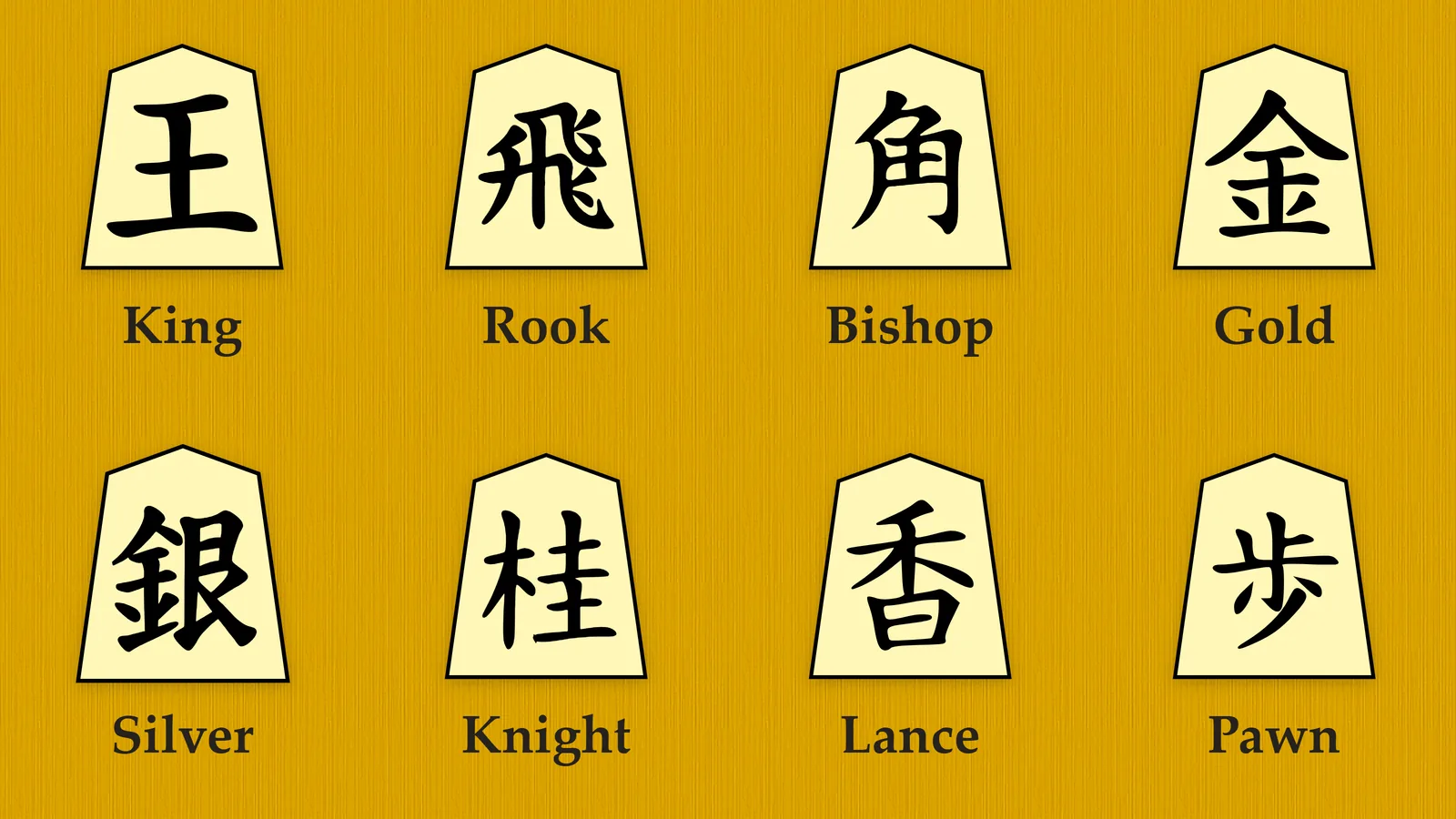
The army at a glance
Every shogi piece is themed as a rank in a medieval army, and the theme is a genuinely useful memory aid: the further from the king a piece’s title sounds, the cheaper the piece.
Meet them in value order, roughly:
- King (王将/玉将, osho/gyokusho): steps one square any direction. Lose it, lose the game. A set contains two subtly different kings, a story told on the king page.
- Rook (飛車, hisha, “flying chariot”): slides along ranks and files; the strongest unpromoted piece. Its board position literally names the two opening families. Rook page.
- Bishop (角行, kakugyo, “angle mover”): slides along diagonals; starts aimed at the enemy bishop. Bishop page.
- Gold general (金将, kinsho): steps one square any direction except diagonally backward. The king’s bodyguard and the piece most others promote into. Gold page.
- Silver general (銀将, ginsho): steps forward or to any diagonal. The army’s lead attacker. Silver page.
- Knight (桂馬, keima): the only jumper, and only to its two forward L-squares. Knight page.
- Lance (香車, kyosha, “incense chariot”): slides straight forward any distance, never back. Lance page.
- Pawn (歩兵, fuhyo, “foot soldier”): steps and captures one square straight forward. Nine of them, and they run the game’s economy. Pawn page.
Each linked page goes deep: movement diagrams, the promoted form, tactics, and a mnemonic. This page is the map.
Shogi piece names chart
Every piece has a Japanese name written in kanji, a romanized reading, and an English name. The English names are translations by role, not literal: the “rook” is really a flying chariot.
| English name | Kanji | Romaji | Literal meaning | Promoted form |
|---|---|---|---|---|
| King | 王将 / 玉将 | osho / gyokusho | king general / jeweled general | None |
| Rook | 飛車 | hisha | flying chariot | Dragon king (龍王, ryuo) |
| Bishop | 角行 | kakugyo | angle mover | Dragon horse (龍馬, ryuma) |
| Gold general | 金将 | kinsho | gold general | None |
| Silver general | 銀将 | ginsho | silver general | Promoted silver (成銀, narigin) |
| Knight | 桂馬 | keima | cassia horse | Promoted knight (成桂, narikei) |
| Lance | 香車 | kyosha | incense chariot | Promoted lance (成香, narikyo) |
| Pawn | 歩兵 | fuhyo | foot soldier | Tokin (と金) |
Many sets, and most online boards, show only the first character of the name, such as 飛 for the rook. The promoted silver, knight, and lance have no special names; they are simply “promoted” (成, nari) plus the piece.
What are the pieces worth?
Shogi values are less settled than chess’s tidy 1-3-3-5-9, partly because a piece’s worth changes with whether it’s on the board, in hand, or promoted. Still, the rough consensus ordering every beginner should carry:
| Piece | Kanji | Per side | Relative value | Promotes to |
|---|---|---|---|---|
| King | 王将 | 2 | n/a (the game) | does not promote |
| Rook | 飛車 | 2 | 10 | Dragon King |
| Bishop | 角行 | 2 | 8 | Dragon Horse |
| Gold General | 金将 | 4 | 6 | does not promote |
| Silver General | 銀将 | 4 | 5 | Promoted Silver |
| Knight | 桂馬 | 4 | 4 | Promoted Knight |
| Lance | 香車 | 4 | 3 | Promoted Lance |
| Pawn | 歩兵 | 18 | 1 | Tokin |
The headline facts: the rook narrowly outranks the bishop; the gold and silver sit close together in the middle; knight and lance are the cheap pieces above the pawn. Promotion shifts everything, most dramatically for the pawn, whose promoted form fights like a gold while costing only a pawn when lost.
And one caveat chess players need stapled to their scoresheet: in shogi, material counts for less than time. A won piece means little if the opponent’s attack lands first, and every piece you take arms their drops when you eventually give it back. Values are a compass, not a scoreboard.
Reading the kanji: faster than you think
The honest answer to “do I have to learn Japanese?” is: you have to learn eight characters, most sets abbreviate them to one character each, and there’s a trick that halves the work. Several pieces share a component, 将 (general, the same character that starts the word shogi itself), or a radical that hints at meaning. Here’s the recognition guide players actually use:
- 王 / 玉: King. The simplest characters on the board: three horizontal strokes and a vertical (玉 adds one small dot). If it looks like a little ladder, protect it.
- 飛: Rook. The busiest, most dramatic character, fitting for the strongest piece. “Fly.”
- 角: Bishop. Means “angle” or “horn,” and the character is a tidy box with legs, pointy like its diagonals.
- 金: Gold. A little roof over crossed strokes, like a pagoda over treasure. The character you’ll also see on many promoted pieces’ reverse faces (often written cursively in red).
- 銀: Silver. Gold’s character plus a busier right half; the metals look related on the board just as they play related roles.
- 桂: Knight. The tree radical (木) on the left: the “cassia horse” is named for a tree. Tree = jumps over things, if you want a memory hook.
- 香: Lance. Means “incense”: rising smoke, straight up, one direction. The movement is in the metaphor.
- 歩: Pawn. Means “step.” You’ll see eighteen of these; you’ll learn it first without trying.
| Piece | Front face | Promoted face |
|---|---|---|
| King (ōshō / gyokushō) | 王将 | no promoted side |
| Rook (hisha) | 飛車 | 龍王 Dragon King |
| Bishop (kakugyō) | 角行 | 龍馬 Dragon Horse |
| Gold General (kinshō) | 金将 | no promoted side |
| Silver General (ginshō) | 銀将 | 成銀 Promoted Silver |
| Knight (keima) | 桂馬 | 成桂 Promoted Knight |
| Lance (kyōsha) | 香車 | 成香 Promoted Lance |
| Pawn (fuhyō) | 歩兵 | と金 Tokin |
Give it three real games. Recognition is faster than reading, and shogi only asks you to recognize.
English shogi pieces and symbol sets
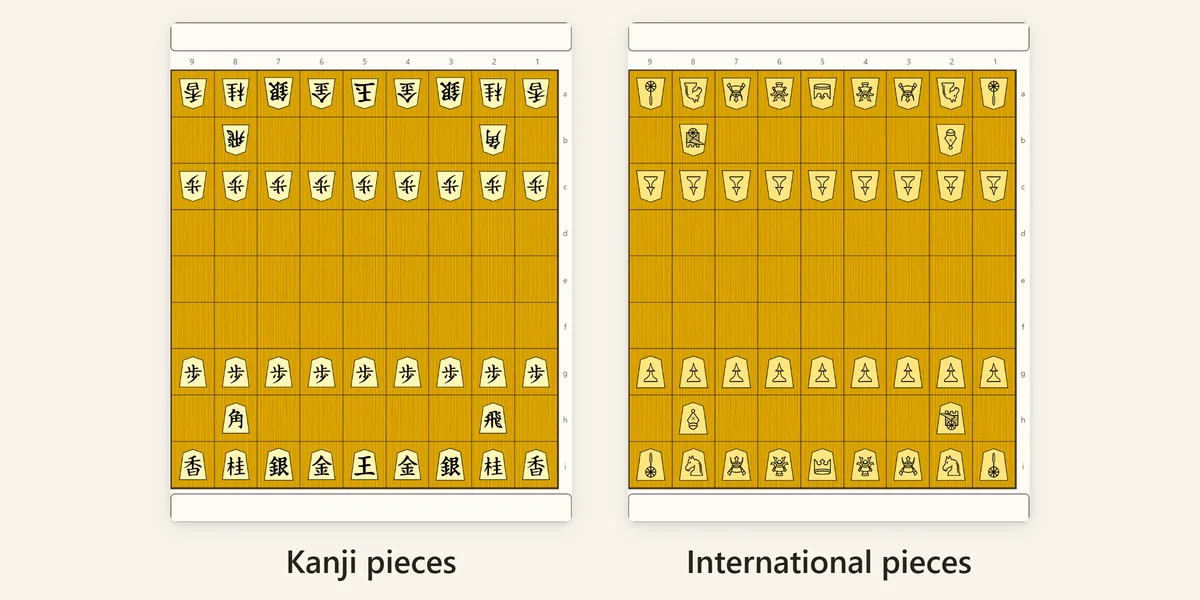
If the kanji put you off, you don’t need them to start. Shogi pieces with English-friendly symbols exist in two common forms:
- International (symbol) pieces: the kanji are replaced by a symbol for each piece and marks showing how it moves.
- Kanji pieces with movement arrows: some beginner sets keep the characters and add arrows, so you can learn both at once.
Our board offers an international piece set, with movement icons in place of kanji, plus a one-tap toggle between the two, so you can learn moves first and characters second without ever being stuck. Try both styles on the free board. For a physical set, see our guide to shogi sets with arrows or international pieces.
One aesthetic note worth knowing before you buy a physical set: traditional pieces come in grades, from single-character stamped sets up to hand-carved two-character calligraphy. The shogi board guide covers equipment.
Promotion in one minute
Six of the eight types promote on reaching the far three ranks; the details, including the mandatory cases and when declining is right, live on the promotion page. The summary:
- Rook becomes dragon king (rook + one-square diagonal steps): the game’s strongest piece.
- Bishop becomes dragon horse (bishop + one-square straight steps): the game’s best defender.
- Silver, knight, lance, and pawn all promote to gold-general movement; the promoted pawn is the celebrated tokin.
- King and gold never promote.
This is why shogi pieces have writing on both faces, usually red for the promoted side on traditional sets: every piece except king and gold carries its second identity on its back.
Why all the pieces are the same color
Newcomers ask this within a minute of seeing a board: how do you tell whose piece is whose? Direction. Your pieces point at your opponent, theirs point at you, and there is no white army or black army.
The design follows from the drop rule. A captured piece changes sides, so pieces must be able to serve either player; paint them two colors and the rule breaks. The wedge shape is the ownership marker, and it’s also why a shogi board mid-game looks like two weather fronts colliding, every piece an arrow in flight. Once you’ve played a few games, color-coded chess pieces start looking oddly static.
Where to go next
If you’re new, take the pieces in this order: pawn and king first (you already mostly know them), then gold and silver as a pair, then rook and bishop, and finally the two specialists, knight and lance. Then the how to play guide assembles the army into a game, and the rules reference handles every edge case. Or skip the syllabus and just play; the board explains illegal moves as you go.
FAQ
What are the shogi piece names?
The eight shogi pieces are the king (osho/gyokusho), rook (hisha), bishop (kakugyo), gold general (kinsho), silver general (ginsho), knight (keima), lance (kyosha), and pawn (fuhyo). Each player commands 20 pieces: one king, rook, and bishop, two golds, silvers, knights, and lances, and nine pawns.
What do the kanji on shogi pieces mean?
Each piece shows its name: 王/玉 (king/jeweled general), 飛 (fly, the rook), 角 (angle, the bishop), 金 (gold), 銀 (silver), 桂 (cassia tree, the knight), 香 (incense, the lance), and 歩 (step, the pawn). Promoted forms appear on the reverse face, traditionally in red.
Why are shogi pieces not different colors for each player?
Because captured pieces switch sides under the drop rule, every piece must be able to serve either player. Ownership is shown by orientation instead: each wedge-shaped piece points toward its owner’s opponent. When a captured piece is dropped back, it’s simply turned around.
How many shogi pieces promote?
Six of the eight types: rook (to dragon king), bishop (to dragon horse), and silver, knight, lance, and pawn (all to gold-general movement). Only the king and the gold general never promote. Promotion becomes available when a piece’s move starts in, ends in, or crosses the far three ranks.
What is the strongest piece in shogi?
The dragon king, the promoted rook, which combines full rook slides with one-square diagonal steps. Among unpromoted pieces the rook ranks first, followed closely by the bishop. The promoted bishop (dragon horse) is often called the game’s best defensive piece rather than its best attacker.
Piece guides
Every piece has its own page with a movement diagram you can play with, the promoted form, and the tactics it stars in.
King
Steps one square any direction. Lose it and the game is over.
Rook
The strongest unpromoted piece. Its file placement names the two opening families.
Bishop
Runs the diagonals. The early bishop trade shapes many openings.
Gold General
The king’s bodyguard, and the movement most promoted pieces copy.
Silver General
The lead attacker: forward and all four diagonals.
Knight
The only jumper, and only forward. It can never retreat.
Lance
A one-way rook, charging straight up its file.
Pawn
Nine per side. They run the game’s economy.