Taikyoku Shogi and Tai Shogi: The Biggest Shogi Games
Taikyoku shogi (大局将棋, “ultimate shogi”) is the largest known version of shogi. It is played on a 36x36 board of 1,296 squares, and each player starts with 402 pieces, 804 in all. Tai shogi (泰将棋), at 25x25, was considered the biggest until taikyoku came to light in the 1990s.
Taikyoku shogi at a glance
| Taikyoku shogi | Standard shogi | |
|---|---|---|
| Board | 36x36 (1,296 squares) | 9x9 (81 squares) |
| Pieces per player | 402 | 20 |
| Pieces on the board at the start | 804 | 40 |
| Piece types | 209 by function (207 names) | 8 |
| Drops | No | Yes |
| How you win | Capture every enemy king and crown prince | Checkmate the king |
| When it was devised | Edo period (exact date unknown) | Drops added around the 16th century |
How many piece types? Sources give 207, 208 or 209, and all three are right in their own way. The piece faces carry 207 different names. Two of those names cover two different pieces each: the howling dog comes in two versions that promote differently, and the left and right mountain eagles move differently. That makes 209 piece types by how they play. The two mountain eagles look identical, so a set holds 208 physically distinct pieces. The 804 total is not in dispute: 402 per side, twice.
Where taikyoku came from
Nobody knows who invented taikyoku shogi or exactly when. The rules survive in a manuscript called Taikyoku Shogi Koma from the archives of the Ōhashi family, one of the hereditary shogi houses of the Edo period. It was found among uncatalogued papers at the shogi museum in the Kansai Shogi Kaikan around 1990. The manuscript gives only the piece names, a setup diagram and dots marking each piece’s moves, with no full rules. Game historian Umebayashi Isao interpreted the moves, and they were first published in detail in the 1997 book Sekai no Shogi. English-language sources usually give 1997 as the year of its rediscovery.
Historians disagree on the date it was made:
- English-language sources place it around the mid-16th or 17th century.
- Game researcher Kosaku Noboru argues for the late 18th century. His theory is that the Ōhashi family wanted a game grander than tai shogi to raise the house’s standing.
- Professional player and game historian Kimura Yoshinori guessed it was made by hobbyists between the end of the Edo period and the middle of the Meiji era.
There is no evidence it was ever widely played, or that a set was even made at the time. As of 2012 only two restored sets were known, and one belongs to Osaka University of Commerce.
The 2004 game: 3,805 moves over three days
The first official game of taikyoku shogi on record was played for Japanese television. On 19 May 2004, the Fuji TV show Trivia no Izumi (The Fountain of Trivia) ran a segment on the trivia fact that one form of shogi uses 804 pieces. To prove it, two professionals played a full game:
| Detail | Value |
|---|---|
| Players | Hirofumi Itō (6-dan) and Takanori An’yōji (4-dan), ranks as of 2004 |
| Playing time | 32 hours 41 minutes |
| Days | 3 |
| Length | 3,805 moves |
| Result | An’yōji, playing first, won |
The players kept a rulebook of piece moves beside the board and took several breaks to rest and sleep. Afterwards An’yōji said he never wanted to play it again. The broadcast is what made the game widely known in Japan.
Why almost nobody plays it
The game is huge and its rules were never settled. Five problems stand out:
- Setup alone is a project. You place 804 pieces on 1,296 squares before the first move.
- Too much to remember. There are 209 piece types, each with its own move.
- The sources disagree. Promotion is the clearest example. One reading says a piece promotes when it makes its first capture. Another says it must promote when it enters the 11 far ranks. Some piece moves are marked with symbols the original text never explains.
- Sets barely exist. Only a couple of restored sets are known, and the board alone measures about 65 by 55 cm.
- No checkmate rule. The game has no rules for check or mate. You win by capturing every enemy king and crown prince, though in practice a player who is mated resigns.
Like the other big historical variants, taikyoku has no drops. Captured pieces stay off the board, so the army thins out the way it does in chess.
Taikyoku vs the other large shogi variants
Taikyoku sits at the top of a ladder of large historical variants. Each step up means a bigger board, and usually more pieces.
| Variant | Board | Squares | Pieces per player | Piece types | Usually dated to |
|---|---|---|---|---|---|
| Chu shogi | 12x12 | 144 | 46 | 21 | Early 14th century |
| Dai shogi | 15x15 | 225 | 65 | 29 | About 1230 |
| Tenjiku shogi | 16x16 | 256 | 78 | 36 | 15th or 16th century |
| Dai dai shogi | 17x17 | 289 | 96 | 64 | 15th century |
| Maka dai dai shogi | 19x19 | 361 | 96 | 50 | 15th century |
| Tai shogi | 25x25 | 625 | 177 | 93 | 15th century |
| Taikyoku shogi | 36x36 | 1,296 | 402 | 209 | Edo period |
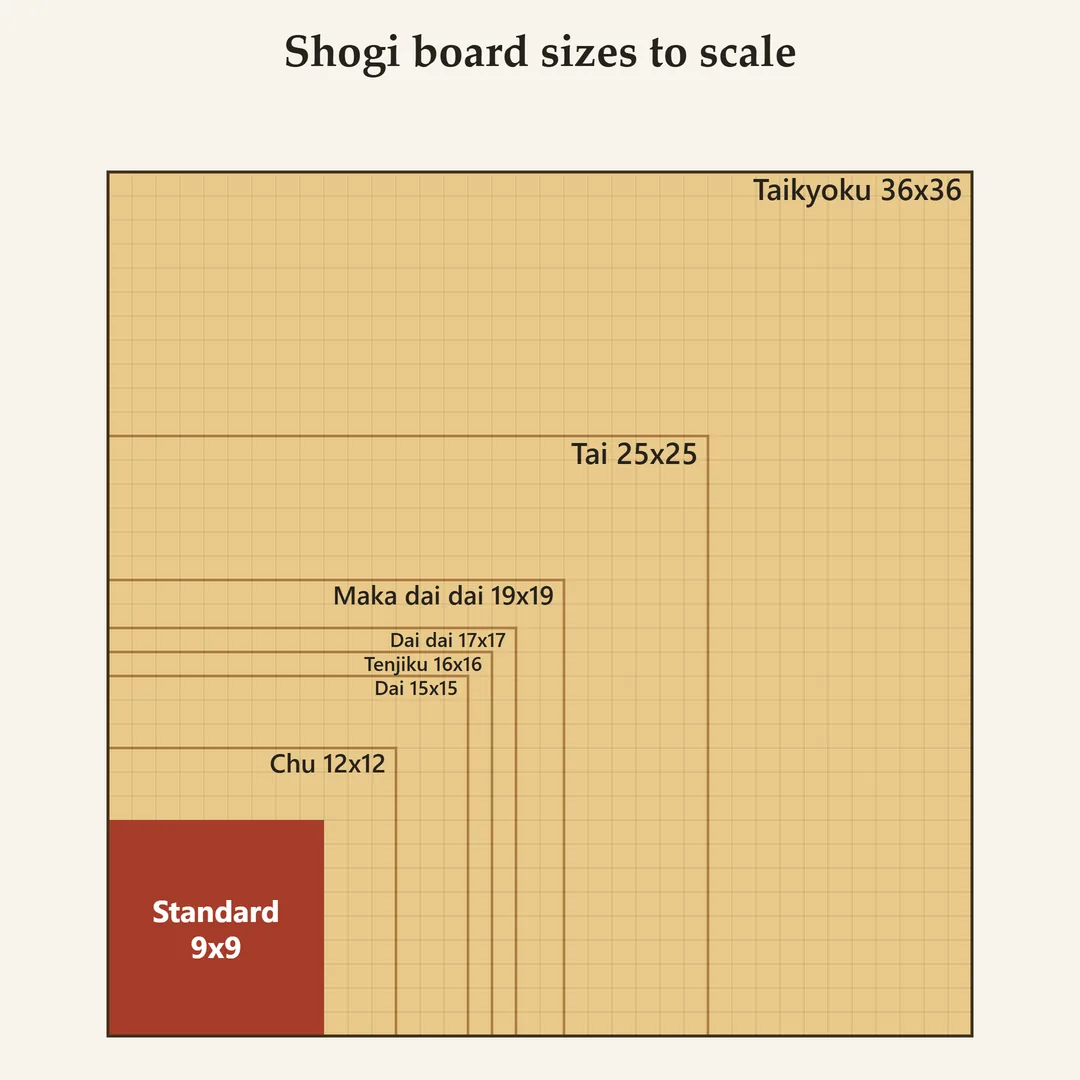
None of these use drops. Of the group, chu shogi is the only one with a real playing community today. Tenjiku and maka dai dai shogi have small followings, mostly with modernized rules. For the small end of the family tree, see the shogi variants guide.
Tai shogi: the 25x25 game
Tai shogi is the second-largest variant and the one that held the “biggest” title before taikyoku. It is a separate game, not a smaller edition of taikyoku.
| Tai shogi | |
|---|---|
| Japanese name | 泰将棋 (also 無上泰将棋, mujō tai shōgi) |
| Board | 25x25 (625 squares) |
| Pieces per player | 177 |
| Piece types | 93 |
| Drops | No |
| Promotion | When a piece that can promote makes a capture |
| How you win | Capture the enemy emperor and every prince |
| Usually dated to | 15th century |
Tai shogi is close to a merger of two smaller giants, dai dai shogi and maka dai dai shogi. It includes almost every piece from both, plus many pieces from chu shogi. Only nine pieces appear in no smaller game, including the peacock, the vermillion sparrow and the turtle-snake. Its king is called the emperor.
A single game can run to more than a thousand moves per player. It was never popular. A production run of just six sets in the early 17th century was noteworthy enough to be recorded, and the few sets made seem to have been meant for display. You can see one laid out in its starting position at the shogi museum in Tendō, Yamagata.
The rules have the same problem as taikyoku’s. The historical texts are terse and contradict each other, and English and Japanese sources still disagree on which pieces promote and into what. Tai shogi also had a moment in film: the 1991 Japanese movie Ōte presents it, under a different name, as the largest shogi in the world.
Can you play taikyoku or tai shogi online?
Not easily. As of October 2026:
- Lishogi, the main free shogi server with variants, offers chu shogi, minishogi, kyoto shogi, dobutsu shogi and two modern variants. Neither tai nor taikyoku is on the list.
- WinBoard’s shogi variants package, free desktop software by H. G. Muller, can display and record tai shogi games, but it has no computer opponent for it. It does not cover taikyoku.
- Hobby projects exist. One open-source taikyoku implementation on GitHub describes itself as a work in progress.
If you want a big-board shogi you can actually play tonight, play chu shogi on lishogi. If you want something faster, the small variants run in seconds: play Animal Shogi or 5x5 minishogi here, or the full 9x9 game on our free board.
FAQ
What is the biggest shogi game?
Taikyoku shogi. It uses a 36x36 board with 1,296 squares, and each player starts with 402 pieces, 804 in all. It is the largest shogi variant known and is often called the largest chess-family game ever devised.
How many piece types does taikyoku shogi have?
It depends how you count. The pieces carry 207 different names. Two names each cover two pieces that move or promote differently, so there are 209 types by function. Because the left and right mountain eagles look the same, a set holds 208 physically different pieces.
How long does a game of taikyoku shogi take?
The only well-documented modern game, played in 2004 for the Japanese TV show Trivia no Izumi, took 32 hours and 41 minutes over three days and lasted 3,805 moves. Takanori An’yōji beat Hirofumi Itō.
What is the difference between taikyoku shogi and tai shogi?
They are separate games. Tai shogi is played on a 25x25 board with 177 pieces per side of 93 types and is dated to the 15th century. Taikyoku shogi is larger at 36x36 with 402 pieces per side, and it only became widely known after its rules were published in 1997.
Can you play taikyoku shogi online?
Not on any major server as of October 2026. Lishogi offers chu shogi but not tai or taikyoku, and the WinBoard desktop package shows tai shogi without a computer opponent. A few hobby projects exist but are unfinished.