Shogi vs Chess: 11 Key Differences (and Which to Learn First)
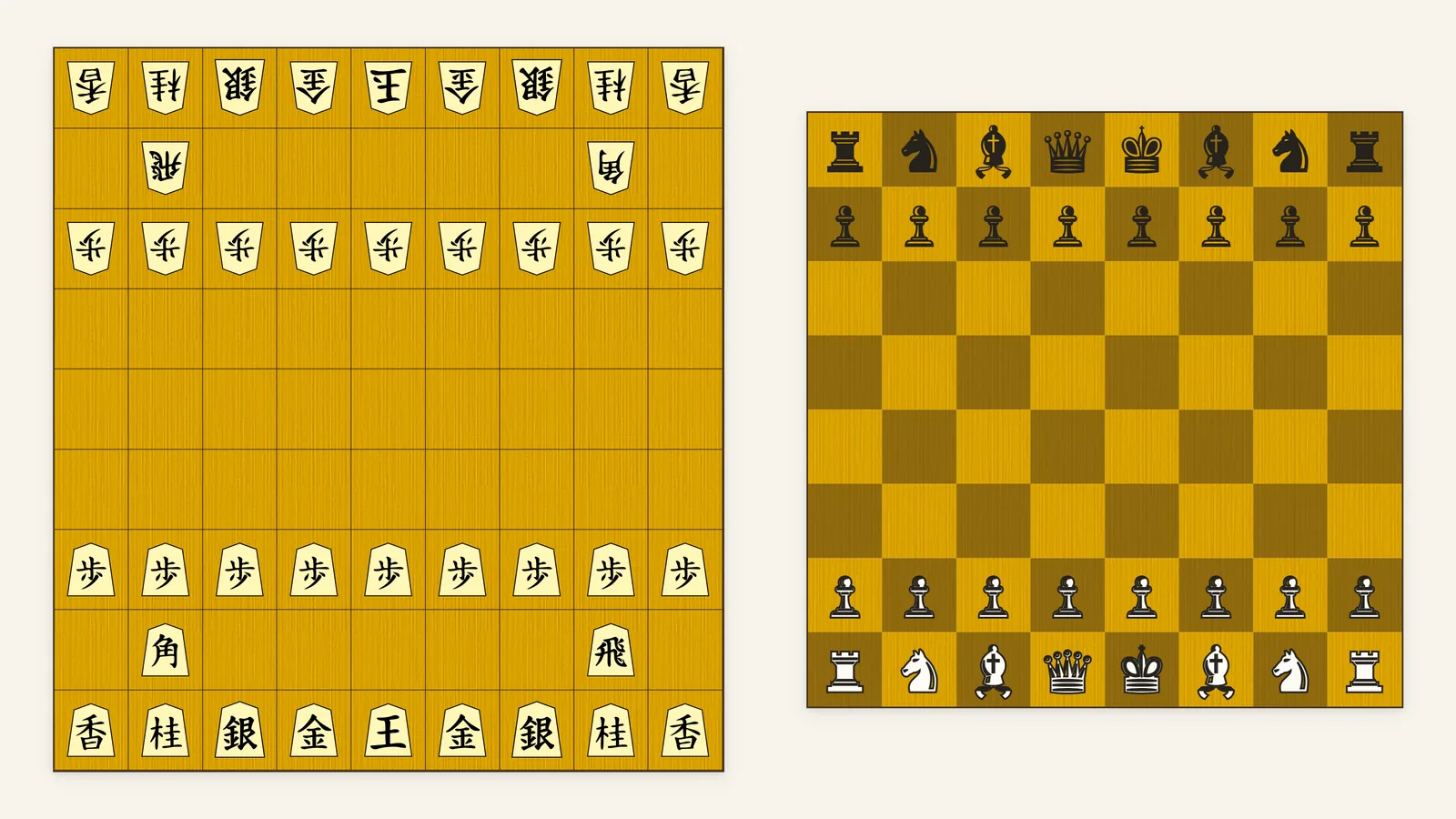
Shogi and chess are sibling games descended from the same Indian ancestor, chaturanga. Chess is played on an 8x8 board with 16 pieces per side; shogi uses a 9x9 board, 20 pieces per side, and one transformative extra rule: captured pieces switch sides and can be dropped back into play.
The verdict first
Choose chess if you want the larger player pool, deeper English-language resources, and a game where accumulated advantages get converted with technique. Choose shogi if you want a game that stays violent to the last move, almost never draws, and rewards attacking speed over material counting. Learn both if you can; board vision transfers, and each game exposes the assumptions the other trained into you.
Now the details, because the details are where it gets interesting.
Same family, different branches
Both games descend from chaturanga, a seventh-century Indian strategy game. The westbound branch crossed Persia into Europe and became chess; the eastbound branch crossed Asia and, in Japan, became shogi, with physical evidence (excavated pieces at the Kofuku-ji temple) dating to 1058. Neither is the other’s parent; they’re cousins who inherited the same goal, checkmate the king, and then evolved on different continents for a thousand years. Our history of shogi follows the eastern branch step by step.
The full origin story is on what is shogi. The short version of what evolution wrought: chess became a game of attrition and conversion; shogi, after adding the drop rule around the 15th century, became a game of perpetual mutual attack.
The comparison table
| Shogi | Chess | |
|---|---|---|
| Board | 9x9, uncheckered | 8x8, checkered |
| Pieces per side | 20, of 8 types | 16, of 6 types |
| Captured pieces | Join captor’s hand; return by drop | Permanently removed |
| Strongest piece | Rook, then promoted rook (dragon) | Queen |
| Promotion | 6 of 8 piece types, three-rank zone | Pawns only, last rank only |
| Pawn captures | Straight ahead | Diagonally |
| Castling | No castling move; castles built by hand | One-move castling |
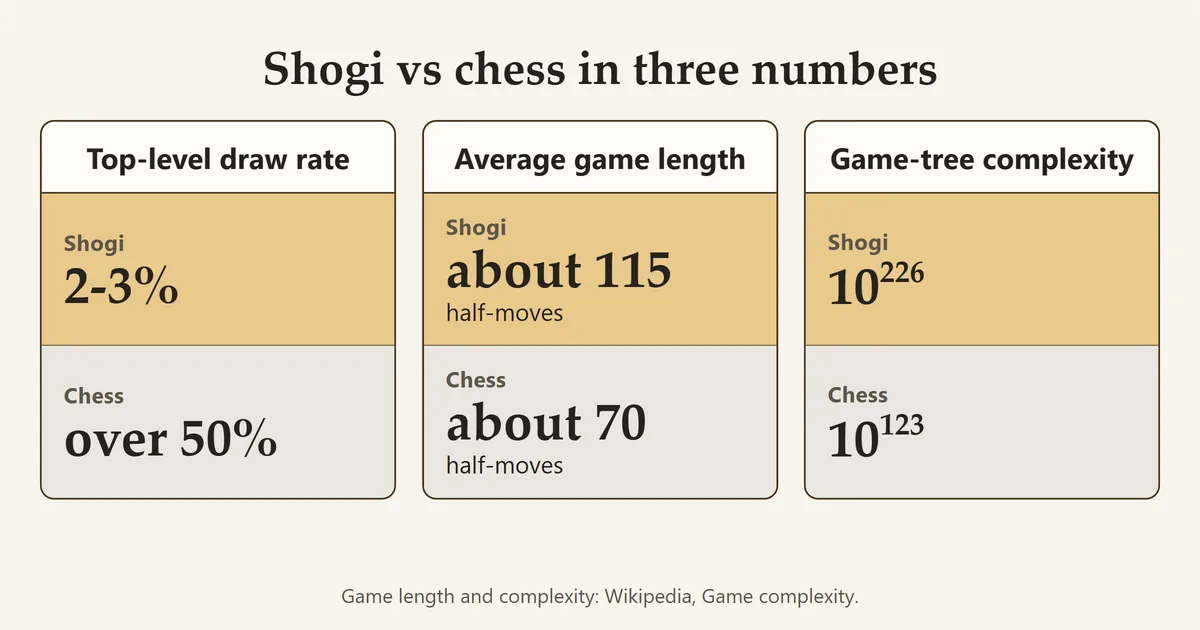
| Draw rate (top level) | Roughly 2-3% | Over 50% |
| Average game length | ~115 half-moves | ~70 half-moves |
| Game-tree complexity (est.) | 10^226 | 10^123 |
| Piece identification | Kanji, orientation shows owner | Shape and color |
Each row is a real difference in how the games feel. Let’s take the big ones.
Drops: the difference that contains the others
Chess is a closed economy: 32 pieces at the start, fewer every trade, and the game trends toward emptiness. Endgame technique, the art of converting small advantages on a bare board, is chess’s crowning discipline because the bare board is where chess games go.
Shogi is an open economy. Your captures become your reserves, droppable on nearly any empty square, so the total force in play never falls. Three consequences follow, and together they’re most of the answer to “how different can it really be?”:
-
Material means less. In chess, winning a piece cleanly is usually decisive; technique does the rest. In shogi, winning a piece means your opponent will eventually hand it back to you at the worst square imaginable, and games are routinely won by the side with less material and more speed.
-
Defense means structure, not trades. The chess defender’s dream, trade the attackers and breathe, doesn’t exist; traded attackers reload. Shogi defense is about castles, formations that make every square near the king expensive. This is why shogi players spend a dozen opening moves on fortification and chess players spend one.
-
The game never dries out. Which brings us to draws.
Draws: shogi barely has them
Over half of top-level chess games end drawn, and the rate rises with skill; at the summit, decisive classical games are the exception. It isn’t cowardice, it’s mathematics: chess positions drain toward simplicity, and simplified positions are defensible.
Professional shogi’s draw rate is 2 to 3 percent. The rules cooperate (repetition draws exist but are rare, and perpetual check is illegal, it loses), but the deep cause is the drop rule: no attrition, no dead positions, no fortress that can’t be besieged with fresh material. When professionals do draw by repetition, they replay the game with colors reversed. A shogi tournament produces winners at nearly every board, every round. If chess’s draw problem has ever annoyed you, this alone justifies a look across the aisle; you can start playing shogi knowing every game will produce a result.
Pieces and promotion: more types, humbler powers
Chess concentrates power: the queen is a monster, minor pieces are specialists, and pawns are structure. Shogi distributes it: no queen exists, the eight piece types are mostly short-range steppers, and power grows through promotion, which six of the eight types can earn just by reaching the far three ranks. The promoted rook and bishop (dragon king and dragon horse) are shogi’s versions of heavy artillery, and the promoted pawn, the tokin, fights like a gold general while costing only a pawn when captured, one of the game’s signature bargains. Details on the promotion page.
Chess players translating their instincts should expect two adjustments: attacks are built from short-range pieces at close quarters (less sniping, more infantry), and back ranks are never safe, because drops ignore the journey and just arrive.
Length, pace, and where the tension lives
Shogi games run longer on average (~115 half-moves to chess’s ~70) and their drama is back-loaded: openings are constructive and quiet, middlegames sharpen, and endgames are flat-out mutual mating races, the opposite of chess’s turn toward technical quietude. In chess the tension often peaks in the middlegame and resolves; in shogi the final phase is the loudest, with both kings under fire and the result balancing on a single tempo. Players who love king hunts and hate technical endings tend, once exposed, to defect.
Culture and access
Chess is globally organized and massively resourced in English. Shogi is Japan’s game, with professional players as national celebrities, title matches on multi-day schedules, and centuries of literature, most of it untranslated. For an English speaker that used to mean a real access gap; playable sites, engines, and translated materials have narrowed it substantially (this site exists to narrow it further, no reading of Japanese required, though the kanji come quickly; see the pieces guide).
The learning curve question, is shogi actually harder?, deserves its own honest treatment, and has one: is shogi harder than chess.
Try the other side
Whichever game is home, visiting the cousin makes you better at both. Chess players report that shogi rewires their sense of king safety and initiative; shogi players credit chess with sharpening precise calculation in simplified positions. The visit costs an hour: the rules are quick, the lesson is free, and the board plays at beginner-friendly strength in your browser. Worst case, you return to chess with a new appreciation for how strange your own game’s draws would look to a shogi player.
FAQ
What is the main difference between shogi and chess?
The drop rule. In shogi, captured pieces join the captor’s reserves and can be placed back on the board as that player’s own on later turns. Material never leaves the game, so attacks continually renew, comebacks stay possible, and draws nearly vanish. Chess removes captured pieces permanently.
Is shogi chess?
Shogi is a member of the chess family, which is why English speakers call it Japanese chess, but it is its own game. Shogi and chess both descend from India’s chaturanga and both are won by checkmating the king. They evolved separately for centuries, on different continents, with different rules.
Is shogi the same as chess?
No. Shogi uses a 9x9 board, 20 pieces per side, pawns that capture straight ahead, promotion for six of its eight piece types, no queen, and above all the drop rule, which lets captured pieces return to play. “Japanese chess” is a fair label but undersells the differences.
Is shogi like chess?
Yes, in the ways that matter for learning. Board vision, tactical patterns like forks and pins, king-safety instincts, and calculation discipline all carry over. Chess players typically adjust slowly to two things: material matters less in shogi, and endgames are mating races where speed beats accumulation. Drop awareness takes deliberate practice.
Why does chess have more draws than shogi?
Chess trends toward attrition: pieces trade off permanently, positions simplify, and simplified positions favor the defender, producing draw rates above 50 percent at top level. Shogi’s captured pieces return as drops, so force never drains from the game; professional shogi draws occur in only about 2 to 3 percent of games.