Climbing Silver (Bogin): The Classic Shogi Attack
Climbing silver (bogin, 棒銀) is a Static Rook attack in shogi. You push the pawn in front of your rook, march your right silver straight up behind it, and break through on the rook’s file with pawn, silver and rook working as one. It’s usually the first complete attacking plan a beginner learns.
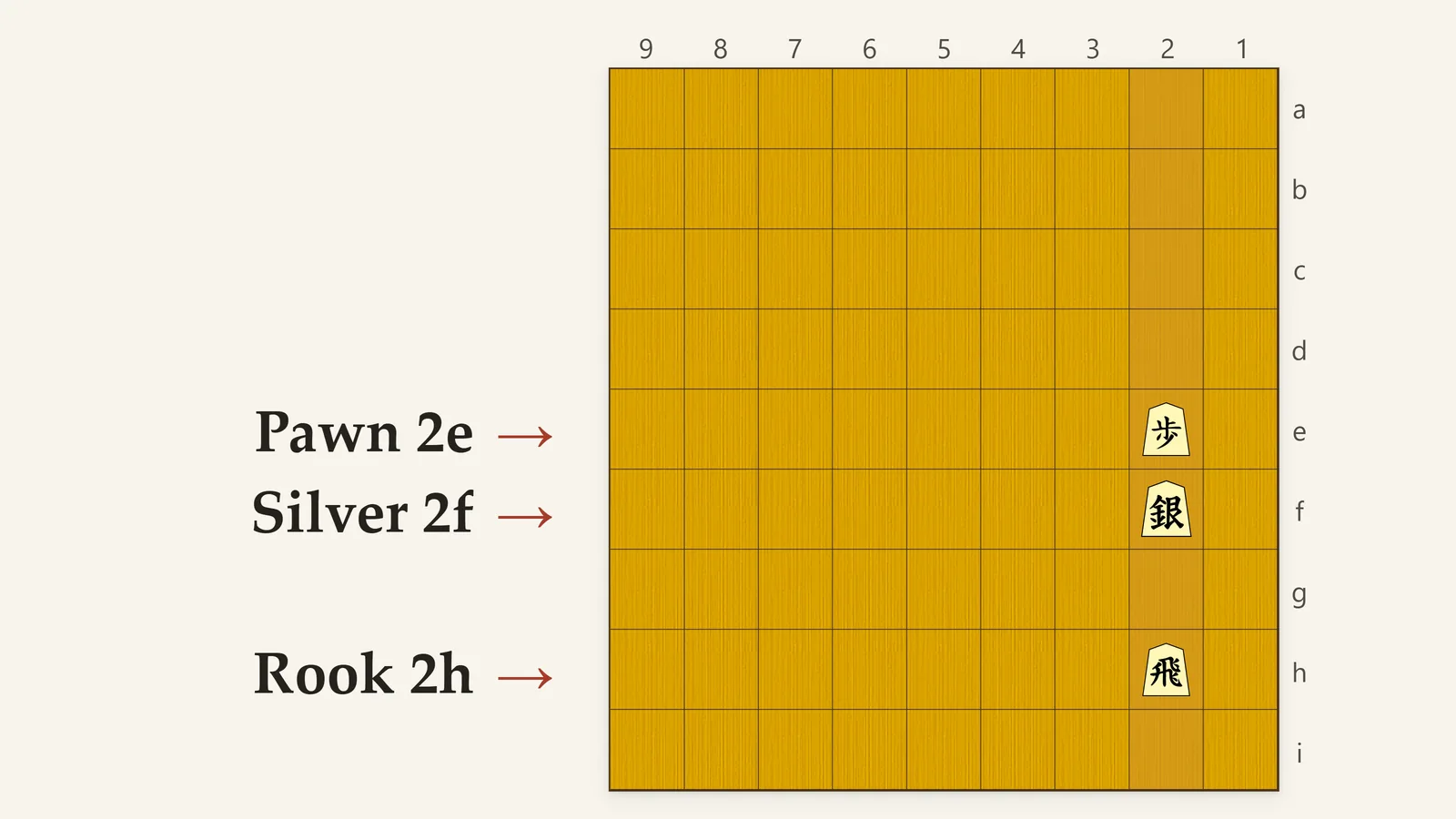
The name and the idea
Bo (棒) means a rod or pole. The name comes from the silver advancing up the board in a straight line, like a pole. Your rook stays on its starting file, so this is a Static Rook plan.
The attack lines up three pieces on one file:
- The pawn in front, which strikes the enemy pawn and opens the file.
- The silver in the middle, which captures on the opened square and pushes into the enemy camp.
- The rook behind, which backs up every capture on the file.
The target is the enemy’s bishop side. In the starting position the opponent’s bishop sits right above your rook’s file, so climbing silver aims at the “bishop’s head”, a square that’s often weak early in the game. If the defender hasn’t covered it, the silver breaks in and the rook follows.
Why the silver? It moves forward in three directions and can retreat diagonally, so it can attack and still get back if the push fails. The silver general guide covers how it moves.
The typical move order
Below is the basic climbing silver route for Black (the player who moves first). Coordinates use file number plus rank letter, with rank a at the top (the opponent’s side). Western shogi notation is in brackets.
- Push the rook pawn: 2g to 2f, then 2f to 2e (P-26, P-25). This clears the squares the silver will climb through.
- Silver up one: 3i to 3h (S-38).
- Silver onto the rook file: 3h to 2g (S-27).
- Silver up again: 2g to 2f (S-26).
- Silver to the fifth rank: 2f to 1e or 2f to 3e (S-15 or S-35). This is the key step. One Japanese guide says the attack has succeeded once the silver reaches the fifth rank.
- Break the file: push the pawn from 2e to 2d (P-24). If White captures with the pawn from 2c, the silver takes back on 2d (Sx24), with the rook behind it on the same file.
The order of the first moves can vary, and your opponent’s moves happen in between. The shape is what matters: pawn pushed, silver climbing behind it, rook at home on the 2nd file.
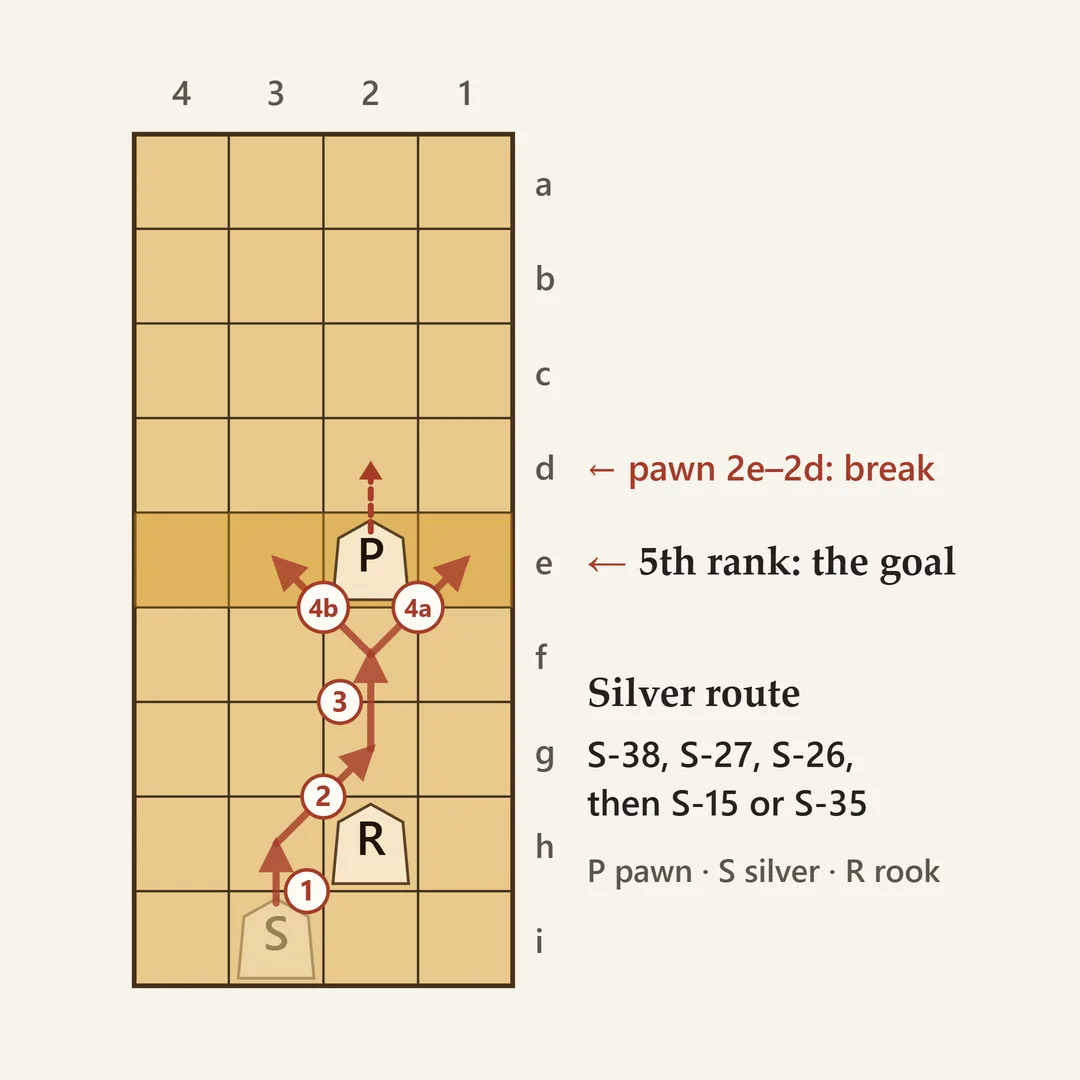
Two common variations:
- After a pawn trade. If the rook pawns have already been traded, the silver can climb straight up the file to 2e. A pawn dropped on 2d then renews the attack.
- The edge sacrifice. With the silver on 1e, Black can sometimes give the silver for White’s edge lance. A dangling pawn (tarefu) dropped deep on the 1st file then threatens to promote. See the tesuji guide for the dangling pawn.
When climbing silver works
Climbing silver is simple, and that’s its strength and its weakness. One Japanese overview puts it this way: it attacks quickly but its aim is easy to read, and a silver that gets stuck in mid-board can leave you worse off.
| Situation | Good for the climbing silver? | Why |
|---|---|---|
| The bishop’s head is not defended | Yes | The silver breaks in on the 2nd file with rook support |
| White hasn’t pushed the 1st-file pawn | Yes | The silver can use 1e as its stepping stone |
| White has a pawn on 1d | Harder | That pawn attacks 1e, so the edge route is closed |
| White’s silver or bishop guards the 5th rank | Harder | The silver can’t reach the 5th rank safely |
| Your own king isn’t castled | Risky | A failed attack hands pieces to the opponent, and they drop them next to your king |
Castle first, even with this attack. The castles guide shows quick castles that suit Static Rook.
How Ranging Rook meets it
Against a Ranging Rook player, the climbing silver often switches to the 3rd file. The pawn, silver and rook line up on the 3rd file, the pawn pushes to 3e, and if White captures, the silver recaptures on 3e and reaches the fifth rank. The Static Rook player may move the rook to 3h to back it up.
Ranging Rook has standard answers:
- Move the rook to the attacked file. The defender swings the rook to 3b to meet the attack head on.
- Stop the silver short of the fifth rank. A silver on 4c covers the squares the attacking silver wants.
- Guard the 2nd file early. After Black’s pawn reaches 2e, the bishop goes to 3c so the rook pawn can’t be traded.
- Close the edge. A pawn on 1d stops the silver from using 1e.
Professional player Yusuke Toyama recommends Third File Rook as an answer to the climbing silver. With the rook already on the 3rd file, those defensive moves come naturally.
Static Rook players also have a version for this matchup: the diagonal climbing silver (naname bogin). It uses the left silver, starting on 7i, which climbs diagonally toward the 2nd or 3rd file.
How Static Rook defences meet it
When both sides play Static Rook, the defender’s main job is to defend the bishop’s head before the file opens. Bringing pieces to the squares around the bishop, such as the bishop on 3c and a silver on 2b, gives the defender more guards on the breakthrough square than the attacker has attackers.
Climbing silver also lives on inside professional openings. In the Bishop Exchange (kakugawari) family there is a Bishop Exchange Climbing Silver. In Double Wing Attack, a climbing silver on the 2nd file is a standard option. In the Bishop Exchange version, the silver can also break through on the edge: pawn to 1e, pawn takes, silver takes on 1e, with threats on both the 1st and 3rd files.
A short history
The shape is old. A Japanese reference notes that similar formations may appear in games of Ohashi Sokei, the first Meijin, and the plan shows up often in Edo-period games. The word 棒銀 appears in print by 1894. Older texts sometimes called it a “foolish silver” (馬鹿銀), a teasing name for an attack that seems too direct. It’s still played at every level, including by professionals.
Why learn it first
- It’s one plan you can play every game. Push, climb, break. No memorized move trees.
- It teaches teamwork. Pawn, silver and rook each do one job. Every later attack uses the same idea.
- Its failures teach defense. When the climbing silver is stopped, you see exactly which squares the defender covered.
Try it against the computer on Easy, then read the openings hub to see where it fits among the bigger systems. For the principles behind it, see the shogi strategy guide.
FAQ
What is the climbing silver in shogi?
Climbing silver (bogin) is a Static Rook attack where the right silver advances straight up the rook’s file behind a pushed pawn, with the rook supporting from its starting square. Pawn, silver and rook combine to break through on the opponent’s bishop side.
Is climbing silver good for beginners?
Yes. It’s a complete plan with a clear goal (get the silver to the fifth rank, then break the file), and it works against many beginner setups. When opponents stop it, you learn how defense works on a file.
What is the move order for climbing silver?
Push the rook pawn to 2e, then move the right silver 3i to 3h, 3h to 2g, and 2g to 2f. From 2f it steps to 1e or 3e, the fifth rank. Then push the pawn to 2d, and if White captures, recapture with the silver.
How do you defend against climbing silver?
Defend the bishop’s head before the file opens and keep the attacking silver off the fifth rank. Common tools are a bishop on 3c, a silver on 4c, a pawn on 1d to close the edge, and, for Ranging Rook players, moving the rook to the file under attack. Third File Rook is a common answer.
What does bogin mean?
Bogin (棒銀) means “rod silver” or “pole silver”. The name describes the silver moving straight up the board in a line.