Shogi Titles: Ryuo, Meijin and the 8 Major Titles
Professional shogi has eight major titles: Ryuo, Meijin, Eio, Oi, Oza, Kisei, Kio and Osho. Each is decided once a year in a match between the current holder and a challenger who has won a qualifying tournament or league. As of October 1, 2026, Sota Fujii holds six of the eight and Takumi Ito holds the other two.
The eight major shogi titles
Ryuo and Meijin are the two most prestigious titles and rank as equals. The table follows the Japan Shogi Association’s (JSA) official order of precedence. Holders and prizes are as of October 1, 2026.
| Title | Became a title | Match format | Time per player | Winner’s prize | Holder (as of Oct 1, 2026) |
|---|---|---|---|---|---|
| Ryuo (竜王) | 1988 | Best of 7, two-day games | 8 hours | 44 million yen | Sota Fujii (5th straight term) |
| Meijin (名人) | 1935 (first winner 1937) | Best of 7, two-day games | 9 hours | Not published | Sota Fujii (4th straight) |
| Eio (叡王) | 2017 | Best of 5, one-day games | 4 hours | Not published | Takumi Ito (3rd straight) |
| Oi (王位) | 1960 | Best of 7, two-day games | 8 hours | Not published | Sota Fujii (7th straight) |
| Oza (王座) | 1983 | Best of 5, one-day games | 5 hours | Not published | Takumi Ito |
| Kisei (棋聖) | 1962 | Best of 5, one-day games | 4 hours | 40 million yen | Sota Fujii (7th straight) |
| Kio (棋王) | 1975 | Best of 5, one-day games | 4 hours | Not published | Sota Fujii (4th straight) |
| Osho (王将) | 1951 | Best of 7, two-day games | 8 hours | Not published | Sota Fujii (5th straight) |
Notes on the table:
- Prizes. Only the Ryuo and Kisei prizes are published. The JSA lists the Ryuo winner’s prize as 44 million yen, with 16.5 million yen for the loser. The Kisei prize rose to 40 million yen in 2025, and its sponsor Hulic adds a special prize of 10 million yen.
- Time controls. Once a player’s main time runs out, every move must be made within one minute. The Eio and Oza count time to the second on a chess clock. The others time each move with a stopwatch and don’t count any part of a minute.
- Founding dates. Some events ran as tournaments before becoming titles. The Oza began in 1953, the Kio in 1974 and the Eio in 2015.
Two titles in progress (October 2026)
Two title matches are live as this page is updated:
- Oza. Takumi Ito is defending against Akihito Hirose 9-dan. After two games the score is 1-1. Game 3 is set for October 2, 2026, and a fifth game, if needed, for October 27.
- Ryuo. Sota Fujii defends against Shin’ichiro Hattori 7-dan in the 39th Ryuo match, starting October 9 and 10, 2026 in Tokyo. The best of seven runs to December 17 if it goes the distance.
We will update the holders when these finish.
The title calendar
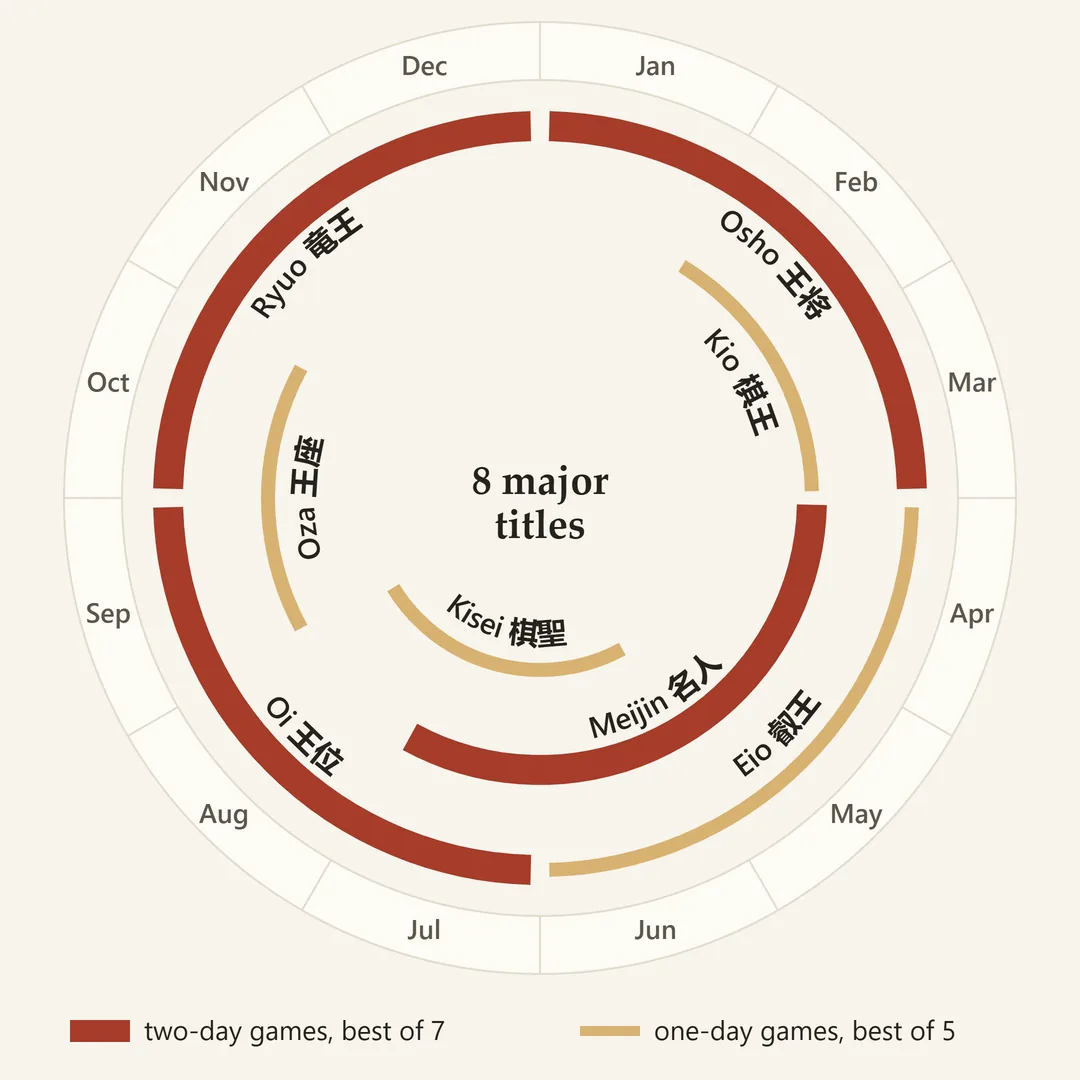
Each title has its fixed season, so the eight matches cover most of the year. The months below are the JSA’s usual schedule.
| Months | Title match |
|---|---|
| January to March | Osho |
| February to March | Kio |
| April to June | Eio |
| April to July | Meijin |
| June to August | Kisei |
| July to September | Oi |
| September to October | Oza |
| October to December | Ryuo |
Ryuo: the richest title
The Ryuo (竜王, “dragon king”) carries the biggest prize in shogi. The Yomiuri Shimbun created it in 1988 to replace the older Judan title. Its 44 million yen winner’s prize is the largest in the game.
The Ryuo is also the most open title. All professionals play, along with four women’s professionals, one apprentice and four amateurs. Players are split into six ranked groups. The top finishers from each group, 11 players in all, meet in a knockout to find the challenger, who plays the holder in a best of seven between October and December.
Fujii has held the Ryuo since 2021. He beat Yuki Sasaki 4-0 in 2025 and qualified for the lifetime Ryuo title that year.
The word ryuo has a second meaning: it is also the name of the promoted rook, the dragon king. If you came here for the piece, that page has its moves.
Meijin: the oldest title
The Meijin (名人, “master”) is the oldest title in shogi, with roots in the early 1600s. For about 260 years under the Tokugawa shogunate, the title passed down through three families of shogi masters, and a Meijin held it for life. In 1935 the 13th Meijin, Kinjiro Sekine, gave it up so it could be won by play instead. Yoshio Kimura became the first Meijin decided that way, in 1937.
Today the challenger comes from the Meijin ranking league (順位戦, junisen). Professionals are divided into five classes, A, B1, B2, C1 and C2, and play a full season to move up or down. The class A winner challenges the Meijin in a best of seven from April to July. With 9 hours per player, it has the longest time control of any title match.
Fujii has held the Meijin since 2023. In 2026 he beat Tetsuro Itodani 4-0.
Lifetime titles (eisei)
A player who wins the same title often enough qualifies for a lifetime title (永世称号, eisei shōgō). It is a permanent honor, separate from the yearly title. By JSA custom the player takes the name on retirement, not while still active.
| Title | Lifetime title | Requirement |
|---|---|---|
| Ryuo | Eisei Ryuo | 5 in a row or 7 in total |
| Meijin | Numbered Meijin (e.g. 19th Meijin) | 5 in total |
| Eio | Eisei Eio | 5 in total |
| Oi | Eisei Oi | 5 in a row or 10 in total |
| Oza | Meiyo (honorary) Oza | 5 in a row or 10 in total |
| Kisei | Eisei Kisei | 5 in total |
| Kio | Eisei Kio | 5 in a row |
| Osho | Eisei Osho | 10 in total |
Lifetime Meijins are numbered in order. Kimura became the 14th, Yasuharu Oyama the 15th, Makoto Nakahara the 16th and Koji Tanigawa the 17th. Toshiyuki Moriuchi and Yoshiharu Habu qualify as the 18th and 19th. In 2017 Habu became the only player to qualify for lifetime status in seven different titles. Fujii has qualified for three so far: Kisei, Oi and Ryuo.
Other shogi tournaments
Besides the eight titles, the JSA runs non-title tournaments, many of them faster and some shown on TV. They don’t award titles, but a win in a tournament open to all professionals counts toward dan promotion. A few of the main ones, with the latest winner listed by the JSA as of October 1, 2026:
| Tournament | Latest winner |
|---|---|
| NHK Cup (NHK杯) | Sota Fujii (75th) |
| Asahi Cup Open (朝日杯) | Sota Fujii (19th) |
| Ginga tournament (銀河戦) | Masayuki Toyoshima (33rd) |
| JT Pro Official, or Shogi Nihon Series (将棋日本シリーズ) | Sota Fujii (46th) |
| Shinjin-O (新人王戦) | Shin’ichiro Hattori (56th) |
The NHK Cup shows how fast these can be: 10 minutes each, then 30 seconds per move. The guide to how long a shogi game lasts compares it with the two-day title matches.
Related pages
Read about the players who win these titles, how professionals climb from 4-dan to 9-dan in the shogi ranks guide, and how the Meijin system grew out of Edo-period shogi houses in the history of shogi. Or play a game yourself, free in your browser.
FAQ
What is the Ryuo in shogi?
The Ryuo is one of shogi’s eight major professional titles and carries the largest prize, 44 million yen. It was created in 1988 and is decided by a best-of-seven match from October to December. Ryuo is also the name of the promoted rook, the dragon king.
What does Meijin mean in shogi?
Meijin means “master” and is the oldest shogi title. It was hereditary from the early 1600s until 1935, when it became a title won by play. The challenger is the winner of class A in the yearly Meijin ranking league, and the match uses 9 hours per player.
Who holds the shogi titles right now?
As of October 1, 2026, Sota Fujii holds six titles: Ryuo, Meijin, Oi, Kisei, Kio and Osho. Takumi Ito holds the Eio and the Oza. Ito is defending the Oza against Akihito Hirose, and Fujii’s Ryuo defense against Shin’ichiro Hattori begins on October 9.
How many titles are there in shogi?
There are eight major titles for regular professionals: Ryuo, Meijin, Eio, Oi, Oza, Kisei, Kio and Osho. The Eio became the eighth in 2017. Women’s professionals have their own separate set of eight women’s titles.
What is a lifetime title in shogi?
A lifetime title (eisei) is a permanent honor for winning the same title enough times, such as five Meijin titles or five Ryuo titles in a row. By custom the player starts using it after retiring. Yoshiharu Habu qualifies in seven titles, more than anyone else.