Shogi Ranks Explained: Kyu, Dan, Pro and Online Ratings
Shogi ranks use the same kyu and dan system as judo and go. Beginners start at a high kyu number and count down to 1-kyu, then move up through the dan ranks, starting at 1-dan. Amateurs and professionals use separate ladders: an apprentice professional starts at 6-kyu, which is roughly amateur 3-dan to 5-dan strength, and full professionals begin at pro 4-dan and top out at 9-dan.
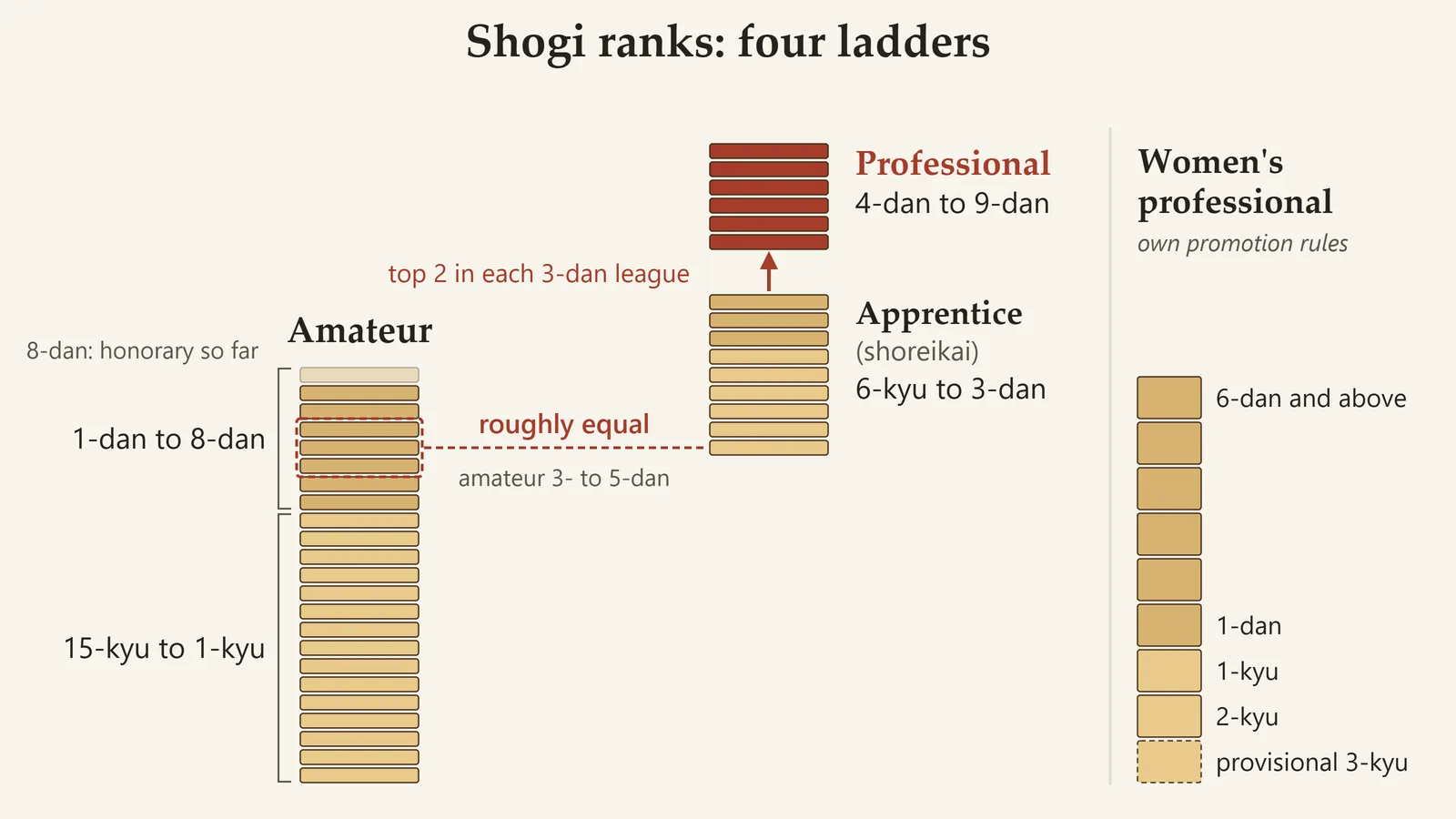
Kyu and dan: the basics
Kyu ranks count down, dan ranks count up. A 10-kyu player is weaker than a 1-kyu player, and a 1-dan is weaker than a 5-dan. The step from 1-kyu to 1-dan (初段, shodan) is the traditional line between a casual player and a serious one.
| Ladder | Ranks | Who uses it |
|---|---|---|
| Amateur | 15-kyu to 1-kyu, then 1-dan to 8-dan | Club players, online players, holders of JSA certificates |
| Apprentice professional | 6-kyu to 3-dan | Members of the JSA apprentice school (shoreikai) |
| Professional | 4-dan to 9-dan | Full professionals (棋士, kishi) |
| Women’s professional | 2-kyu upward into the dan ranks | Women’s professionals (女流棋士, joryū kishi) |
The ladders overlap in name but not in strength. According to the Japan Shogi Association (JSA) system summarized on English Wikipedia, an apprentice at 6-kyu, the bottom of the shoreikai, plays at roughly amateur 3-dan to 5-dan strength.
Amateur shogi ranks
Amateur ranks run from 15-kyu up to 1-kyu, then 1-dan to 8-dan. So far, amateur 8-dan has only been given as an honor.
Your local club or an online server gives you a working rank. To make it official, you can apply to the JSA for a certificate. As of October 2026, the JSA issues:
- Kyu certificates (級位認定状) for 10-kyu to 1-kyu, at 4,400 yen.
- Dan diplomas (免状, menjō) for 1-dan to 6-dan, from 33,000 yen for 1-dan to 275,000 yen for 6-dan. Each one is signed by hand by the JSA president, the Meijin and the Ryuo.
Since 2014, the JSA has also accepted ranks from 5-kyu to 6-dan earned on the Shogi Wars app as grounds for an official certificate.
Professional shogi ranks
A professional starts at 4-dan and can be promoted to 9-dan. Professionals are never demoted. Getting to 4-dan means winning promotion out of the shoreikai’s 3-dan league, which the shogi players guide covers step by step.
After that, promotion comes from wins and results. Meeting any one condition for the next rank is enough. A simplified version of the JSA rules:
| Promotion to | Example ways to qualify |
|---|---|
| 5-dan | 100 official wins at 4-dan, or become a title challenger, or reach Meijin ranking class C1 |
| 6-dan | 120 wins since 5-dan, or reach class B2, or reach Ryuo group 2 |
| 7-dan | 150 wins since 6-dan, or win a major title, or reach class B1, or challenge for the Ryuo |
| 8-dan | 190 wins since 7-dan, or win two major titles, or reach class A, or win the Ryuo |
| 9-dan | 250 wins since 8-dan, or win three major titles, or win the Meijin, or win the Ryuo twice |
Results can move a young player up fast. Sota Fujii was promoted from 4-dan in October 2016 to 9-dan in July 2021, according to his JSA profile.
The other professional ranking: Meijin classes
Dan ranks never go down, so they work like a lifetime achievement record. The ranking that does move is the Meijin ranking league (順位戦, junisen). Professionals are split into five classes, A, B1, B2, C1 and C2, and are promoted or relegated each year on results. The winner of class A challenges for the Meijin title. The shogi titles guide explains how the Meijin and the other seven titles work.
There is no official Elo-style rating for professionals. Fan sites calculate unofficial ones.
Women’s professional ranks
Women’s professionals have their own rank ladder with its own promotion rules. It does not map onto the regular 4-dan to 9-dan scale.
| Women’s rank | How it is reached (examples) |
|---|---|
| Provisional 3-kyu | Strong results in a JSA training group (研修会, kenshūkai) |
| 2-kyu | Full women’s professional status, through set results within two years |
| 1-kyu to 1-dan | Official wins or advancing in women’s tournaments |
| 2-dan | 60 wins since 1-dan, or become a women’s title challenger |
| 3-dan | 90 wins since 2-dan, or win a women’s title |
| 4-dan | 120 wins since 3-dan, or win three women’s titles |
| 5-dan | 150 wins since 4-dan, or win seven women’s titles |
| 6-dan and above | Awarded by the JSA board for career results |
Women may also enter the regular apprentice school and earn the 4-dan professional rank the same way men do. The shogi players page covers where that stands.
Online shogi ranks and ratings
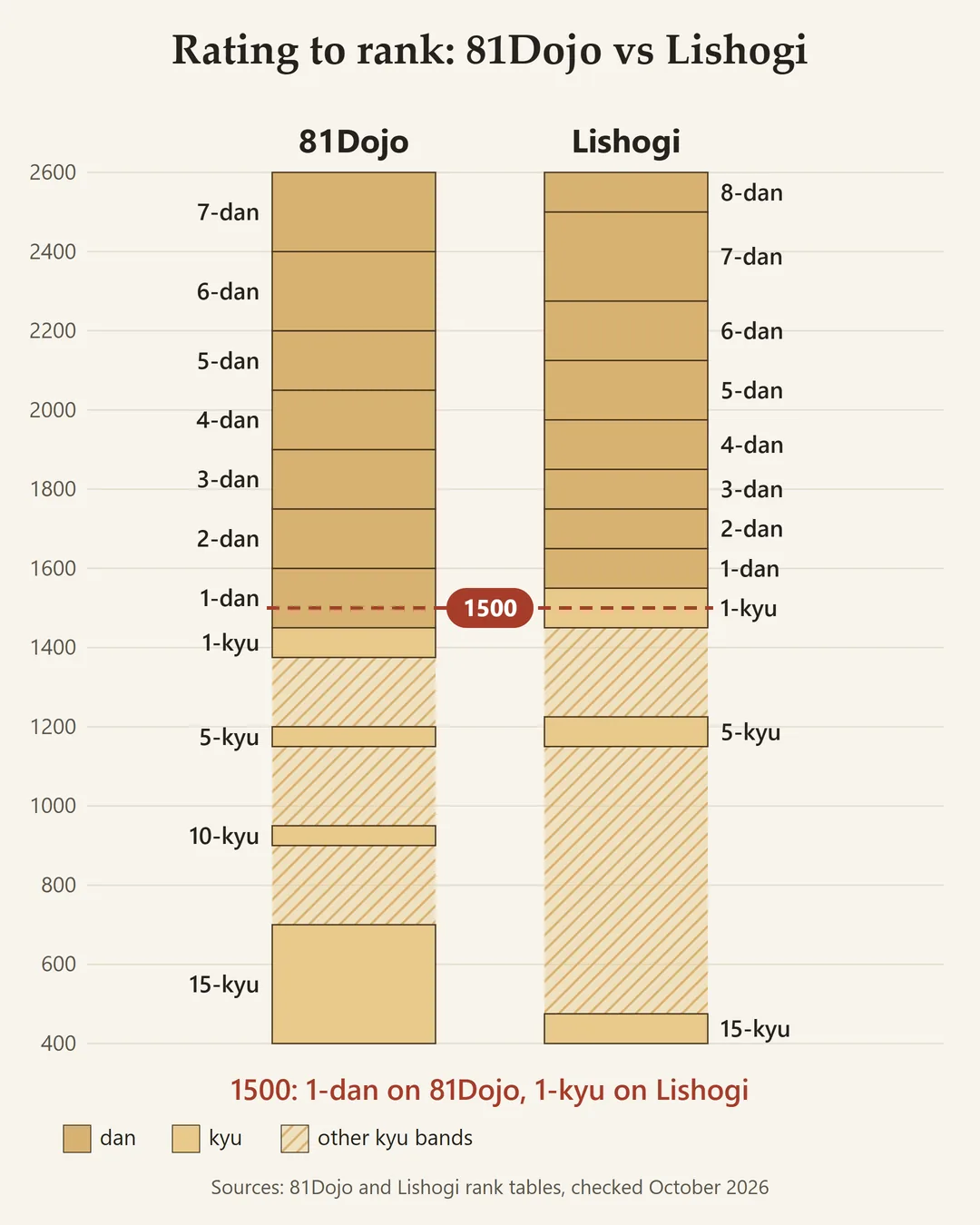
Online servers give you a rating, a number that goes up when you win and down when you lose, and translate it into a kyu or dan rank. Each server has its own scale, so a 1-dan on one site is not the same as a 1-dan on another.
| Server | Rating system | How rank is shown |
|---|---|---|
| 81Dojo | Its own formula, based on rating difference and thinking time | Rank set by rating bands, 15-kyu to 7-dan |
| Shogi Wars | Its own rating, used for matchmaking | Rank plus a progress percentage toward the next rank |
| Lishogi | Glicko-2, starting at 1500 | Rank shown once your rating is stable, 15-kyu to 8-dan |
81Dojo
81Dojo is an international server run under the patronage of the JSA. A new account’s rating is settled after five games against established players. If you beat someone rated higher during those games, your rating jumps to theirs. After that, you can’t cross a rank boundary with a single win. You stop just short and must win an extra “promotion match” first.
81Dojo publishes this rating-to-rank table (abridged):
| 81Dojo rank | Rating |
|---|---|
| 7-dan | 2400 and up |
| 6-dan | 2200 to 2399 |
| 5-dan | 2050 to 2199 |
| 4-dan | 1900 to 2049 |
| 3-dan | 1750 to 1899 |
| 2-dan | 1600 to 1749 |
| 1-dan | 1450 to 1599 |
| 1-kyu | 1375 to 1449 |
| 5-kyu | 1150 to 1199 |
| 10-kyu | 900 to 949 |
| 15-kyu | 0 to 699 |
81Dojo also publishes a chart comparing its ranks with Shogi Wars and Shogi Club 24, the older Japanese server.
Shogi Wars
Shogi Wars (将棋ウォーズ), a popular Japanese app, matches you with opponents by its own rating. Your rank is shown with an achievement percentage (達成率) that tracks your progress within it. As noted above, its 5-kyu to 6-dan ranks can be submitted to the JSA for an official certificate.
Lishogi
Lishogi, a free open-source server, uses the Glicko-2 rating system. Everyone starts at 1500, and a question mark beside a rating means it is still provisional. Ranks appear only once your rating is stable. Lishogi’s published mapping:
| Lishogi rating | Rank |
|---|---|
| 400 to 474 | 15-kyu |
| 1150 to 1224 | 5-kyu |
| 1450 to 1549 | 1-kyu |
| 1550 to 1649 | 1-dan |
| 1650 to 1749 | 2-dan |
| 1750 to 1849 | 3-dan |
| 1850 to 1974 | 4-dan |
| 1975 to 2124 | 5-dan |
| 2125 to 2274 | 6-dan |
| 2275 to 2499 | 7-dan |
| 2500 and up | 8-dan |
The same number means different things on different sites: 1500 is 1-kyu on Lishogi but 1-dan on 81Dojo. That is why ranks don’t transfer between servers.
Where to start
Everyone starts somewhere around 15-kyu. Learn the moves with how to play shogi, then play the computer free in your browser until the rules feel automatic. Our board has no rating, so losing costs nothing. When you want a rank, the online shogi guide covers where to play rated games.
FAQ
What is the highest rank in shogi?
For professionals, 9-dan is the highest rank. For amateurs, the scale goes up to 8-dan, which so far has only been given as an honor, and the JSA sells dan diplomas up to 6-dan. Titles such as Meijin and Ryuo sit above the rank system and are won in annual matches.
How do shogi ranks compare to chess ratings?
Shogi has no single official rating for professionals. Online servers each use their own number: Lishogi uses Glicko-2, like several chess sites, and 81Dojo uses its own formula. Because the scales differ, a shogi rank cannot be converted directly into a chess rating.
What rank is a beginner in shogi?
Most systems start beginners around 15-kyu. On Lishogi every new account starts at 1500, which its table maps to 1-kyu, but the rank is hidden until your rating settles.
Can amateurs get an official shogi rank?
Yes. The Japan Shogi Association issues kyu certificates from 10-kyu to 1-kyu and dan diplomas from 1-dan to 6-dan. Its certificate office lists the accepted ways to qualify, and ranks from 5-kyu to 6-dan earned on Shogi Wars are among them.
What rank do professional shogi players start at?
Professionals start at 4-dan. Apprentices in the JSA’s shoreikai climb from 6-kyu to 3-dan, and the top two in each six-month 3-dan league are promoted to professional 4-dan.